Cosmos: UC physicist explores distant newborn stars
Physicist Matthew Bayliss found a cluster of stars spawned by a black hole

University of Cincinnati assistant professor Matthew Bayliss talked to Cosmos Magazine about his research into distant supermassive stars that burn hot and die young.
Finding these newborn stars is difficult because they are so comparatively short-lived. Bayliss examined a galaxy cluster in the Phoenix constellation that was generating many new stars from a central black hole.
Bayliss, a physicist in UC's McMicken College of Arts and Sciences, and his research partners used a technique called gravitational lensing to observe the distant stars with help from NASA's Chandra X-ray Observatory and the Hubble Space Telescope.
The study, led by Massachusetts Institute of Technology assistant professor Michael McDonald, was published in the The Astrophysical Journal.
“In the past, outbursts from the undersized black hole may have simply been too weak to heat its surroundings, allowing hot gas to start cooling,” Bayliss told the magazine.
“But as the black hole has grown more massive and more powerful, its influence has been increasing.”
Bayliss was lead author for a related research project on distant stars that was published in Nature Astronomy.
That study marked the first use of gravitational lensing to observe distant stars through X-ray detection.
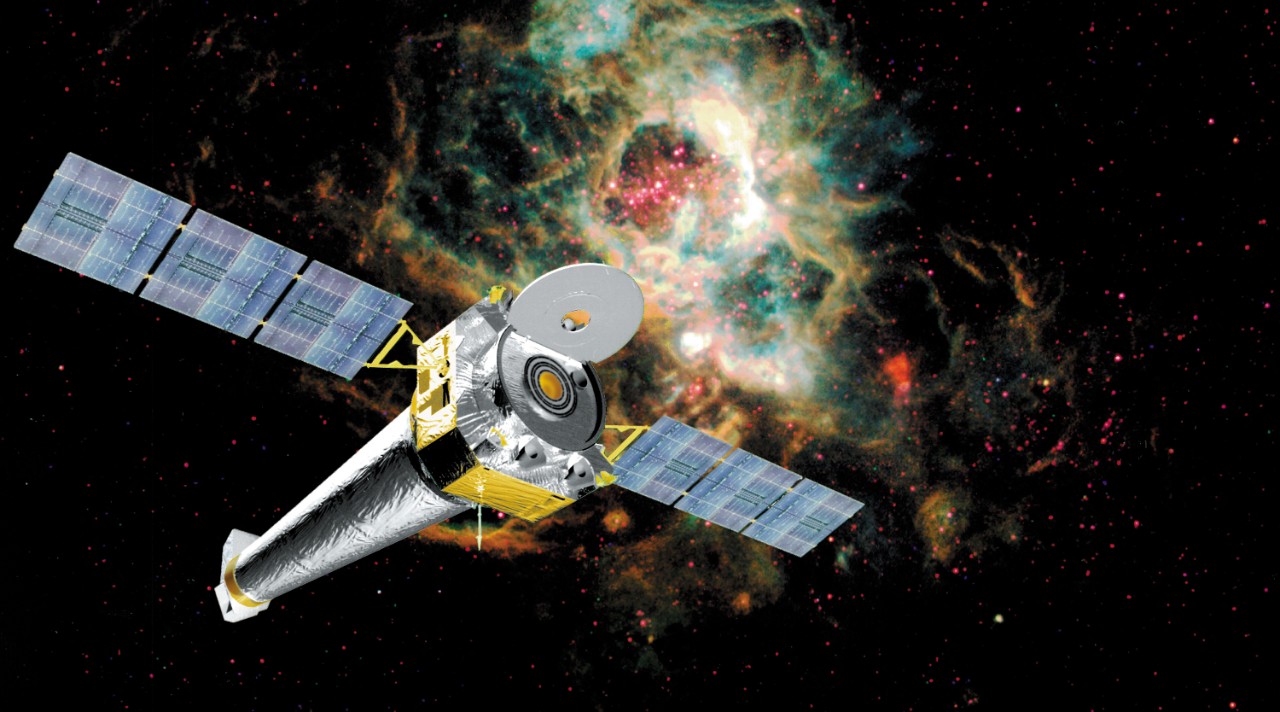
Featured image at top: An artist's rendering of NASA's Chandra X-ray Observatory. Illustration/TRW

UC physicist Matthew Bayliss is studying supermassive stars using NASA's Chandra X-ray Observatory. Photo Illustration/Lisa Ventre and Margaret Weiner/UC Creative Services and NASA
Related Stories
How AI might help nonprofits
November 7, 2025
University of Cincinnati Professor Victoria LaPoe examined whether people respond differently to AI-created messaging in nonprofit advertising.
Shining like a disco ball: Rachel Hoermann’s story of finding passion and purpose at UC
November 6, 2025
Rachel Hoermann has dreamed of becoming a writer since childhood. But like many who grew up in Ohio’s rust belt, the idea of going to college felt out of reach. For years, she cycled through work that never quite satisfied her creative drive. That changed when she came across a box that once belonged to her father—a discovery that would alter the course of her life.
New hires reflect UC’s commitment to research, innovation and impact
November 6, 2025
With the 2025-26 school year in full swing, the College of Arts and Sciences has welcomed five faculty members to lead departments that span from chemistry to journalism. Dean James Mack said these new hires “reflect our unwavering commitment to ‘Discovery in Action,’ as we continue to enhance our academic and research excellence”. With these additions, the future of UC is in good hands, and students can look forward to new opportunities for learning, research, and innovation.