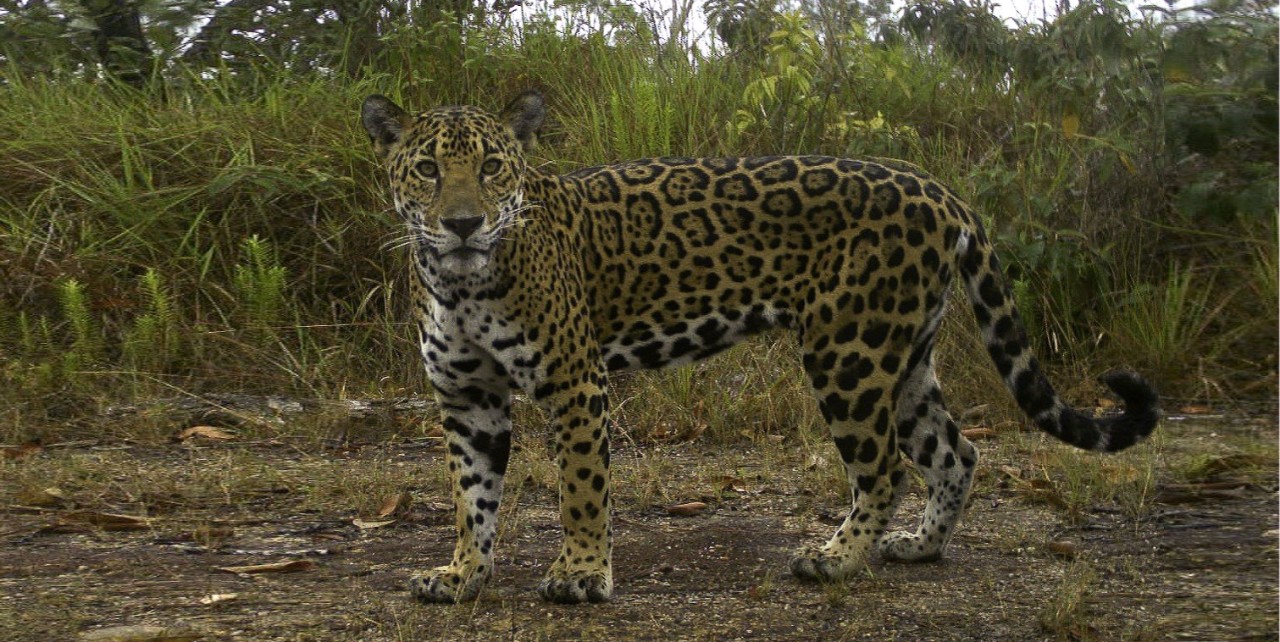
WVXU: UC research helping to protect jaguars
UC professor Brooke Crowley is using geochemistry to identify the secretive cats' prime hunting grounds in Belize

University of Cincinnati associate professor Brooke Crowley talked to WVXU’s Cincinnati Edition about how her research is helping protect jaguars in South America.
Crowley used isotopic analysis in jaguar poop to identify critical habitat for the big cats in the geologically diverse Mountain Pine Ridge Forest Reserve in Belize. Her study was published recently in the journal Isotopes in Environmental Health and Studies.
“(Jaguars) are elusive and solitary and very wary of people, so it’s hard to study them in the wild,” Crowley said.
Researchers in Belize use scat-detecting dogs to find jaguar poop for lab analysis at UC.
Crowley can identify a geologic signature from the strontium and other elements in the jaguar scat to show where the big cats have been hunting. By identifying the critical habitat, researchers can steer conservation efforts.
I am an isotope ecologist by trade. What that means is I'm a chemical detective.
Brooke Crowley, UC professor
Crowley has applied this isotopic analysis to other secretive animals around the world such as Henst’s goshawks in Madagascar and even extinct horses in North America.
“I am an isotope ecologist by trade. What that means is I’m a chemical detective,” Crowley said.
The project was a collaboration among UC, Virginia Tech, the American Museum of Natural History and the City University of New York.
But Crowley said you don't have to be a conservationist working in South America to help jaguars and other rainforest animals. Crowley said consumer choices here in the United States and elsewhere can make a big difference in protecting natural resources.
"The decisions we make as consumers drive deforestation elsewhere," she said.
By buying locally-raised beef, responsibly grown coffee and other sustainably sourced foods, people can help prevent deforestation, she said. Likewise, many nonprofits such as the Sierra Club and the Nature Conservancy use donations to help preserve habitat and pay for conservation work.
"Conservation of our planet's remaining biodiversity is crucial. Biodiversity keeps everything in balance. We rely on the planet for our survival," she said.
Check out UC's Crowley on WVXU
Read previous coverage of her Jaguar research

UC associate professor Brooke Crowley is using isotopic analysis to study endangered species around the world. She has conducted research on lemurs, birds of prey and big cats such as jaguars, along with prehistoric animals such as mammoths. Photo/Jay Yocis/UC Creative Services
Related Stories
How AI might help nonprofits
November 7, 2025
University of Cincinnati Professor Victoria LaPoe examined whether people respond differently to AI-created messaging in nonprofit advertising.
Shining like a disco ball: Rachel Hoermann’s story of finding passion and purpose at UC
November 6, 2025
Rachel Hoermann has dreamed of becoming a writer since childhood. But like many who grew up in Ohio’s rust belt, the idea of going to college felt out of reach. For years, she cycled through work that never quite satisfied her creative drive. That changed when she came across a box that once belonged to her father—a discovery that would alter the course of her life.
New hires reflect UC’s commitment to research, innovation and impact
November 6, 2025
With the 2025-26 school year in full swing, the College of Arts and Sciences has welcomed five faculty members to lead departments that span from chemistry to journalism. Dean James Mack said these new hires “reflect our unwavering commitment to ‘Discovery in Action,’ as we continue to enhance our academic and research excellence”. With these additions, the future of UC is in good hands, and students can look forward to new opportunities for learning, research, and innovation.