UC Hoxworth scientist takes her desire to serve others to Ghana

Mary Rudemiller had no idea that a trip to Ghana in 2013 to visit her daughter who was volunteering in the Peace Corps at the time would be so life-changing. Not only for her, but also for the people helped by the Ghana Health Mission (GHM), a Cincinnati-based nonprofit. Rudemiller, a clinical scientist in the Immunohematology Reference Laboratory at Hoxworth Blood Center, now serves as the program manager for the GHM scholarship program.
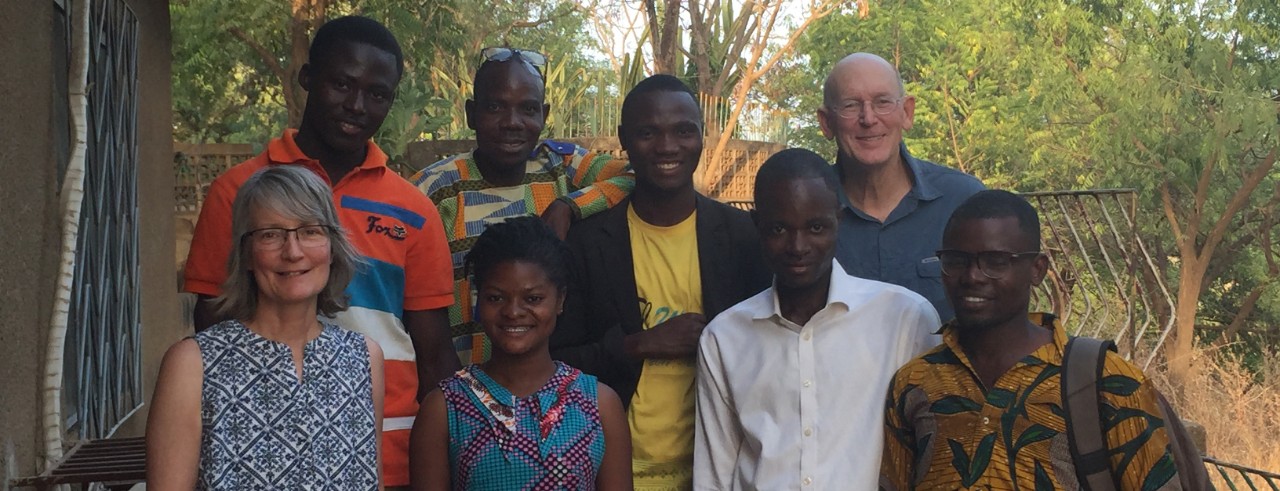
Rudemiller, who has worked at Hoxworth for 35 years, got involved with GHM thanks to that visit to her daughter, Elyse, a 2012 University of Cincinnati graduate with degrees in creative writing and psychology. During that trip, Rudemiller met David Stone, the founder of Yakote Women Farmers, (YWF) a nonprofit that serves the Nabdam region in northeastern Ghana.
One of the objectives of YWF is providing financial aid to students who want to earn a degree to get a job in the teaching, nursing or midwifery fields. Without that financial aid, the students have no chance of obtaining a degree, and getting that aid requires going through an interview.
“We find out if they’re truly impoverished and most of them are,” Rudemiller says. “Most of them have lost one or both parents. We want them to study something that will enable them to get a job. We know they can get a job in the region by teaching or being a nurse or midwife.”
YWF started the scholarship program in 2009, with GHM taking over management of the program in 2018. Thanks to the scholarship program, during the last 10 years, 43 students have received degrees at various schools in villages and cities throughout Ghana. The average cost per student is approximately $800 (U.S.) per year. After her initial visit to Ghana, Rudemiller became a scholarship sponsor, and when the program risked collapsing due to a vacancy in leadership, she decided to go all in as program manager.
Rudemiller spent two weeks in the Nabdam region of the West African country in January 2019. She describes the experience as arduous, with temperatures in the mid-90s. Traveling can especially be an ordeal thanks to rough, winding road conditions.
“Going over there and seeing directly the needs of the people and how they live, I don’t know how they live like they do,” Rudemiller says. “The need is so great for medical professionals. There are 9,000 people living in the village of Yakote, but only nine midwives. There are no doctors. There is a clinic with nurses but they are not equipped for labor and delivery.”
Rudemiller says she spends more time on this program than she initially thought she would, especially when the students are ready to start semesters and payments are due, but she says it’s worth it.
“Education has played a huge role in my life,” she says. “It’s allowed me to support my family and put my children through school. Those are the same dreams the students in Ghana have to elevate their status.”
Rudemiller says she plans to return to Nabdam every other year to continue her mission of getting as many Ghanaian students as she can on the path to education and employment. To find out how you can help, contact Mary at rudemimc@gmail.com.
Featured photo of Mary Rudemiller with David Stone and a mixture of program graduates, current students and potential applicants courtesy of Mary Rudemiller.
Related Stories
Sugar overload killing hearts
November 10, 2025
Two in five people will be told they have diabetes during their lifetime. And people who have diabetes are twice as likely to develop heart disease. One of the deadliest dangers? Diabetic cardiomyopathy. But groundbreaking University of Cincinnati research hopes to stop and even reverse the damage before it’s too late.
App turns smartwatch into detector of structural heart disease
November 10, 2025

An app that uses an AI model to read a single-lead ECG from a smartwatch can detect structural heart disease, researchers reported at the 2025 Scientific Sessions of the American Heart Association. Although the technology requires further validation, researchers said it could help improve the identification of patients with heart failure, valvular conditions and left ventricular hypertrophy before they become symptomatic, which could improve the prognosis for people with these conditions.
Combination immunotherapy helps overcome melanoma treatment resistance
November 10, 2025

MSN highlighted research led by the University of Cincinnati Cancer Center's Trisha Wise-Draper showing a combination of immunotherapy medications can activate a robust immune response and help overcome treatment resistance in patients with refractory melanoma.