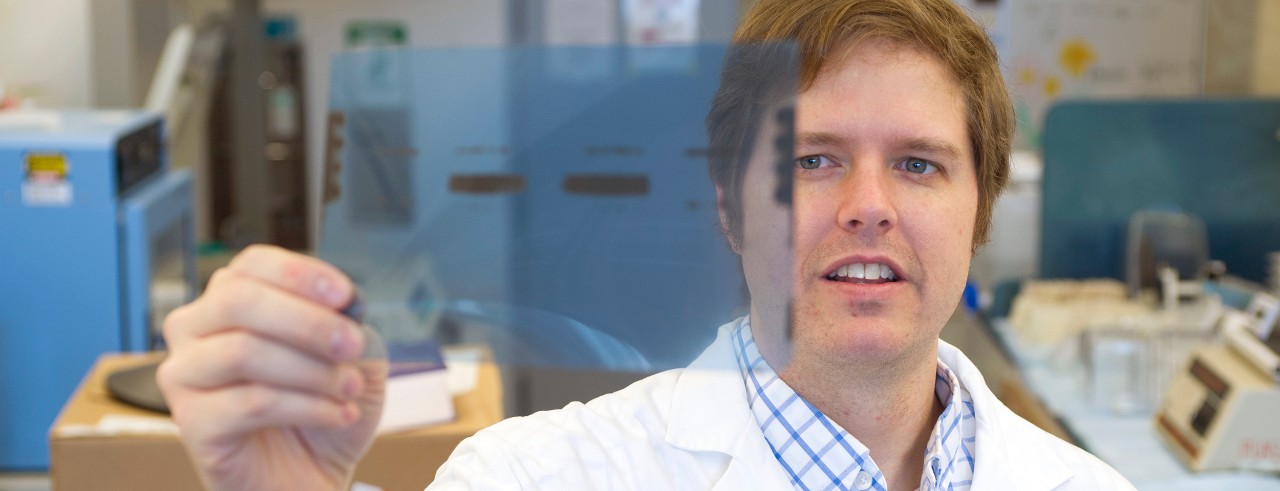
UC researcher receives $4M in federal funds
These grants will help Tom Cunningham, PhD, study how a key enzyme in the metabolism of cells contributes to developmental disorders and cancer.

A University of Cincinnati cancer biology scientist has been awarded nearly $4 million in federal funding to continue his research on how altered activity of a key enzyme in the metabolism of cells contributes to developmental disorders and cancer.
Tom Cunningham, PhD, assistant professor of cancer biology, received two, five-year grants—a National Institute of General Medical Sciences R35 Maximizing Investigators' Research Award ($401,250 x five years) and a National Cancer Institute R01 ($367,144 x five years)—with hopes of discovering more about metabolic processes that control normal development and cancer.
This type of research aligns with President Pinto's innovation agenda, one of the platforms of Next Lives Here.
“My lab has made discoveries over the years that allow us to better appreciate the role of a particular enzyme essential to coordinating the metabolic processes of cells; it’s the gatekeeper of nucleotide production in all life, from bacteria to humans,” he says, referring to phosphoribosyl pyrophosphate synthetase (PRPS). “Humans and most other animals express two highly related isoforms, or protein variants, of this enzyme (PRPS1 and PRPS2). Mutations found in the PRPS1 gene in human patients with various developmental disorders highlight its essential role during normal development.
“In contrast, no disease-causing mutations have been found in the human PRPS2 gene, and no obvious defect has been detected in animal models engineered to lack PRPS2, indicating the PRPS2 isoform is not essential for normal development. Although the role of PRPS2 during normal development remains mysterious, the non-essential PRPS2 enzyme is frequently overproduced by cancer cells and is required for tumor formation, therefore making it an attractive therapeutic target.”
Cunningham says his two grants and the research that accompanies them go hand-in-hand: His R35 grant will be used to further examine these two variants and their roles during development in mammals. His R01 grant seeks to determine how and why cancer cells hijack the function of this key enzyme to drive tumor development.
“We will use disease-mimicking animal models of PRPS1 superactivity and loss of function that enable us to study how the mutations lead to the various disease manifestations displayed in human patients,” he says. “Collectively, our team hopes to better understand the complicated role of nucleotides in cellular metabolism and how their abnormal production, breakdown, transport or utilization contributes to disease. We also hope these studies will open up new avenues for understanding the metabolic weaknesses of cancer cells which could lead to new, targeted therapeutic strategies for patients.”
Receiving two federal grants of this caliber is quite rare for a young investigator in this field. Cunningham has only been running his own lab for three years and previously received a Scholar Award from the V Foundation for Cancer Research in 2017—the first recipient of that prestigious award in UC’s history.
“The V award served as a springboard for these two larger National Institutes of Health-sponsored awards. Combining the funding received from these two new awards with the outstanding scientific environment and resources present within the Department of Cancer Biology and the UC College of Medicine at large, my research team is now poised to make the types of impactful discoveries that are transformative for our understanding and treatment of human disease,” he says.
Related Stories
Sugar overload killing hearts
November 10, 2025
Two in five people will be told they have diabetes during their lifetime. And people who have diabetes are twice as likely to develop heart disease. One of the deadliest dangers? Diabetic cardiomyopathy. But groundbreaking University of Cincinnati research hopes to stop and even reverse the damage before it’s too late.
App turns smartwatch into detector of structural heart disease
November 10, 2025

An app that uses an AI model to read a single-lead ECG from a smartwatch can detect structural heart disease, researchers reported at the 2025 Scientific Sessions of the American Heart Association. Although the technology requires further validation, researchers said it could help improve the identification of patients with heart failure, valvular conditions and left ventricular hypertrophy before they become symptomatic, which could improve the prognosis for people with these conditions.
Combination immunotherapy helps overcome melanoma treatment resistance
November 10, 2025

MSN highlighted research led by the University of Cincinnati Cancer Center's Trisha Wise-Draper showing a combination of immunotherapy medications can activate a robust immune response and help overcome treatment resistance in patients with refractory melanoma.