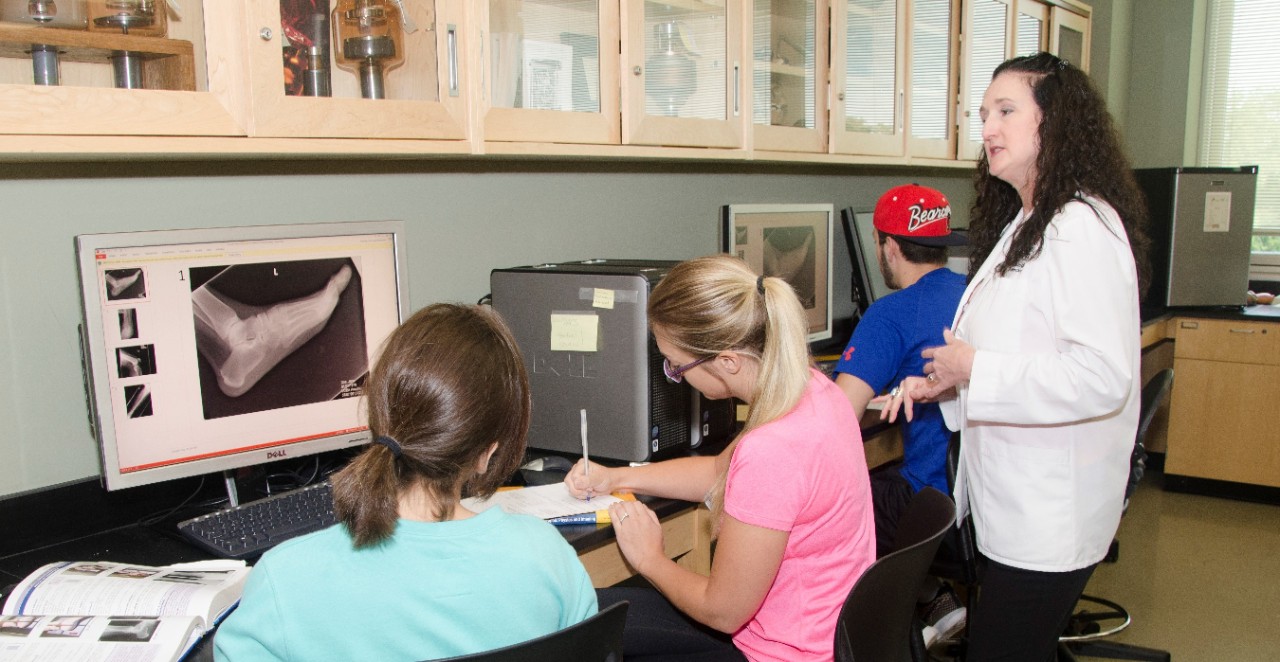
UC Blue Ash Rad Tech students maintain impressive tradition


The 2019 graduates maintained the radiologic technology program’s nearly perfect record on the national certification exam.
If you are a new graduate from the radiologic technology program at the University of Cincinnati Blue Ash College, you can expect to do extremely well on the national certification exam required to earn your license. In fact, nearly every student who has graduated from the program since 2006 has passed the exam on their first attempt.
There were 21 new graduates from the program this spring. All of them recently passed the national certification exam conducted by the American Registry of Radiologic Technologists (ARRT) on their first attempt. Over the past 13 years, 283 new graduates from the radiologic technology program at UC Blue Ash have taken the exam and 98.6 percent have passed it on the first try.
Radiologic technology is the use of radiation to provide images of the various body parts to facilitate the diagnosis and treatment of certain injuries and illnesses. The certification exam is a challenging and comprehensive review. It covers all aspects of radiologic technology, from introductory information students learn in the first semester, to advanced topics related to medical imaging and interventional procedures. The national average for students passing the exam their first time is around 89 percent.
Students in the program at UC Blue Ash credit the demanding classes and the dedication by professors in preparing them so well for the exam.
“I can’t count the amount of times our professors stayed after class to help us understand the tough subjects we encountered in this program. I thought all of our professors were outstanding,” says Keith Quan, who graduated this spring and works in the Computed Tomography (CT) Department at Bethesda North Hospital.
“We set very high standards for our students and expect them to be role models in the radiologic technology profession,” says Heather Moore, radiologic technology program director at UC Blue Ash. “From day one in our program we work on preparing them for a successful career and the capstone course they complete in their last semester helps prepare them for the comprehensive material covered in the certification exam.”
The bar continues to be set very high for new graduates from the radiologic technology program at UC Blue Ash. The next group that will be expected to carry on the tradition of excellence will be the class of 2020.
Get the details about the radiologic technology program on the UC Blue Ash College website or call 513-936-1631.
About UC Blue Ash College
UC Blue Ash College is a regional college within the University of Cincinnati. It offers one of the best values in higher education with access to a nationally recognized UC education in more than 50 degree and certificate programs, as well as tuition that is about half of most colleges and universities. The college is located on a scenic 135-acre wooded campus in the heart of Blue Ash, Ohio. To learn more, call 513-745-5600, visit us online, like us on Facebook or follow us on Twitter and Instagram.
Tags
Related Stories
Sugar overload killing hearts
November 10, 2025
Two in five people will be told they have diabetes during their lifetime. And people who have diabetes are twice as likely to develop heart disease. One of the deadliest dangers? Diabetic cardiomyopathy. But groundbreaking University of Cincinnati research hopes to stop and even reverse the damage before it’s too late.
App turns smartwatch into detector of structural heart disease
November 10, 2025

An app that uses an AI model to read a single-lead ECG from a smartwatch can detect structural heart disease, researchers reported at the 2025 Scientific Sessions of the American Heart Association. Although the technology requires further validation, researchers said it could help improve the identification of patients with heart failure, valvular conditions and left ventricular hypertrophy before they become symptomatic, which could improve the prognosis for people with these conditions.
Combination immunotherapy helps overcome melanoma treatment resistance
November 10, 2025

MSN highlighted research led by the University of Cincinnati Cancer Center's Trisha Wise-Draper showing a combination of immunotherapy medications can activate a robust immune response and help overcome treatment resistance in patients with refractory melanoma.