UC's annual Biology Day is growing – and remains a hit with students
Hughes students were joined by Shroder students for the first time ever this year at the popular event

By Michelle Flanagan
Snakes, frogs, hissing cockroaches, cavefish and pizza for lunch? What's not to love? For the 130 students from Hughes STEM and Shroder high schools who converged on the University of Cincinnati May 7 for the sixth annual Biology Day, it was a day of fun and adventure.
The event is a collaboration between the university's Department of Biological Sciences, the McMicken College of Arts and Sciences, Office of Equity, Inclusion, and Community Impact and Cincinnati Public Schools (CPS).
These groups come together to provide freshmen students with a year-end field trip introducing them to UC’s campus designed to pique their interest in science fields.


The Biology Day initiative supports the university's Next Lives Here strategic direction, UC’s vision to lead urban public universities into a new era of innovation and impact. Next Lives Here promotes academic excellence, urban health, and CPS Strong, which aims to significantly increase the number of UC graduates from Cincinnati Public Schools through advancements in pipeline programs, scholarships, mentoring, innovative research and academic support services, among others.
For the students, Biology Day is consistently a favorite field trip. Despite that fact that UC is in the backyard of these schools, many students have never stepped foot on campus. That began to change six years ago when Stephanie Rollmann, a behavioral biologist at UC, developed the Biology Day program.


“Biology Day began with a desire to increase interaction with our community partners and to increase interest and awareness in STEM,” said Rollman. “My favorite part is still interacting and learning with the high school students.”
Every activity is designed by a faculty member or a graduate student in the biology department, and typically reflects a topic of active research. This allows students to experience things that are actually going on right now, and thus are still relevant. It also means that each year’s students have at least slightly different experiences.
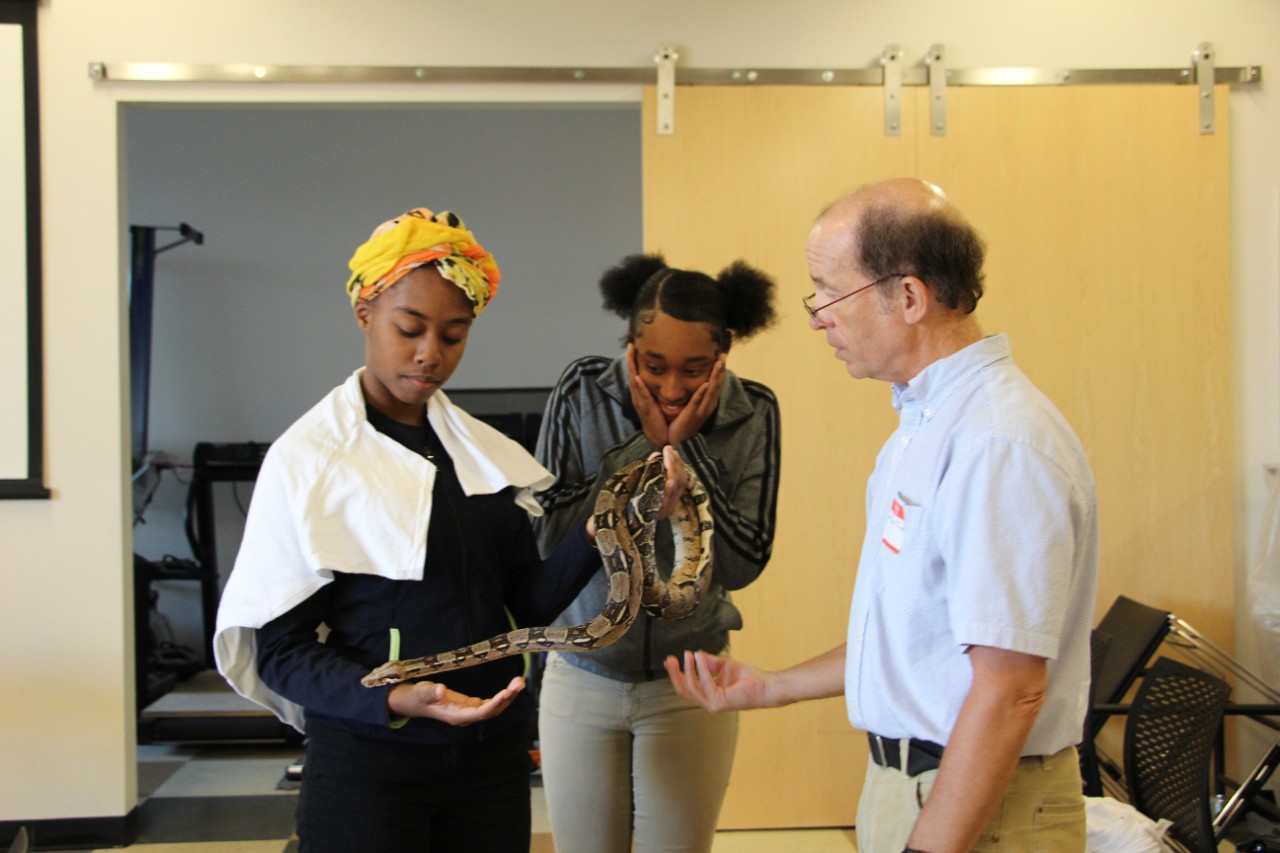
This year’s activities included Snakes and Evolution, led by Bruce Jayne; Microbiology, led by Annette Rowe and Dennis Grogan; Cavefish Evolution, led by Josh Gross; Sensory Illusions, led by Annette Stowasser; Physiology and Cockroaches, led by Josh Benoit; Scanning Electron Microscopy (SEM), led by Melodie Fickenscher; Development and Amphibians led by Dan Buchholz; Evolution, led by Lucinda Lawson; Insect: Vision, led by Elke Buschbeck; Spider Vision and Behavior, led by George Uetz and Nathan Morehouse; and Plant DNA, led by Theresa Culley.
After several years of establishing a rhythm, the program is expanding. This year was the first that Hughes STEM was joined by another high school.
“We would enjoy getting more schools to participate,” said Rollmann, who directs the event. “The challenge in expanding was logistical – the availability and timing of buses.” For Hughes students, this wasn’t an issue because they are within walking distance of campus.
One of Rollmann’s favorite activities this year was the SEM activity.
“This activity was available because of a program with Hitachi [a renown scientific instrument company] led by Ted Fowler and Melodie Fickenscher,” she said. “Students examined the fine-scale details of organisms and compared those details to what is observable under a standard dissecting scope.”
Ultimately, this activity gave students a new view of organisms, and what they’re actually made of.
In another new activity, students were able to isolate the DNA of plants. In scientific practice, this allows professionals to study genetic causes of disease, and potentially further the development of drugs and treatments. Isolating DNA also allows scientists to detect bacteria and viruses in the environment, determine paternity, and more. For the students, it was another way to see the possibilities of a career in biology.
Featured image at top: Professor of biology Dr. Bruce Jayne coaches high school students on how to hold large snakes. Photo credit: Beth Vleaminck
Related Stories
New approach could treat cancer by rearranging tumor cell structures
November 10, 2025
The University of Cincinnati’s Jiajie Diao, PhD, and colleagues have published new research showing a proof of concept that rearranging the location of lipid droplets within cells can increase the effectiveness of cell starvation, making it a potential cancer treatment. The research was published as the November cover story in the journal Trends in Biotechnology.
Silicon Valley is closely watching UC’s NEXT Innovation Scholars
November 7, 2025
The University of Cincinnati’s NEXT Innovation Scholars program has built a network of elite Silicon Valley talent that’s seeking out undergraduate Bearcats and sharing insights with them.
How AI might help nonprofits
November 7, 2025
University of Cincinnati Professor Victoria LaPoe examined whether people respond differently to AI-created messaging in nonprofit advertising.