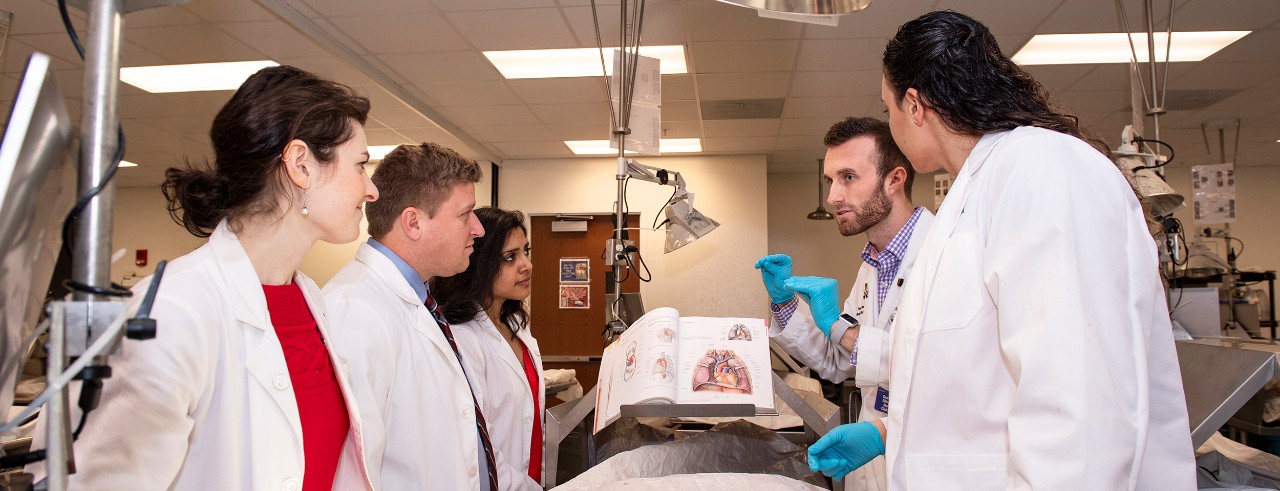
Dress rehearsal underway for LCME reaccreditation
UC College of Medicine to host mock visits in June, September

Practice makes perfect so the saying goes. Maybe it is also true for the University of Cincinnati College of Medicine as it moves through the reaccreditation process with the Liaison Committee on Medical Education (LCME).
LCME is the official accrediting body for medical schools in the United States and Canada and is reviewing comprehensive data on the university’s medical school as part of an institutional self-study with plans to make an official site visit in October 20-23. In preparation of that visit, the College of Medicine will hold two ‘mock visits’—one June 3-4 and a second visit set Sept. 9-10.
“It will be very good practice in terms of logistics with the official survey team,” says Pamela Baker, PhD, associate dean of medical education and faculty accreditation lead. “We have already done a dry run of a college tour for the team, provided guidance to participating faculty and students on questions they may be asked, and reviewed etiquette involved for the entire process.”
The LCME survey team reviews a host of topics ranging from mission, leadership and faculty preparation to academic and learning environments, along with curricular objectives and assessment. The survey team also reviews student/patient safety, medical student selection, academic support, career advising, assignment, health and counseling services, and financial aid.
You can read more about UC’s LCME reaccreditation process online.
A LCME Self-Study Taskforce and six subcommittees of faculty, staff and medical students at the College of Medicine have spent the past 14 months working with LCME to produce a 35-page Self-Study Summary Report, a completed Data Collection Instrument and an Independent Student Analysis. The information has been shared with a team of reviewers hired by the college to participate in the mock visit.
That team includes three high-level administrators from other medical schools who have experience with LCME and expertise in the areas of medical school leadership, student affairs and admissions and curriculum oversight, says Baker. The self-study has allowed the college to address areas that need improvement and potential areas of concern by LCME.

Medical student Domenic Termine is shown on clinical rotations with Anuja Gupta, MD
“It is important that we speak consistently about the improvements we have put in place,” says Baker. “Part of the feedback from the mock visit is not just where there are areas of concern, but follow up meetings with individuals or groups of individuals will occur to give them feedback on how the mock visit team perceived their interaction during the sessions.”
Baker says mock visits are important in increasing the comfort level of all faculty and students participating in the process.
“This is like a dress rehearsal so we can get used to the flow and rhythm of what is expected for the visit,” says Jessica Marks, director of strategic communications and recruitment in the College of Medicine’s Office of Admissions. “This will help us best prepare for the official visit in October.”
Marks, who is providing staff support to Baker on LCME matters, says medical students have been an integral part of the reaccreditation process.
“Every student is busy preparing for the end-of-block, USMLE step one exam, or with clinical rotations yet they still have found time to be part of the re-accreditation process,” says Marks. “Our students are invested in the success of the college and we couldn’t be more grateful to have their input in this important process.”
The UC College of Medicine has a long track record of success. In 1819, Daniel Drake, MD, founded the Medical College of Ohio, the forerunner of the College of Medicine. The college’s birth is also the foundation of the University of Cincinnati which marks its bicentennial this year.
For additional information about the reaccreditation process please contact Dr. Pamela Baker at bakerpl@ucmail.uc.edu or 513-558-1891.
Related Stories
Sugar overload killing hearts
November 10, 2025
Two in five people will be told they have diabetes during their lifetime. And people who have diabetes are twice as likely to develop heart disease. One of the deadliest dangers? Diabetic cardiomyopathy. But groundbreaking University of Cincinnati research hopes to stop and even reverse the damage before it’s too late.
App turns smartwatch into detector of structural heart disease
November 10, 2025

An app that uses an AI model to read a single-lead ECG from a smartwatch can detect structural heart disease, researchers reported at the 2025 Scientific Sessions of the American Heart Association. Although the technology requires further validation, researchers said it could help improve the identification of patients with heart failure, valvular conditions and left ventricular hypertrophy before they become symptomatic, which could improve the prognosis for people with these conditions.
Combination immunotherapy helps overcome melanoma treatment resistance
November 10, 2025

MSN highlighted research led by the University of Cincinnati Cancer Center's Trisha Wise-Draper showing a combination of immunotherapy medications can activate a robust immune response and help overcome treatment resistance in patients with refractory melanoma.