UC helps STEM students solve technology problems
When a virus infected computers at Hughes STEM High School, UC's ShareIT students got a lesson in information-technology teamwork

During a recent after-school program sponsored by the University of Cincinnati, students from the Hughes STEM High School worked with volunteers on Javascript programming for one exercise.
But it wasn't all fun and games.
Recently every computer at Hughes was infected with an Emotet trojan virus, so the IT@UC team members participating in ShareIT gave a presentation to the students about the crisis.

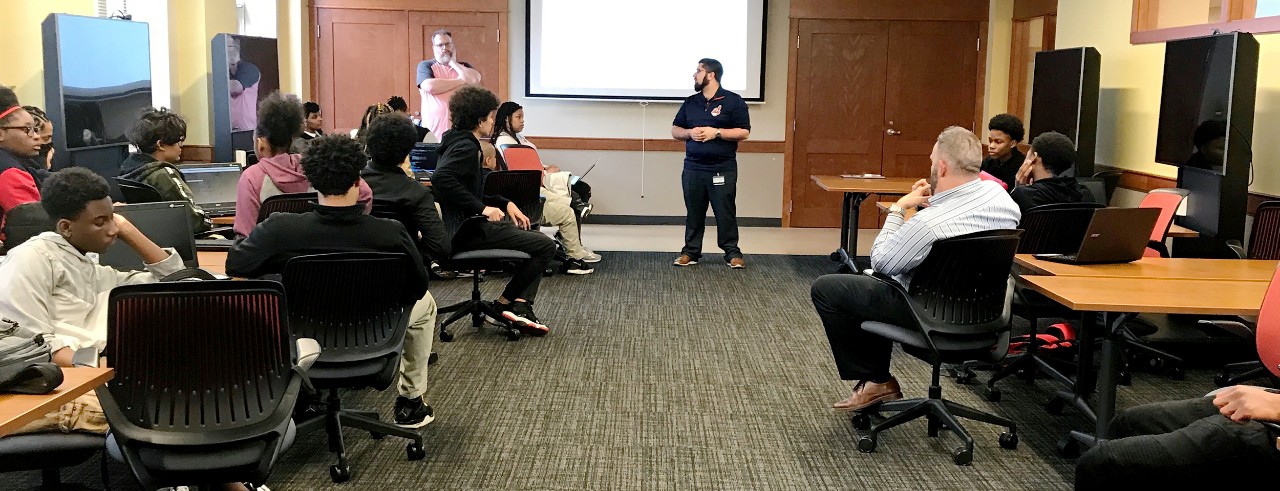
Tony Iacobelli talks with students about the importance of teamwork in emergency situations. Photo/Jill Gibboney
Tony Iacobelli, information security analyst at IT@UC, spoke to the students on what the virus was, how it impacted their systems and how various IT teams work together to remediate the virus and return systems to normal operation. Iacobelli introduced IT@UC team members around the room asking them to define what their department’s role is during a crisis.
“It really resonated with them”, Iacobelli said. “It gave the students an opportunity to see not only how to do work in IT fields, but also how these individual divisions within IT@UC rely on each other to tackle difficult things like infectious malware.”
The Share IT partnership with Hughes STEM High School by the Diversity Committee at IT@UC will come to a close with a final presentation of projects at 3:30 p.m. May 9 at the 1819 Innovation Hub. The final projects will be judged by a panel of IT@UC staff, as well as members of the 1819 Innovation Hub’s Venture Labs and Corporate Innovation Spaces, along with Hughes STEM High School faculty members.
Featured image top: ShareIT students and instructors discuss how information technology works together across teams. Photo/Jill Gibboney
Related Stories
Sugar overload killing hearts
November 10, 2025
Two in five people will be told they have diabetes during their lifetime. And people who have diabetes are twice as likely to develop heart disease. One of the deadliest dangers? Diabetic cardiomyopathy. But groundbreaking University of Cincinnati research hopes to stop and even reverse the damage before it’s too late.
App turns smartwatch into detector of structural heart disease
November 10, 2025

An app that uses an AI model to read a single-lead ECG from a smartwatch can detect structural heart disease, researchers reported at the 2025 Scientific Sessions of the American Heart Association. Although the technology requires further validation, researchers said it could help improve the identification of patients with heart failure, valvular conditions and left ventricular hypertrophy before they become symptomatic, which could improve the prognosis for people with these conditions.
Combination immunotherapy helps overcome melanoma treatment resistance
November 10, 2025

MSN highlighted research led by the University of Cincinnati Cancer Center's Trisha Wise-Draper showing a combination of immunotherapy medications can activate a robust immune response and help overcome treatment resistance in patients with refractory melanoma.