UC's $15 million to fight opioid deaths makes local headlines
A recap of media coverage following the HHS' HEALing Communities announcement

On Thursday, April 18, Health and Human Services (HHS) Secretary Alex Azar announced the launch of the HEALing Communities Study to help reverse our nation’s opioid crisis. Four states – Ohio, Kentucky, Massachusetts and New York, will receive over $350 million to support a multi-year study with the goal to cut opioid overdose deaths by 40% in three years. The announcement made news across Ohio and the region.
Funded by the National Institute on Drug Abuse (NIDA), part of the National Institutes of Health (NIH), University of Cincinnati and Ohio State University will co-lead a $65.9 million effort across Ohio that will also partner with Recovery Ohio and Case Western Reserve University as well as additional universities and community organizations in 19 counties across Ohio. UC will be awarded $15.1 million over four years. Read the full story here.
HEALing Communities Award in the news:
WLW-700 AM(interview at 69:25 minute mark.)
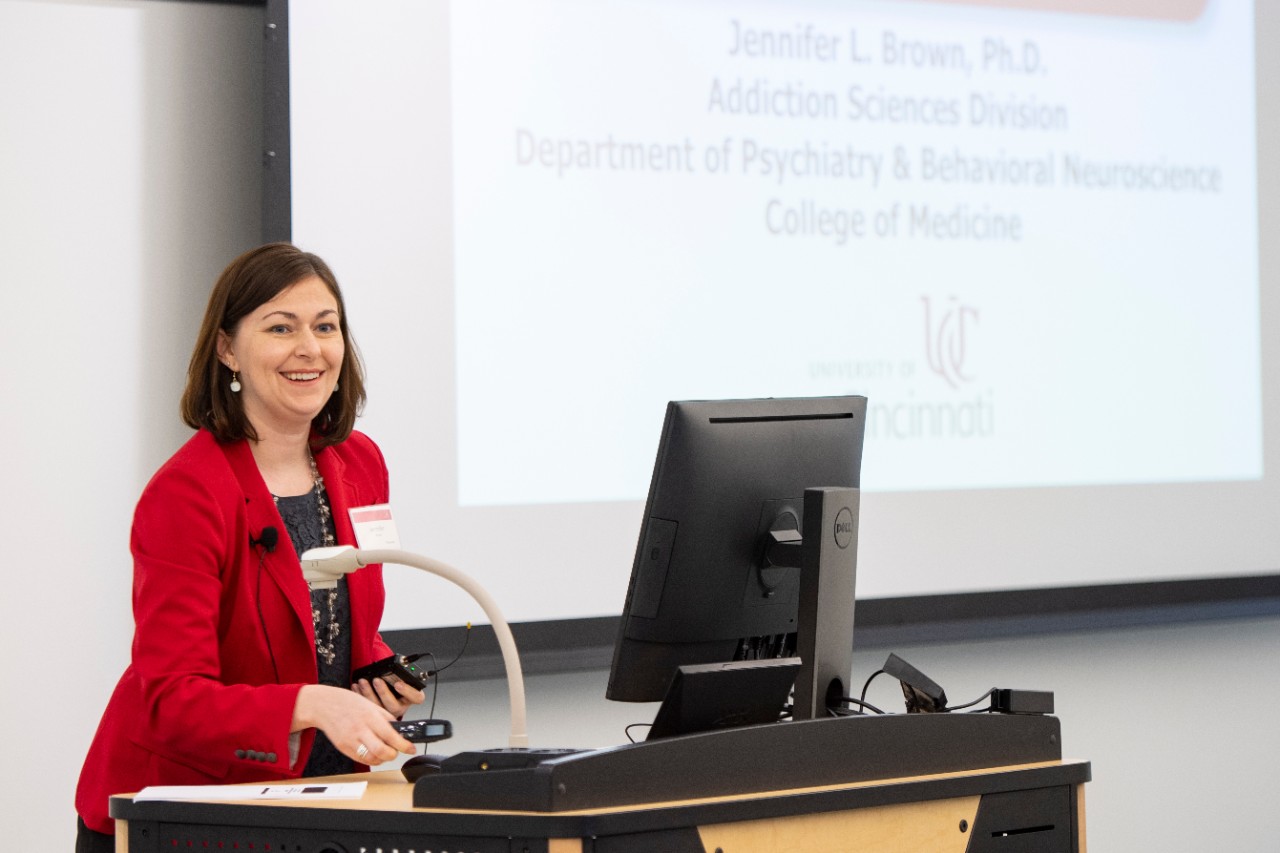
Featured image at top: Jennifer Brown, PhD, presents at the UC / UC Health Opioid Symposium. Photo by Colleen Kelley/AHC Communication Services.
Related Stories
Sugar overload killing hearts
November 10, 2025
Two in five people will be told they have diabetes during their lifetime. And people who have diabetes are twice as likely to develop heart disease. One of the deadliest dangers? Diabetic cardiomyopathy. But groundbreaking University of Cincinnati research hopes to stop and even reverse the damage before it’s too late.
App turns smartwatch into detector of structural heart disease
November 10, 2025

An app that uses an AI model to read a single-lead ECG from a smartwatch can detect structural heart disease, researchers reported at the 2025 Scientific Sessions of the American Heart Association. Although the technology requires further validation, researchers said it could help improve the identification of patients with heart failure, valvular conditions and left ventricular hypertrophy before they become symptomatic, which could improve the prognosis for people with these conditions.
Combination immunotherapy helps overcome melanoma treatment resistance
November 10, 2025

MSN highlighted research led by the University of Cincinnati Cancer Center's Trisha Wise-Draper showing a combination of immunotherapy medications can activate a robust immune response and help overcome treatment resistance in patients with refractory melanoma.