UC researchers use wireless technology to heal wounds

Researchers at the University of Cincinnati are healing wounds wirelessly.
A team of UC researchers invented a noninvasive device that uses high-frequency electric fields, slightly higher than the range emitted from cell phones, to treat diabetic ulcers. They recently received a U.S. patent for the device.
The work reflects UC’s innovation agenda, a platform of the university’s strategic direction, Next Lives Here.

UC Ph.D. candidate in biomedical engineering Nava P. Rijal holds the recently patented device. The team of researchers invented this noninvasive device, which uses high-frequency electric fields to treat diabetic ulcers. Photo/Corrie Stookey/CEAS Marketing
About 15 percent of people with diabetes have diabetic ulcers, chronic wounds that are most common in the foot. These ulcers can start with a small cut and can persist for a long time, because cells affected by diabetes don’t respond quickly enough to heal these wounds. Untreated, the ulcers can cause long-term complications and even lead to amputation.
“We’re not talking about just an inconvenience,” said UC associate professor of biomedical engineering Daria Narmoneva, who is the lead inventor of the device. “People have to live with this for months, sometimes years.”
Narmoneva’s team wanted to create a noninvasive device that was more effective than current treatments, which only work for about 70 percent of people. The research team, which included UC physics professor Andrei Kogan, came up with a device that uses electric waves to trigger the sluggish cells into action.
We’re not talking about just an inconvenience. People have to live with this for months, sometimes years.
Daria Narmoneva, UC associate professor of biomedical engineering

UC Associate Professor of Biomedical Engineering Daria Narmoneva inspects the recently patented device for healing diabetic ulcers. The device uses electric waves to trigger sluggish cells into action. Photo/Corrie Stookey/CEAS Marketing

The UC researchers discuss their recently patented device for treating diabetic ulcers. From left, master's student Vasuretha Chandar, professor Daria Narmoneva and Ph.D. candidate Nava P. Rijal. Photo/Corrie Stookey/CEAS Marketing
“We found that a particular signal very high-frequency signal, 7.5 gigahertz, can have a noticeable effect on the cells as far as activating them,” said Narmoneva. “It boosts the formation of the blood vessels and improves the healing.”
And since the process uses a signal similar to that of a cell phone, it’s is safer than something like a current applied through the skin, which heats up cells and tissue and may damage them.
The team also designed the device to work without touching the wound. Current treatments for diabetic ulcers – whether it be with dressings, pressure, ultrasound therapies or even electrode seals – are all invasive. The electric signals emitted by the device, however, are strong enough to trigger the cells into action, without making physical contact with the wound.
So far, the team has shown that the device repairs tissues even better than current treatments. Now the team is wrapping up preclinical trials and will soon move onto human subjects. They hope to then take the device to market.
“We have some really exciting results,” said Narmoneva. “The healing market is enormous, so the impact here can be great.
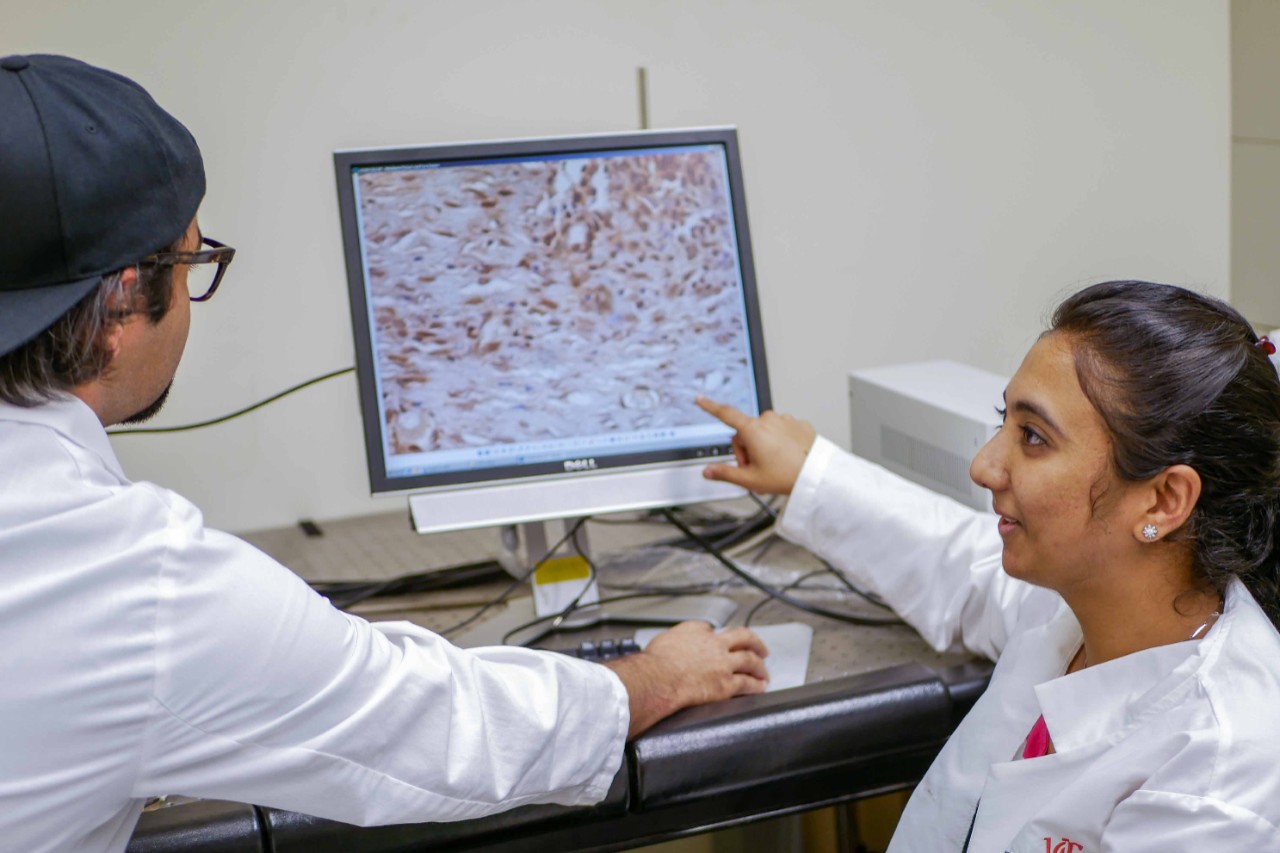
Featured image at top: UC biomedical graduate students Nava P. Rijal and Vasuretha Chandar work in the UC Vascular Tissue and Cellular Engineering laboratory. Photo/Corrie Stookey/CEAS Marketing

The UC researchers pose in the Vascular Tissue and Cellular Engineering laboratory. From left, master's student Vasuretha Chandar, Ph.D. candidate Nava P. Rijal, UC professor Daria Narmoneva and UC professor Andrei Kogan. Photo/Corrie Stookey/CEAS Marketing
Next Lives Here
Being the only academic healthcare university in the region is a big responsiblity. See how UC is solving issues related to health and well-being with its strategic direction Next Lives Here.
Related Stories
Sugar overload killing hearts
November 10, 2025
Two in five people will be told they have diabetes during their lifetime. And people who have diabetes are twice as likely to develop heart disease. One of the deadliest dangers? Diabetic cardiomyopathy. But groundbreaking University of Cincinnati research hopes to stop and even reverse the damage before it’s too late.
App turns smartwatch into detector of structural heart disease
November 10, 2025

An app that uses an AI model to read a single-lead ECG from a smartwatch can detect structural heart disease, researchers reported at the 2025 Scientific Sessions of the American Heart Association. Although the technology requires further validation, researchers said it could help improve the identification of patients with heart failure, valvular conditions and left ventricular hypertrophy before they become symptomatic, which could improve the prognosis for people with these conditions.
Combination immunotherapy helps overcome melanoma treatment resistance
November 10, 2025

MSN highlighted research led by the University of Cincinnati Cancer Center's Trisha Wise-Draper showing a combination of immunotherapy medications can activate a robust immune response and help overcome treatment resistance in patients with refractory melanoma.