UC students engineer heating device for people with spinal cord injuries

People with spinal cord injuries have trouble regulating body temperature. Spinal cord injuries reduce muscle contractions and blood flow and can cause overheating and overcooling.
Students at the University of Cincinnati are inventing an adaptive heating device for people with these types of injuries. The device, which goes across a person’s thighs and knees, heats up to a safe and sustainable temperature and makes it easier for people to regulate their body temperature.
“This is a market with a lot of unmet needs,” said Brandon Geske, one of the students on the project. “There are a lot of people with spinal cord injuries, but there are not a lot of companies innovating in that space.”

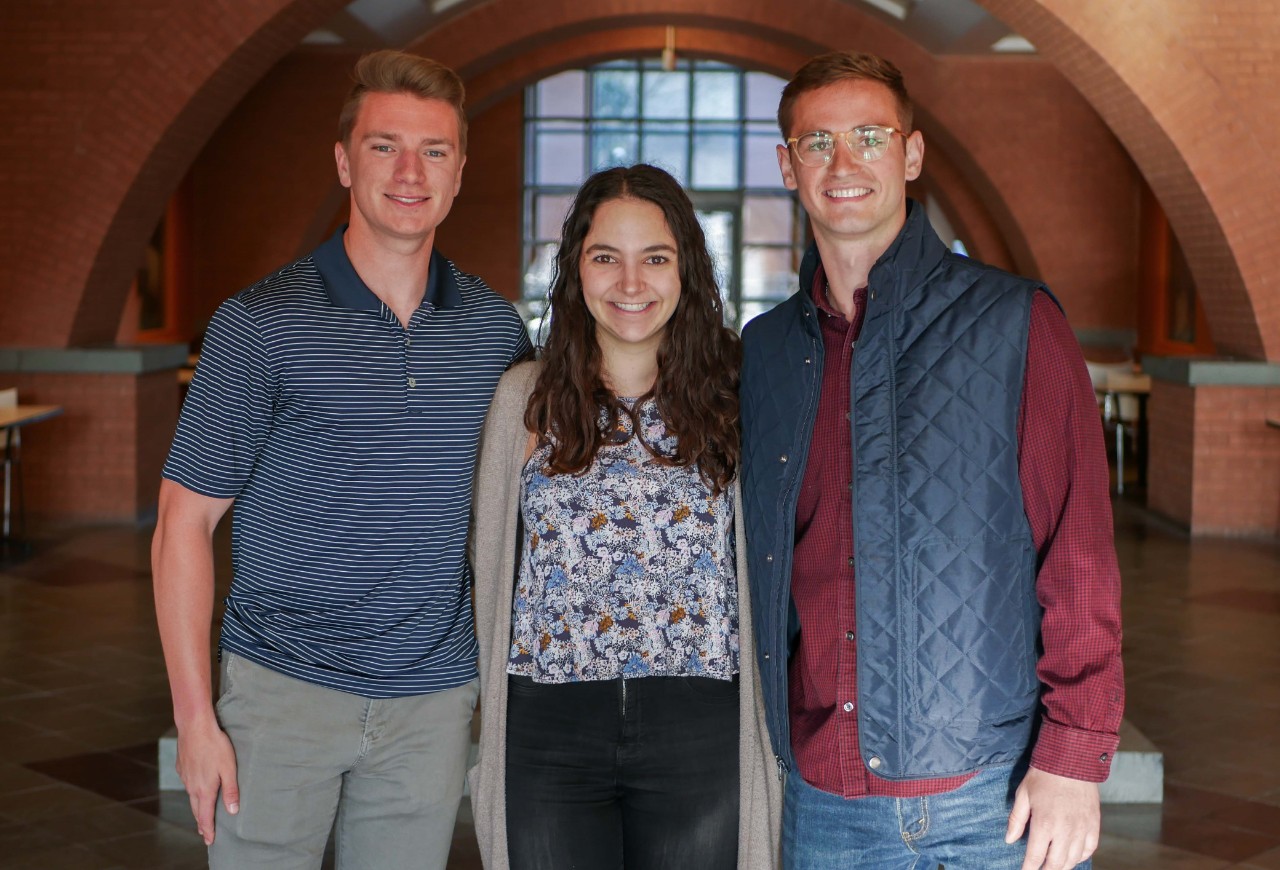
UC biomedical engineering students, from left, Beth Palmer, Brandon Geske and Isaac Stamper are inventing an adaptive heating device for people with spinal cord injuries. The device, which goes across a person’s thighs and knees, heats up to a safe and sustainable temperature and makes it easier for people to regulate their body temperature. Photo/Corrie Stookey/CEAS Marketing
The project is part of UC’s biomedical engineering medical device capstone class. Students in this class combine theory and practice to innovate, a reflection of UC’s strategic direction Next Lives Here.
The student team studied the market and soon realized that, though many products existed for overheating, few products existed for overcooling. The students connected with a person who is quadriplegic and further explored the problem.

UC students Isaac Stamper and Beth Palmer work on the prototype. Photo/Provided
The person complained of coldness in the months following his injury. Sometimes it would take hours for his legs to warm up.
At first look, blankets seemed like the easy fix. But blankets are bulky, get caught in wheels and aren’t good at warming legs fast, especially if the legs are already cold. The students also wanted a device that was more discreet and flexible than a pile of blankets.
“The idea is that [this device] will be something that always goes on the wheelchair,” said Isaac Stamper, another student on the project. “No matter if they’re out and about or in their house, they can always have this device readily available.”
Throughout the process, the team traveled to local company Premier Physical Therapy, attended conferences and spoke to people with spinal cord injuries. The students saw the problem first hand and continuously refined their prototype.
“It’s really rewarding because we’re actually working with a patient who’s getting to see our device and give us feedback,” said Beth Palmer, one of the team members.

UC student Brandon Geske tests one of the team's prototypes. Photo/Provided
After going through several failed designs, like seat covers and heated vests and pants, the team landed on a fabric heating device that is stored in a pouch at the side of a wheelchair. When the user needs it, she takes it out of the pouch and pulls it over her thighs. The second part of the fabric rolls down the front of her legs and covers just below her knees. The device also includes a heated backrest cover.
The device includes three parts: fabric and a power source connected by wires. The device simply plugs into battery, which heats the wires to safe temperature.
The team is currently working out the bugs in the design and is close to completing their prototype. They will then perform user testing on it. If all goes well, students next year will pick up where they left off, scaling up the design to commercial applications.
With this adaptive heating device, people with spinal cord injuries can go about their everyday lives without the dangerous effects of overcooling.
Featured image at top: Three biomedical engineering students pose in the lobby of the Engineering Research Center at UC. Photo/Corrie Stookey/CEAS Marketing
Related Stories
Sugar overload killing hearts
November 10, 2025
Two in five people will be told they have diabetes during their lifetime. And people who have diabetes are twice as likely to develop heart disease. One of the deadliest dangers? Diabetic cardiomyopathy. But groundbreaking University of Cincinnati research hopes to stop and even reverse the damage before it’s too late.
App turns smartwatch into detector of structural heart disease
November 10, 2025

An app that uses an AI model to read a single-lead ECG from a smartwatch can detect structural heart disease, researchers reported at the 2025 Scientific Sessions of the American Heart Association. Although the technology requires further validation, researchers said it could help improve the identification of patients with heart failure, valvular conditions and left ventricular hypertrophy before they become symptomatic, which could improve the prognosis for people with these conditions.
Combination immunotherapy helps overcome melanoma treatment resistance
November 10, 2025

MSN highlighted research led by the University of Cincinnati Cancer Center's Trisha Wise-Draper showing a combination of immunotherapy medications can activate a robust immune response and help overcome treatment resistance in patients with refractory melanoma.