UC student’s co-op leads to full-time job with sweat sensor startup


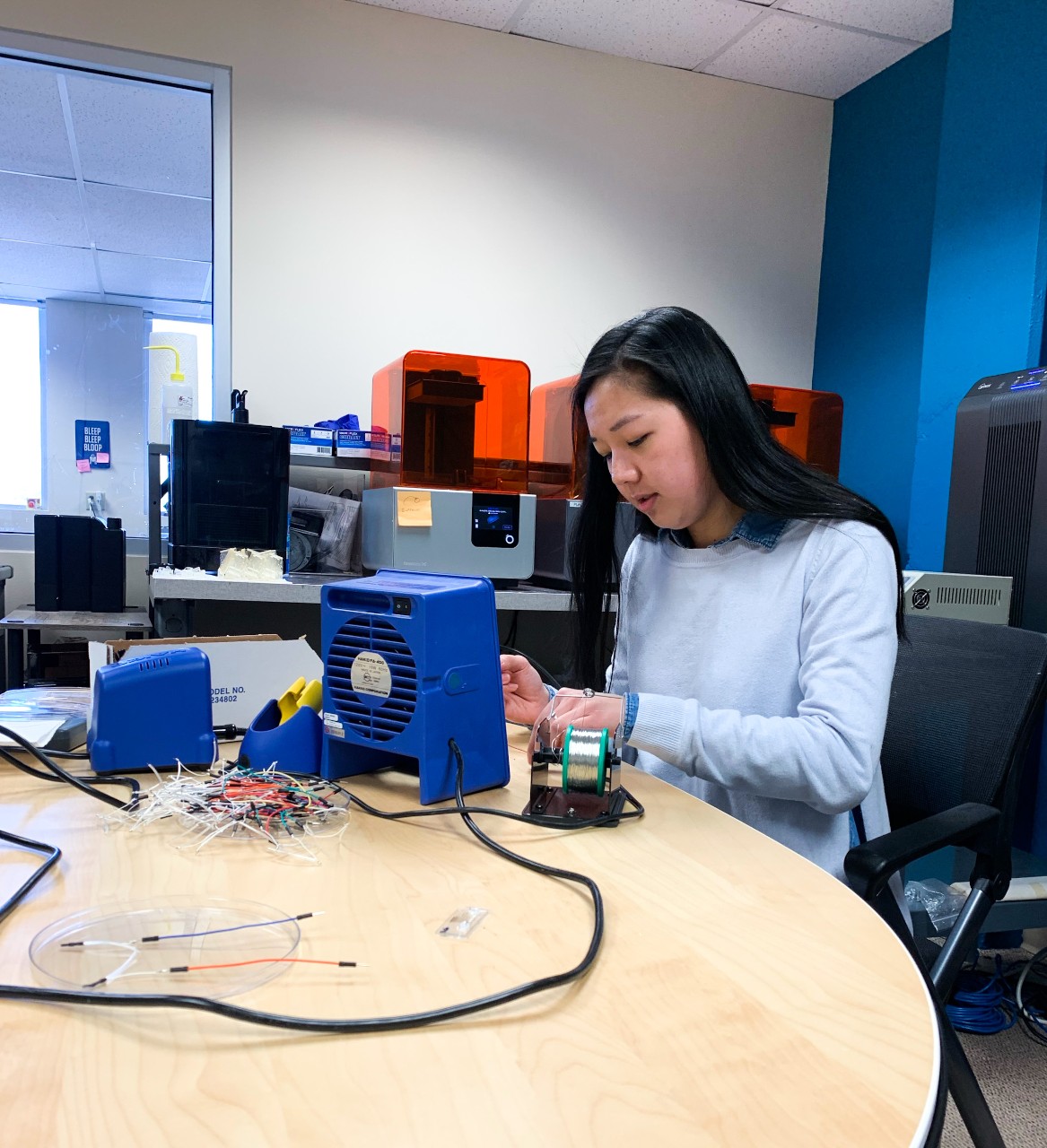
UC biomedical engineering alumna Hannah Tilley. Photo/Provided
When it comes to monitoring health, sweat may be the next big thing. A Cincinnati-based startup company, Eccrine Systems, Inc., develops advanced wearable devices that capture and sense biomarkers from sweat. Medical professionals can apply these sweat-sensing devices to fields ranging from athletics to pediatrics to pharmaceutical monitoring.
Eccrine’s innovative research is what initially drew University of Cincinnati student Hannah Tilley to the company. Tilley, a 2018 graduate of UC’s biomedical engineering program, spent her final two cooperative education (co-op) rotations with Eccrine. She now works there full time as a research engineer.
“I have always loved helping others, and I wanted that to be a priority in my life” Tilley said. “I also enjoy tinkering with and building things. I landed on biomedical engineering because it was a good combination of both [these interests].”
Tilley got a taste of the medical industry with Assurex Health on her first co-op rotation. For the next two rotations, she worked at the molecular genetics lab at Cincinnati Children’s Hospital Medical Center.
“That co-op [with Cincinnati Children’s] showed me that I like the research aspect of the field, in that I like making new discoveries,” Tilley said.
But something was still missing. Though she found her passion for research in the lab, Tilley missed the hands-on aspect of building things. She found the perfect combination of research and development at Eccrine.
“When I was looking for my last coop rotation, I saw Eccrine,” Tilley said. “Knowing that they’re on the cutting edge of science is what really drew me in.”
On co-op at Eccrine, Tilley led the testing of an integrated flow sensor. As sweat is released from the sweat glands in your skin, a collector on the skin gathers sweat that flows into a channel. Tilley analyzed this flow rate to evaluate the efficiency of the flow from skin to the sensors.
Tilley enjoyed the responsibilities that Eccrine gave her, as well as the combination of hands-on work and research. When Eccrine asked her to stay on full time, it was an easy decision.
“I love it here,” Tilley said. “I love the people, the work, the company and what it stands for.”
Eccrine is only one of two companies in the world performing this kind of sweat-sensing research. As the innovative startup continues developing this technology, the potential applications – from military and industry to sports and medicine – seem endless.
For Tilley, that means a lot more opportunity to build on her passion for discovery, a passion she fully developed through her time at UC.
Featured image at top: UC biomedical engineering alumna Hannah Tilley works on a sweat sensor project. Photo/Provided
Related Stories
Sugar overload killing hearts
November 10, 2025
Two in five people will be told they have diabetes during their lifetime. And people who have diabetes are twice as likely to develop heart disease. One of the deadliest dangers? Diabetic cardiomyopathy. But groundbreaking University of Cincinnati research hopes to stop and even reverse the damage before it’s too late.
App turns smartwatch into detector of structural heart disease
November 10, 2025

An app that uses an AI model to read a single-lead ECG from a smartwatch can detect structural heart disease, researchers reported at the 2025 Scientific Sessions of the American Heart Association. Although the technology requires further validation, researchers said it could help improve the identification of patients with heart failure, valvular conditions and left ventricular hypertrophy before they become symptomatic, which could improve the prognosis for people with these conditions.
Combination immunotherapy helps overcome melanoma treatment resistance
November 10, 2025

MSN highlighted research led by the University of Cincinnati Cancer Center's Trisha Wise-Draper showing a combination of immunotherapy medications can activate a robust immune response and help overcome treatment resistance in patients with refractory melanoma.