UC student mentors Cincinnati State co-op students at laser lab
Ph.D. student connects undergraduates with future STEM careers through statewide alliance for STEM students


Michael Kattoura, PhD, attends an international conference, TMS2016 in Nashville. photo/Provided
When Michael Kattoura studied at the University of Cincinnati, he not only earned his PhD but also helped pass the torch to new researchers, building leadership skills along the way.
As a student in UC's College of Engineering and Applied Science between 2013 and 2017, he worked as a teaching assistant for the Department of Mechanical and Materials Engineering and also as a research assistant at the Ohio Center for Laser Shock Processing for Advanced Materials and Devices lab. In January 2015, he became the most senior PhD student at the LSP lab and thus took the responsibility of laboratory equipment training and management.
But that’s not all. He also served as a mentor to students on co-op at the lab. By 2017, he also had mentored nine college students over the course of two years. And these weren’t the typical UC co-op students. They were students from Cincinnati State Technical and Community College.
The lab offers research opportunities in collaboration with Cincinnati State and UC through the Louis Stokes Alliances for Minority Participation program. UC and Cincinnati State are members of the state-wide alliance of 10 schools that supports programs across Ohio that are designed to prepare students from underrepresented minorities who are majoring in science, technology, engineering and math fields for rigorous college schedules.
This partnership provides a pre-engineering program that enables students to develop a strong foundation and to transfer to a four-year degree program in STEM. The LSAMP program at Cincinnati State focuses on attracting students to join STEM majors, supporting them to persevere to obtain a two-year degree followed by providing a pathway for completing a four year degree.
UC offers co-ops and summer research experiences as a complement to the program. The lab is just one site that participates in the collaborative program with Cincinnati State and UC. The lab has offered research experiences and mentorship to 18 co-op participants through UC’s LSAMP program since fall of 2014, including three students from Cincinnati State that transferred to UC to pursue a four-year degree.

Michael Kattoura enjoys Cincinnati life. Photo/Provided
The nine students did their co-op research work under Kattoura’s supervision, assisting with PhD level research, including his own. In addition, he trained the students about equipment, teaching engineering concepts related to the different research in progress at the lab.
The LSP lab specializes in utilizing advanced surface treatments such as high energy laser and high-speed impact machine to enhance the properties of metals. In addition, the lab investigates advanced processing and manufacturing techniques such as additive manufacturing (3-D printing) and additive stir friction. Many of the research projects at the LSP lab put students at the cutting edge of these industries, providing valuable professional experiences they would not typically have in a two-year degree program.
Students on co-op at the LSP as they worked on two types of research work. First, they assisted graduate students in their projects, including Kattoura’s own research. The LSP also offers co-op students their own ongoing research project to work on and present in the LSMCE annual conferences. The goal is to give the students a more independent research experience where they are required to present it on a national level. In this case, the Louis Stokes Midwest Center of Excellence (LSMCE) annual conferences.
“My role on the team was to provide students with work experiences, guidance and support to continue their education in four-year program universities and pursue fulfilling careers,” says Kattoura.
Professors Vijay Vasudevan (materials science and engineering) and S.R. Mannava (mechanical engineering), who coordinate the center, are strong advocates for the LSAMP program. They are just two of many UC faculty members who have provided opportunities for co-op and research for Cincinnati State students, strengthening the alliance between the schools.
“These stories highlight the commitment of Dr. Vasudevan and Dr. Mannava and their goal of providing opportunities for Cincinnati State students,” says Kenneth Simonson, PI for LSAMP and Recruitment and Yield Specialist, Office of Inclusive Excellence & Community Engagement for CEAS.
Kattoura is deeply grateful for the students who helped with his research: Joshua Black, Dezeray Butts, Joseph Stanford, Omar Eddins, Luisa Anaya, William Edwards, Gabriel Dennery and Naasson Crawford, each of whom he acknowledges along with LSAMP in all of his recent publications and PhD dissertation.
“I am extremely thankful for all the help they provided and for the great memories,” says Kattoura, who also worked at UC as a visiting research associate this year.
Kattoura currently works at LSP Technologies in Dublin, Ohio, which provides laser peening surface enhancement services and equipment, and other laser technologies.
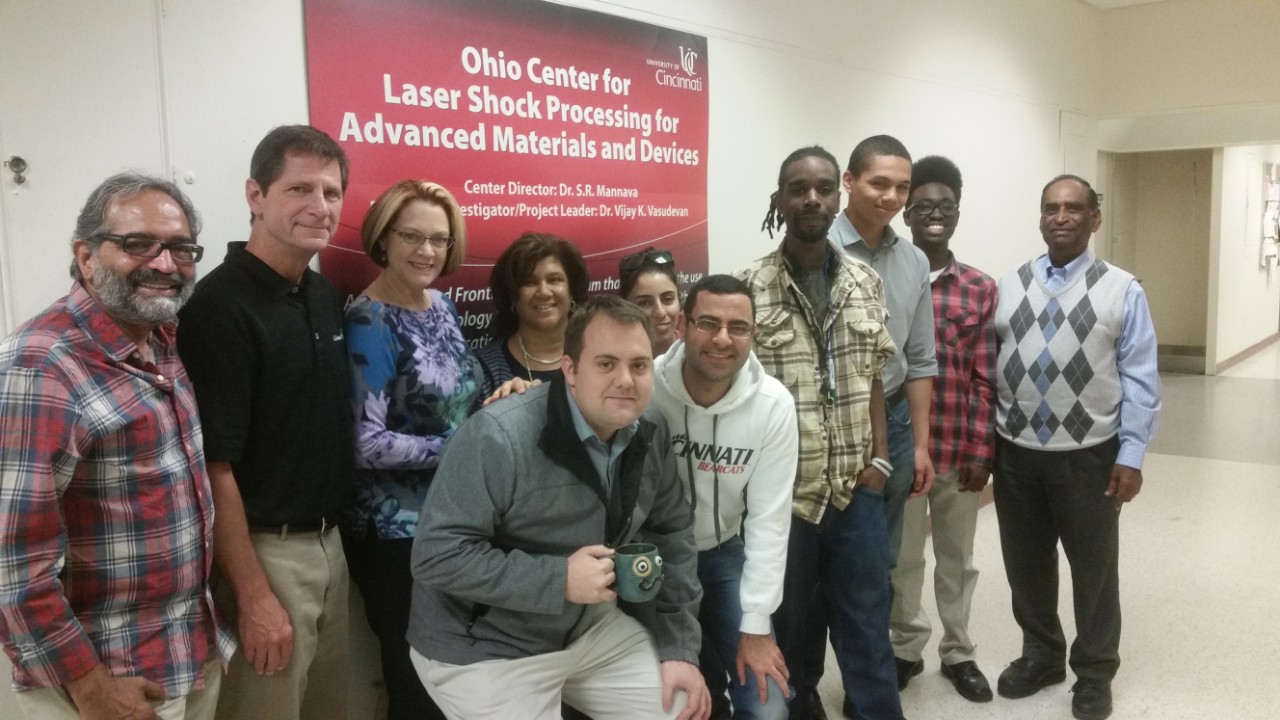
Featured image at top: Michael Kattoura and Professors Vijay Vasudevan and S.R. Mannava welcome students to the LSP team on the cohort's first day in 2017.
Back row, from left: Vijay Vasudevan (Professor of Materials Engineering at UC), Doug Woodruff (Cincinnati State co-op supervisor), Sue Dolan (Cincinnati State co-op supervisor), Kim McMillan (Associate Dean of Center for Innovative Technologies at Cincinnati State), Safa Khodabakhsh (UC Materials Engineering graduate student), Naasson Crawford (LSAMP student), Gabriel Dennery (LSAMP student), William Edwards (LSAMP student), S.R. Mannava (Professor of Mechanical Engineering at UC); front row, from left: Matthew Steiner (Professor of Materials Engineering at UC) and Michael Kattoura. Photo/Provided.
Next Lives Here
The University of Cincinnati is classified as a Research 1 institution by the Carnegie Commission and is ranked in the National Science Foundation's Top-35 public research universities. UC's students, alumni and faculty investigate problems and innovate solutions with real-world impact. Next Lives Here.
Related Stories
Sugar overload killing hearts
November 10, 2025
Two in five people will be told they have diabetes during their lifetime. And people who have diabetes are twice as likely to develop heart disease. One of the deadliest dangers? Diabetic cardiomyopathy. But groundbreaking University of Cincinnati research hopes to stop and even reverse the damage before it’s too late.
Is going nuclear the solution to Ohio’s energy costs?
November 10, 2025

The Ohio Capital Journal recently reported that as energy prices continue to climb, economists are weighing the benefits of going nuclear to curb costs. The publication dove into a Scioto Analysis survey of 18 economists to weigh the pros and cons of nuclear energy. One economist featured was Iryna Topolyan, PhD, professor of economics at the Carl H. Lindner College of Business.
App turns smartwatch into detector of structural heart disease
November 10, 2025

An app that uses an AI model to read a single-lead ECG from a smartwatch can detect structural heart disease, researchers reported at the 2025 Scientific Sessions of the American Heart Association. Although the technology requires further validation, researchers said it could help improve the identification of patients with heart failure, valvular conditions and left ventricular hypertrophy before they become symptomatic, which could improve the prognosis for people with these conditions.