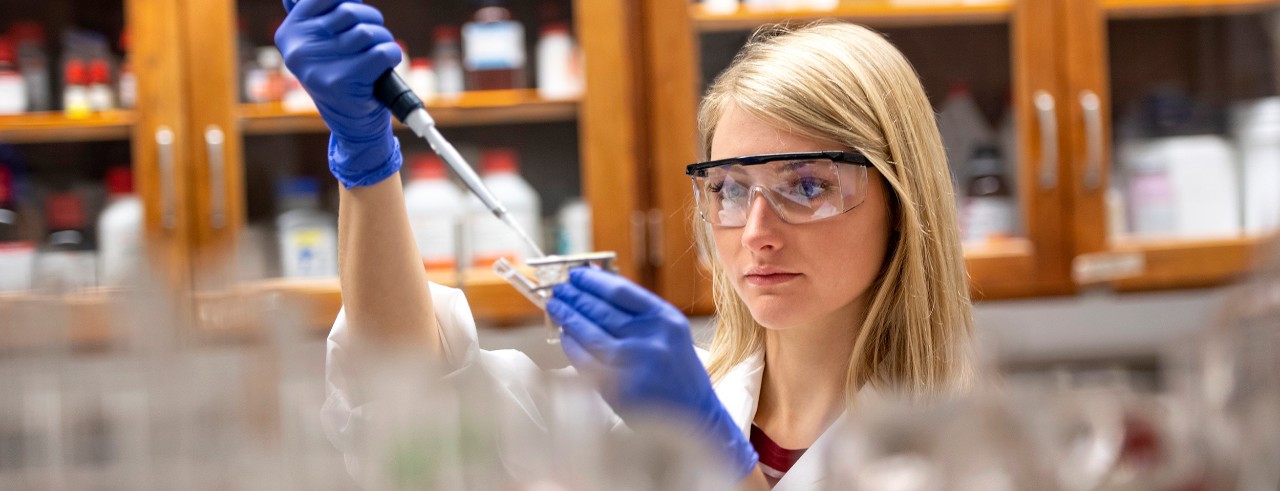
Focus on pharmacy graduate student: Stephanie Ventura Morris

Fifth-year PhD candidate Stephanie Ventura Morris had a stellar 2018. She received three awards from the James L. Winkle College of Pharmacy (the Ritschel Doctoral Fellowship Recipient, the Rieveschl/ /Parke-Davis Meritorious Manuscript Award and a Pinnacle Award) and was awarded the Albert Kligman Young Investigator Scholarship by the International Society for Biophysics and Imaging of the Skin. She also received a first-place student poster award from the Ohio Valley Society of Cosmetic Chemists and a second place student poster award from the national Society of Cosmetic Chemists at the annual conference in December 2018.
Morris, who will graduate in 2019 with a PhD in pharmaceutical sciences and a focus in cosmetic science, shares her experiences in this field of study:
What it is about cosmetic science that you’d like people to know that they don’t know?
Cosmetic science is the science of anything you would apply to your skin, hair, nails or eyes. This includes more than just color cosmetics like makeup. If you have ever used any products on your skin or hair like shampoo, body wash or hair gel, worn a nicotine patch to quit smoking, used antibacterial hand gel, applied an anti-itch cream like Cortisone-10, or shaved your legs or face, you have used a product or technology developed by a cosmetic scientist.
Why choose UC for this field of study?
I have a BS in biology and an MS in pharmaceutical sciences from the University of Cincinnati. The graduate program in cosmetic science at UC is one of only a few in the U.S. Furthermore, I believe it provides the best advanced education in cosmetic science out there. In this program I have had the privilege to work with and be taught by numerous world-class experts in their fields. I would absolutely recommend this program to anyone interested in a career in cosmetic science.
Why choose cosmetic science?
I have always loved science and specifically chemistry and biology. Being a cosmetic scientist allows me to apply these interests to problems that affect nearly everyone on a daily basis.
How has the program here helped you define your goals?
The cosmetic science program here has introduced me to an entire field of applied science I never knew existed. I knew I wanted to be a research scientist but before I joined the program, I was unaware that I could have a career as a researcher in a topic so pertinent to people's everyday lives. I've been using cosmetic products my entire life but I've never stopped to think about how or why they were developed.
Photo credit: UC/Colleen Kelley
Related Stories
Sugar overload killing hearts
November 10, 2025
Two in five people will be told they have diabetes during their lifetime. And people who have diabetes are twice as likely to develop heart disease. One of the deadliest dangers? Diabetic cardiomyopathy. But groundbreaking University of Cincinnati research hopes to stop and even reverse the damage before it’s too late.
App turns smartwatch into detector of structural heart disease
November 10, 2025

An app that uses an AI model to read a single-lead ECG from a smartwatch can detect structural heart disease, researchers reported at the 2025 Scientific Sessions of the American Heart Association. Although the technology requires further validation, researchers said it could help improve the identification of patients with heart failure, valvular conditions and left ventricular hypertrophy before they become symptomatic, which could improve the prognosis for people with these conditions.
Combination immunotherapy helps overcome melanoma treatment resistance
November 10, 2025

MSN highlighted research led by the University of Cincinnati Cancer Center's Trisha Wise-Draper showing a combination of immunotherapy medications can activate a robust immune response and help overcome treatment resistance in patients with refractory melanoma.