Survivorship program celebrates achieving Commission on Cancer requirement

On Nov. 15, 2018, the University of Cincinnati Cancer Institute’s Survivorship Program, supported by the Robert C. & Adele R. Schiff Family Foundation, celebrated something many programs cannot—offering cancer survivors a continuing care plan after beating the disease.
Many organizations across the country are struggling to meet the 50 percent mark of eligible patients having or being offered a survivorship care plan, as is required by the Commission on Cancer (CoC), a program of the American College of Surgeons.
But as of October, the UC program has hit the mark and is on track to keep the number rising.
"We offer a dedicated one-hour survivorship visit with patients, and at that time, we create a personalized care plan for them,” says Michelle Kirschner, a nurse practitioner in the Department of Family and Community Medicine who oversees the survivorship program. "We are the only system locally doing this. That way, each patient has a treatment summary and plan which he or she can take to a primary care physician to help treat the consequences of cancer treatment. This helps shepherd the patient back to wellness.”
Patients who undergo treatment for cancer can later experience nerve issues, cardiac issues or psychosocial problems, among other complications, which is why a care plan is so important, Kirschner adds.
"Meeting this goal improves our overall program and the care we deliver to patients,” she says.
The UC Cancer Institute is one of the first five in the nation to be certified by CoC, and meeting this goal helps this retain this recognition.
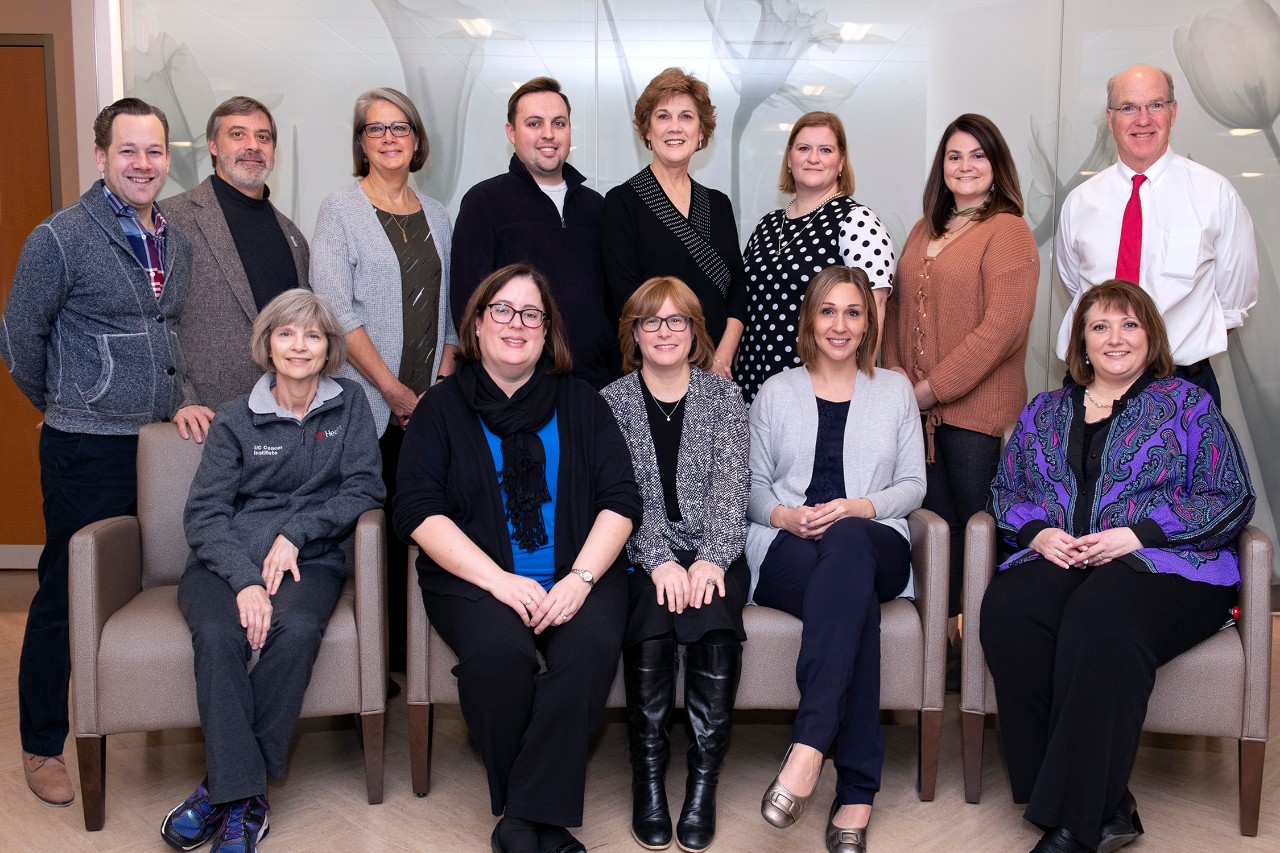
Featured photo by Colleen Kelley: The UC Cancer Institute Survivorship Program from Left to Right, Row 1: Derek Johnson; Philip Diller, MD, PhD; Tammy Ward; Scott Wells; Beth O’Connor (newly hired nurse navigator for the program and the only dedicated nurse navigator locally); Lori Donnelly; Kara Evans; and William Barrett, MD. Row 2: Pat Woellert; Melissa Erickson; Michelle Kirschner; Kelly Acker; and Lana Uhrig, PhD.
Related Stories
Sugar overload killing hearts
November 10, 2025
Two in five people will be told they have diabetes during their lifetime. And people who have diabetes are twice as likely to develop heart disease. One of the deadliest dangers? Diabetic cardiomyopathy. But groundbreaking University of Cincinnati research hopes to stop and even reverse the damage before it’s too late.
App turns smartwatch into detector of structural heart disease
November 10, 2025

An app that uses an AI model to read a single-lead ECG from a smartwatch can detect structural heart disease, researchers reported at the 2025 Scientific Sessions of the American Heart Association. Although the technology requires further validation, researchers said it could help improve the identification of patients with heart failure, valvular conditions and left ventricular hypertrophy before they become symptomatic, which could improve the prognosis for people with these conditions.
Combination immunotherapy helps overcome melanoma treatment resistance
November 10, 2025

MSN highlighted research led by the University of Cincinnati Cancer Center's Trisha Wise-Draper showing a combination of immunotherapy medications can activate a robust immune response and help overcome treatment resistance in patients with refractory melanoma.