Medical Student Interest Group Focuses on Health Care in Rural Areas
Students aim to help medically underserved residents

Second-year medical student McKenzie Nelson remembers trips to the doctor as a child were far and few between. She grew up in the village of Bloomingburg, nestled in southern Ohio and at least an hour from the nearest pediatrician.
“We were medically underserved,” says Nelson. “I never forgot my mom’s experiences with an emergency surgery when there wasn’t time to travel to a larger hospital. We had to make do with what we had in town. Rural physicians are great. They know how to do things on the fly without all the resources that urban centers typically have.”
Nelson has an admiration for doctors serving rural areas and is studying to someday practice pediatrics in a similar setting. She is among the two dozen medical students who are part of the Rural Health Student Interest Group.
The group started last August and meets about five times a year with activities designed to focus on health issues facing rural areas, offer health-related volunteer opportunities in rural areas and provide medical students shadowing opportunities with health professionals. Sharron DiMario, center director of the Area Health Education Center (AHEC) in the College of Medicine, is the advisor for the Rural Health Student Interest Group. The University of Cincinnati (UC) AHEC is housed in the College of Medicine. Its service area includes the counties of Adams, Brown, Butler, Clermont, Clinton, Hamilton, Highland and Warren. Its mission is to enhance access to quality primary and preventive health care by improving the supply and distribution of health care professionals in underserved rural and urban areas. The center partners with the UC Academic Health Center on inter-professional educational programming.
“Encouraging tomorrow’s physicians to practice in rural areas is important and the need is great,” says DiMario. “Fifteen to 20 percent of the nation's population lives in a rural area, and access to care is a problem. Rural areas have 39.8 primary care physicians per 100,000 while urban areas have 53.3 primary care physicians per 100,000. Rural physicians are serving a population that’s older, has a lower per capita income and higher rates of mortality as well.”
DiMario adds, “I am excited about the possibilities for our rural health student group.”
Nathan Northern, a second year medical student, says the rural health student interest group held an outreach program in January in which medical students spoke with elementary school children about the dangers of unsupervised use of prescription drugs. Northern says the current opioid crisis has been fueled by misuse of prescription drugs and that the group felt it was important to create a dialogue on the topic.
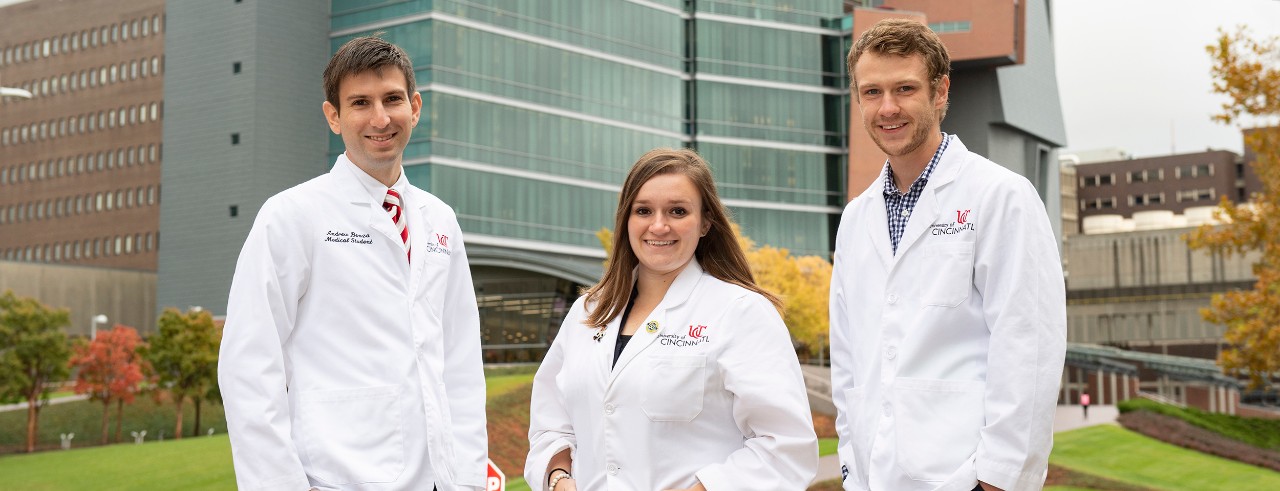
Northern, Nelson and Andrew Benza, also a second-year medical student, decided to form the rural health student interest group after attending a medical student service organization fair last year and sensing a real need.
“A lot of our academic centers like UC focus on the urban areas, which is wonderful and we have a lot of great outreach programs, but we also wanted to be able to provide something extra for rural areas as well,” says Benza. “In any rural setting there is a shortage of physicians and there are actually more people in the upper age group, an aging population that needs care.”

Members of the Rural Health Student Interest Group are shown in front of the UC College of Medicine.
Top photo by Colleen Kelley/AHC and secondary picture by Lisa Britton/AHC.
Related Stories
Sugar overload killing hearts
November 10, 2025
Two in five people will be told they have diabetes during their lifetime. And people who have diabetes are twice as likely to develop heart disease. One of the deadliest dangers? Diabetic cardiomyopathy. But groundbreaking University of Cincinnati research hopes to stop and even reverse the damage before it’s too late.
App turns smartwatch into detector of structural heart disease
November 10, 2025

An app that uses an AI model to read a single-lead ECG from a smartwatch can detect structural heart disease, researchers reported at the 2025 Scientific Sessions of the American Heart Association. Although the technology requires further validation, researchers said it could help improve the identification of patients with heart failure, valvular conditions and left ventricular hypertrophy before they become symptomatic, which could improve the prognosis for people with these conditions.
Combination immunotherapy helps overcome melanoma treatment resistance
November 10, 2025

MSN highlighted research led by the University of Cincinnati Cancer Center's Trisha Wise-Draper showing a combination of immunotherapy medications can activate a robust immune response and help overcome treatment resistance in patients with refractory melanoma.