UC professor and Nanoworld co-director receives alumni award
Mark Schulz co-directs Nanoworld Labs, six labs that develop smart materials and devices based on nanotechnology


UC professor of mechanical and materials engineering Mark Schulz.
A University of Cincinnati professor was honored this month with a faculty award from his alma mater.
UC College of Engineering and Applied Science professor Mark Schulz, PhD, received the Clifford C. Furnas Memorial Award from the University at Buffalo. The annual award is presented to a distinguished graduate of the university’s School of Engineering and Applied Sciences or College of Arts and Sciences.
Schulz is a professor of mechanical and materials engineering at UC and the co-founder and co-director of Nanoworld Laboratories with UC professor of chemical and materials engineering Vesselin Shanov, PhD.
Nanoworld specializes in developing smart materials and devices based on nanotechnology. The research at Nanoworld covers a wide variety of applications, blending a number of academic disciplines. Though housed in engineering buildings, Nanoworld maintains success through this merging of academic fields.
“We collaborate with physics, and we collaborate with medicine,” says Schulz. “Dr. Shanov has a certain background, and I have a certain background – we’re a very interdisciplinary and diverse group.”
Schulz's work demonstrates UC commitment to research under its strategic plan, Next Lives Here.
Nanoworld comprises six labs and about 30 people, from students to post-doctoral fellows to faculty. The lab works on different applications in the area of nanotechnology, including biomedical and water filtration devices. Nanoworld’s hallmark product is the carbon nanotube sheet, manufactured right in the lab.
The beauty of nanomaterials is its “unique suite of properties,” says Schulz. Nanomaterials are flexible, lightweight and small. They can be used as sensors and energy-storage devices, and they can fit into the seams of fabric, something both Shanov and Schulz are utilizing in different projects.

A student works in UC's Nanoworld Labs.
One such project is a firefighter glove with a nanotube layer inside it that can resist fire and cool the firefighter’s hand. Another project involves weaving carbon nanotubes into the fibers of astronaut suits, which would eliminate the need for bulky lithium-ion batteries.
Schulz’s graduate work focused on the development and application of smart materials. When he came to UC in the early 2000s, nanotechnology was just getting off the ground. Nanoworld was a great opportunity to combine his expertise in smart materials with this new and innovative field.
“I came from the defense industry, so I wanted to try to develop things that can be useful, not just do theory,” says Schulz. That industry mindset led to two spinoff companies: a medical device start-up, Inovasc LLC, and a nanomaterials company, General Nano LLC.
Through its nearly 20 years at UC, Nanoworld has continued to drive research in the innovative field of nanomaterials forward. Its success remains rooted in its interdisciplinary approach.
“We don’t work alone,” says Schulz. “We work with everyone from the College of Medicine to the College of Arts and Sciences, and recently, the College of Design, Architecture, Art, and Planning. That diversity, collaboration and inclusion is what has brought sucess to Nanoworld.”
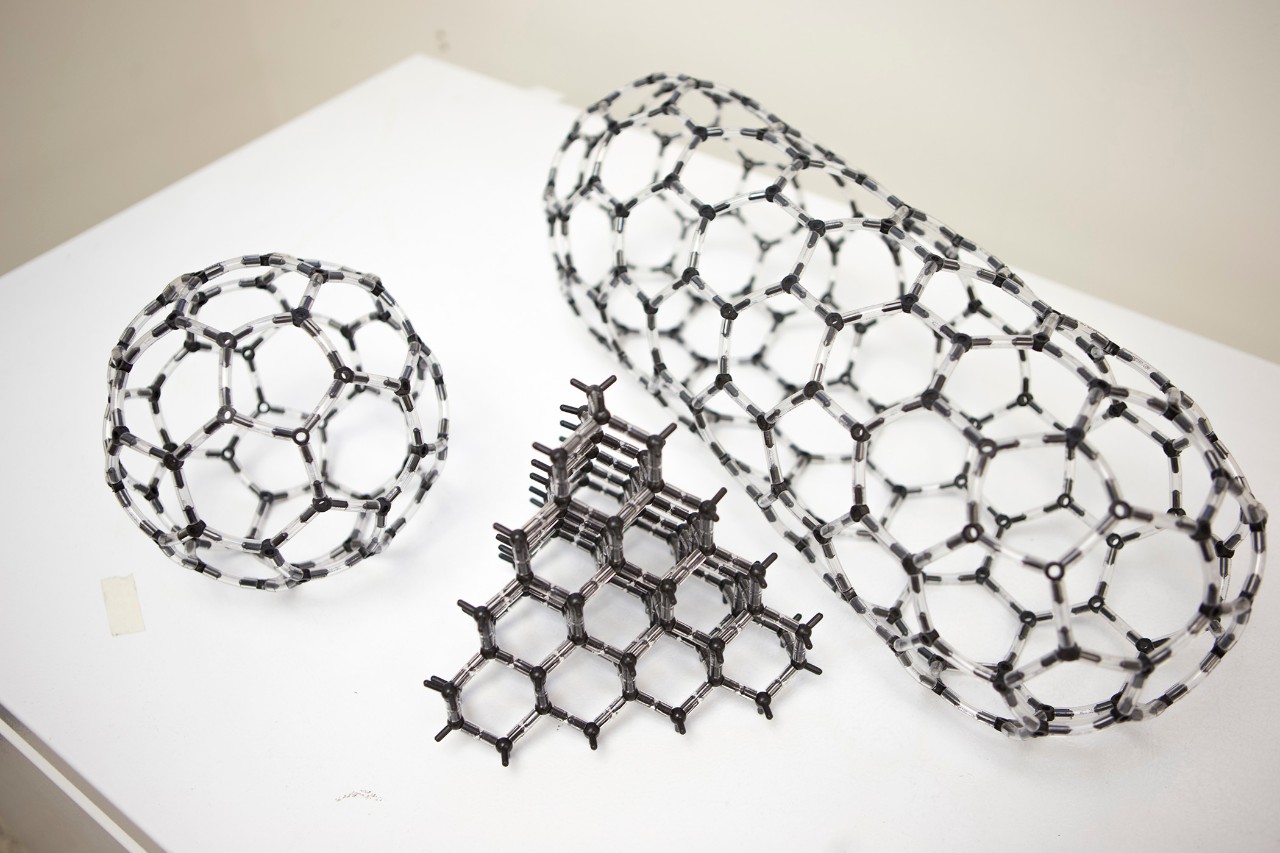
Featured image at top: 3D models of carbon nanotubes, one of the products of UC's Nanowold Labs.
Next Lives Here
See more news related to UC's Next Lives Here strategic direction.
Related Stories
Sugar overload killing hearts
November 10, 2025
Two in five people will be told they have diabetes during their lifetime. And people who have diabetes are twice as likely to develop heart disease. One of the deadliest dangers? Diabetic cardiomyopathy. But groundbreaking University of Cincinnati research hopes to stop and even reverse the damage before it’s too late.
App turns smartwatch into detector of structural heart disease
November 10, 2025

An app that uses an AI model to read a single-lead ECG from a smartwatch can detect structural heart disease, researchers reported at the 2025 Scientific Sessions of the American Heart Association. Although the technology requires further validation, researchers said it could help improve the identification of patients with heart failure, valvular conditions and left ventricular hypertrophy before they become symptomatic, which could improve the prognosis for people with these conditions.
Combination immunotherapy helps overcome melanoma treatment resistance
November 10, 2025

MSN highlighted research led by the University of Cincinnati Cancer Center's Trisha Wise-Draper showing a combination of immunotherapy medications can activate a robust immune response and help overcome treatment resistance in patients with refractory melanoma.