UC lights way with new skin care
Chemist Peng Zhang is developing a novel treatment for skin conditions ranging from acne and foot fungus to cancer

A University of Cincinnati professor wants to use light as an alternative to antibiotics to kill deadly bacteria and treat disease.
Chemist Peng Zhang uses nanoparticles and a simple light-emitting diode like the kind found in flashlights to generate a chemical reaction that can kill harmful bacteria or even cancer cells. The treatment is so noninvasive, he hopes it can be sold over the counter for use at home.
“When you shine a light onto the nanoparticles, they generate something called reactive oxygen species that attacks the target. It could be bacteria or cancer cells,” Zhang said.
Zhang, an associate professor of chemistry in UC’s McMicken College of Arts and Sciences, has co-authored a half-dozen papers on the topic. He presented his latest research to the American Chemical Society national conference in August.

UC chemistry professor Peng Zhang has published numerous papers on the use of reactive oxygen species. Photo/Joseph Fuqua II/UC Creative Services
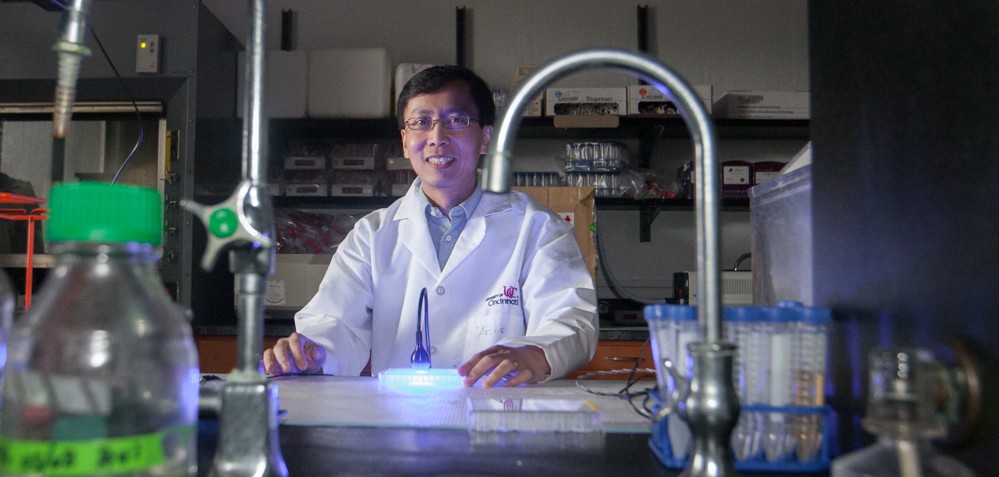
In his lab, Zhang prepares his patented nanoparticle photosensitizer that contains a silver core, a silica shell and a substance called hematoporphyrin. To activate the nanoparticles, he uses a commercially available LED that is brighter than most store-bought flashlights. Zhang prefers a blue bulb because it doesn’t generate as much heat as white ones.
The use of reactive oxygen has many potential applications but the most obvious, Zhang said, is to treat acne. Acne is one of the most common skin maladies, affecting more than 80 percent of teenagers. An estimated 50 million Americans have acne and a third of cases are so severe they require medical treatment.
It's like using a cannon against a mosquito.
Peng Zhang, UC chemistry professor

UC chemist Peng Zhang
Zhang envisions an acne treatment consisting of a gel or ointment rich in nanoparticles that the patient applies to his or her skin and activates with a hand-held light directed on the target area for 10 to 20 minutes.
“It’s effective in minutes unlike traditional antibiotics that can take days,” Zhang said. “The bacteria are killed within minutes of exposure.”
In lab experiments, Zhang’s treatment also was effective against a particularly nasty but extremely common type of Staphylococcus bacteria called MRSA. Most MRSA infections occur in people who have been treated in hospitals, nursing homes or other medical clinics, according to the Mayo Clinic. Left untreated, MRSA infections can lead to deadly sepsis.
Zhang now is working with the UC College of Medicine and UC’s James L. Winkle College of Pharmacy to pursue approvals through the U.S. Food and Drug Administration.
Antibiotics are effective against the bacteria that cause acne, Zhang said. But in these nuisance cases, this treatment could be overkill.
“It’s like using a cannon against a mosquito,” Zhang said.
By using alternatives such as nanoparticles and light, doctors can save antibiotics for the worst, life-threatening infections.

UC chemistry professor Peng Zhang and UC doctoral student Niranga Wijesiri are investigating alternatives to antibiotics. Photo/Joseph Fuqua II/UC Creative Services
Doctors say antibiotic resistance will be one of the biggest risks to human health in coming years, complicating everything from major organ transplants to outpatient surgeries. In his address to the United Nations in September, U.S. Department of Health and Human Services Secretary Alex Azar called antibiotic resistance a global threat that will need a global response.
“The more people are exposed to antibiotics, the more likely the bacteria inside their body can find ways to evade those antibiotics,” said Dr. Carl Fichtenbaum, an infectious disease expert in the UC College of Medicine and associate chairman of Medicine for Translational Research.
“I think if we could use a nonantibiotic approach to cure skin infections, that would be very helpful to limit the need for antibiotics and decrease the spread of resistance,” Fichtenbaum said. “So, I would be very interested in seeing if novel approaches like the photosensitizer using nanotechnology would offer an alternative to using antibiotics.”
The more people are exposed to antibiotics, the more likely the bacteria inside their body can find ways to evade those antibiotics
Dr. Carl Fichtenbaum, UC College of Medicine
Likewise, this method could help doctors treat early-stage skin cancer. Zhang said his photosensitizer could be useful in photodynamic therapy to destroy cancer cells such as carcinomas.
“At this point, we’re limited to topical treatments because you want the site to be easily accessible to light,” he said. “If the cancer is inside tissue, it’s quite a challenge to reach. I saw where they were using fiber optics to shine light onto tissue, but it’s not easy.”
But applications could include antifungal treatments to fight athlete’s foot, another persistent skin condition that is difficult to treat.
“It’s another condition that is very prevalent and uncomfortable,” Zhang said. “It’s a little more difficult to treat than bacterial infections. Fungus has a rigid membrane, unlike bacteria.”
Zhang said he envisions these treatments complementing rather than replacing existing cures.
“We’re trying to conserve critical antibiotics so you can save that silver bullet for when you need it,” Zhang said. “For minor conditions, you really don’t need to use antibiotics.”
Featured image above: UC chemistry professor Peng Zhang poses in front of a blue LED he is using to activate nanoparticles that can kill bacteria. Photo/Joseph Fuqua II/UC Creative Services.

UC chemist Peng Zhang is pursuing FDA approvals for his novel skin treatments. Photo/Joseph Fuqua II/UC Creative Services
Research and innovation
Do you have good research ideas? At UC, students can collaborate with colleges across campus to turn their ideas into real-world solutions. Check out UC's McMicken College of Arts and Sciences or explore other programs on the undergraduate or graduate level.
Related Stories
Sugar overload killing hearts
November 10, 2025
Two in five people will be told they have diabetes during their lifetime. And people who have diabetes are twice as likely to develop heart disease. One of the deadliest dangers? Diabetic cardiomyopathy. But groundbreaking University of Cincinnati research hopes to stop and even reverse the damage before it’s too late.
App turns smartwatch into detector of structural heart disease
November 10, 2025

An app that uses an AI model to read a single-lead ECG from a smartwatch can detect structural heart disease, researchers reported at the 2025 Scientific Sessions of the American Heart Association. Although the technology requires further validation, researchers said it could help improve the identification of patients with heart failure, valvular conditions and left ventricular hypertrophy before they become symptomatic, which could improve the prognosis for people with these conditions.
Combination immunotherapy helps overcome melanoma treatment resistance
November 10, 2025

MSN highlighted research led by the University of Cincinnati Cancer Center's Trisha Wise-Draper showing a combination of immunotherapy medications can activate a robust immune response and help overcome treatment resistance in patients with refractory melanoma.