UC hosts science day at field center
Partnering with UC's College of Arts and Sciences, the UC Alumni Association organizes interactive walks and presentations to families.

By John(na) Jackson
The University of Cincinnati Alumni Association held its third-annual Science Day on Aug. 18 at the UC Center for Field Studies. Located at the edge of the Miami Whitewater Forest, the center played host to 150 people who enjoyed ecology themed activities and a catered lunch.

A child chases after bugs on the prairie landscape during an educational "bug walk."
Organized to be a family-friendly event, Science Day invites UC alumni and community members to share their scientific interests with others while raising awareness about the research taking place at the field station. Activities included nature walks with UC professors, mini-lectures and interactive exhibits for children.
Joshua Benoit, an assistant professor with a focus on entomology, led participants on bug walks to discover the biodiversity of insects readily found in the prairie landscape at the field center. Benoit taught his groups about the different kinds of nets used to capture critters ranging from butterflies to frogs. Then, groups explored the edges of the prairie and nearby creek, practicing the signature swings that scoop up the bugs Benoit presented in his introduction.

A father and son search for creek critters on a guided walk through the woods.
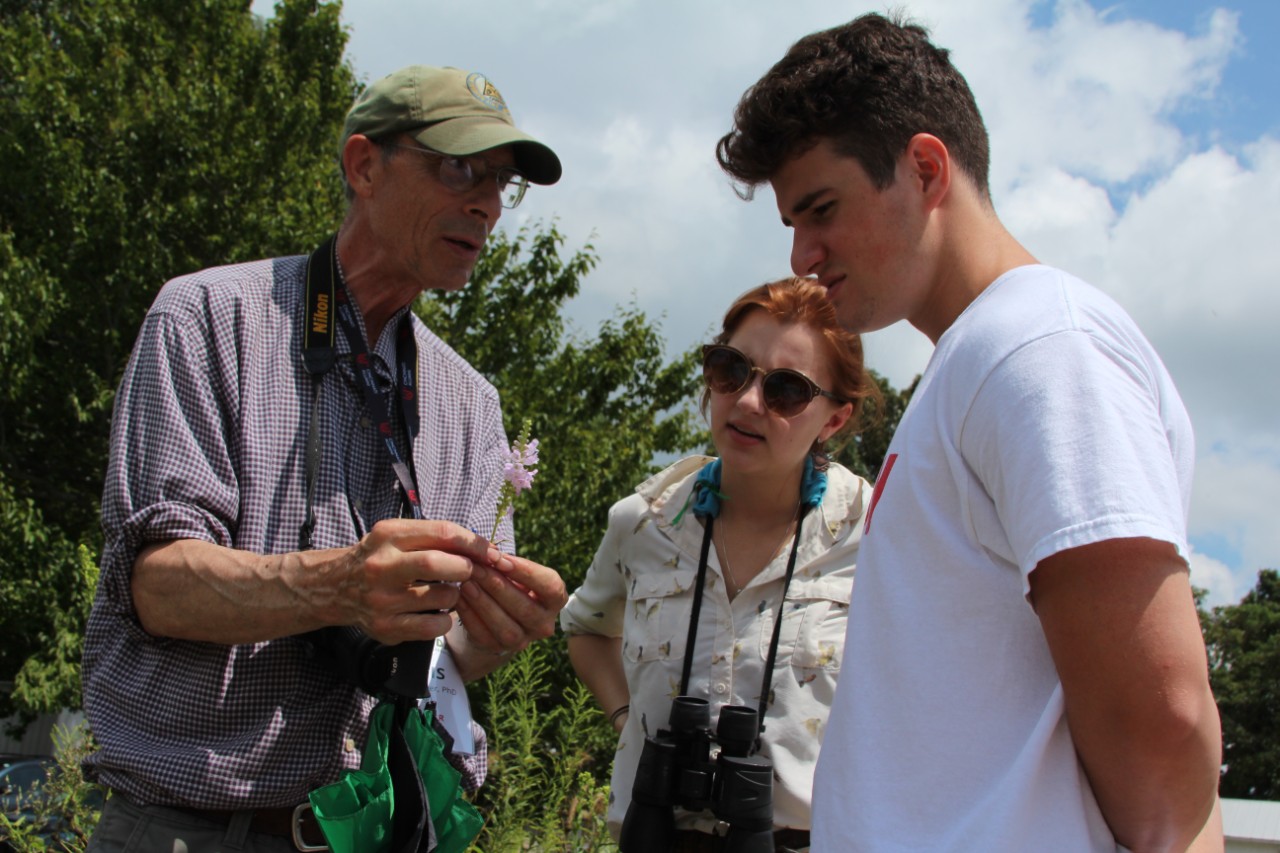
College of Arts and Sciences biologist and researcher Denis Conover led groups on tours demonstrating his vast knowledge of all things that grow from the ground. Participants were given the chance to touch and smell a wide variety of flora, while learning the ways they all interact to create both the forest and prairie ecosystems present at the center.
Mike Miller, a professor emeritus in biology, led creek walks that taught participants about local aquatic biology and creek soil and nutrients in the Miami Whitewater Forest. Children in rain boots waded around the creek sifting water through sieves to find fossils and creek creatures.
Other faculty, students and alumni presented short lectures on their research related to the work of the field center. Topics included beekeeping, water resource recovery, recycling, and a historical look at the weather patterns of ancient Cincinnati that left the area with high concentrations of fossilized ocean life.
Science Day is a collaboration of the College of Arts and Sciences, the College of Engineering and Applied Science, the College of Design, Architecture, Art and Planning, and the Lindner College of Business with support from Great Parks of Hamilton County, which sponsored children's presentations about animals and erosion. Miami Whitewater Forest is part of the Great Parks of Hamilton County.
Interested in giving back to UC? Please contact Juliana Saneholtz, Associate Director of Alumni Relations for the College of Arts and Sciences: juliana.saneholtz@uc.edu.
Related Stories
Sugar overload killing hearts
November 10, 2025
Two in five people will be told they have diabetes during their lifetime. And people who have diabetes are twice as likely to develop heart disease. One of the deadliest dangers? Diabetic cardiomyopathy. But groundbreaking University of Cincinnati research hopes to stop and even reverse the damage before it’s too late.
App turns smartwatch into detector of structural heart disease
November 10, 2025

An app that uses an AI model to read a single-lead ECG from a smartwatch can detect structural heart disease, researchers reported at the 2025 Scientific Sessions of the American Heart Association. Although the technology requires further validation, researchers said it could help improve the identification of patients with heart failure, valvular conditions and left ventricular hypertrophy before they become symptomatic, which could improve the prognosis for people with these conditions.
Combination immunotherapy helps overcome melanoma treatment resistance
November 10, 2025

MSN highlighted research led by the University of Cincinnati Cancer Center's Trisha Wise-Draper showing a combination of immunotherapy medications can activate a robust immune response and help overcome treatment resistance in patients with refractory melanoma.