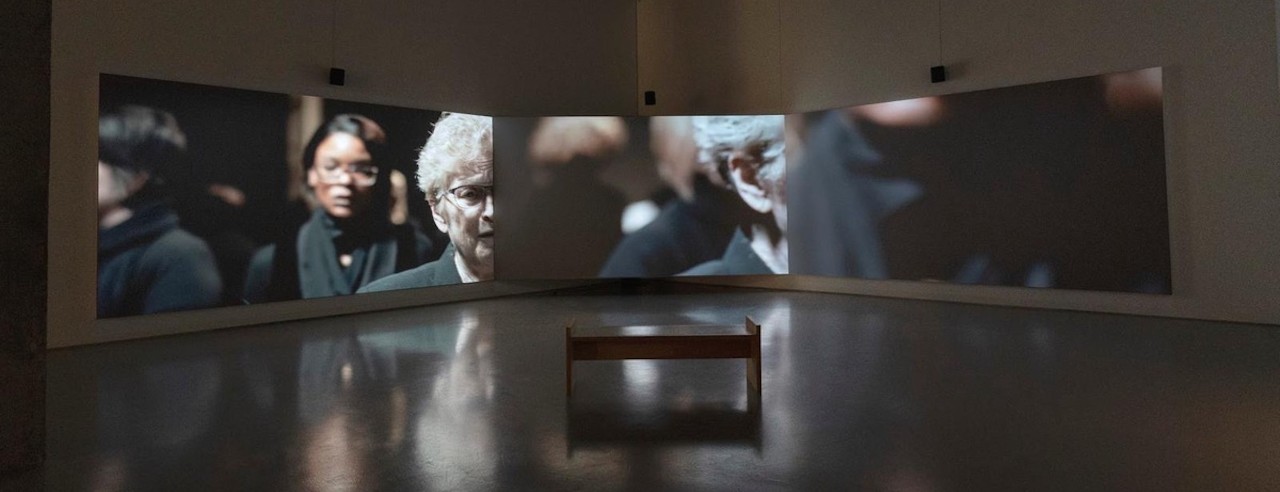
Arte Al Día: Cincinnati’s Contemporary Arts Center presents ‘Sounding Labor, Silent Bodies,’ by Mexican artist Tania Candiani
UC School of Art director guest curates CAC exhibit

The University of Cincinnati played a pivotal role in the latest exhibit in Cincinnati's Contemporary Arts Center (CAC).
Kate Bonansinga, director of the School of Art in UC's College of Design, Architecture, Art, and Planning, served as guest curator of "Tania Candiani: Sounding Labor, Silent Bodies" at the CAC. DAAP fine arts student Kasey Koczo was curatorial assistant during her spring 2020 co-op, paid by a UC Office of Research University Research Council Arts/Humanities & Social Sciences grant that Bonansinga earned for the project.
This solo exhibition "highlights women as a corrective to dominant historical narratives that excluded their role as factory workers, and suggests parallels with current struggles against gender inequality," according to Arte Al Día.
"The exhibition was nearly three years in the making and began when Candiani came to Cincinnati in late August 2017 to offer the School of Art Vista Foundation Annual Lecture," explains Bonansinga. "During that visit we toured around the city (thanks to Professor Matt Lynch and MFA alumnus Jedidiah Knight for serving as guides). Candiani became interested in Cincinnati’s gilded age and industrial might of the late 1800s. Steven Matijcio, who was at the time curator at CAC, supported the exhibition concept: gender and technology and their relationship to labor through the lens of local history."
Bonansinga's work is examplary of UC's strategic direction, Next Lives Here, according to Jennifer H. Krivickas, associate vice president for research in UC's Office of Research.
“Kate’s research and creative activity embodies impact, inclusion and innovation, which together form the philosophical framework for Next Lives Here," she says. "The artist on exhibit is internationally renowned and her work has had a profound impact on the human experience.
"Kate, a University Research Council awardee, used her seed funding to conduct research on Cincinnati’s industrial past in connection to contemporary art that contributes richly to a growing body of international scholarship and to mount an exhibit that engages, educates and inspires the public at the nationally significant Lois & Richard Rosenthal Center for Contemporary Art. The UC Office of Research couldn’t be more proud of Kate and happy for her and this tremendous scholarly achievement,” Krivickas continues.
The exhibition is on display through Jan. 17, 2021. Read more.
Featured image at top: Tania Candiani: Sounding Labor, Silent Bodies at the Contemporary Arts Center, Cincinnati. Photo/Prince Lang, 2020
Related Stories
Sugar overload killing hearts
November 10, 2025
Two in five people will be told they have diabetes during their lifetime. And people who have diabetes are twice as likely to develop heart disease. One of the deadliest dangers? Diabetic cardiomyopathy. But groundbreaking University of Cincinnati research hopes to stop and even reverse the damage before it’s too late.
Is going nuclear the solution to Ohio’s energy costs?
November 10, 2025

The Ohio Capital Journal recently reported that as energy prices continue to climb, economists are weighing the benefits of going nuclear to curb costs. The publication dove into a Scioto Analysis survey of 18 economists to weigh the pros and cons of nuclear energy. One economist featured was Iryna Topolyan, PhD, professor of economics at the Carl H. Lindner College of Business.
App turns smartwatch into detector of structural heart disease
November 10, 2025

An app that uses an AI model to read a single-lead ECG from a smartwatch can detect structural heart disease, researchers reported at the 2025 Scientific Sessions of the American Heart Association. Although the technology requires further validation, researchers said it could help improve the identification of patients with heart failure, valvular conditions and left ventricular hypertrophy before they become symptomatic, which could improve the prognosis for people with these conditions.