Researchers work to make blood cancer a manageable disease
Spectrum News, MSN highlight Cancer Center's Leukemia and Drug Development Lab

During Blood Cancer Awareness Month, Spectrum News and MSN highlighted researchers in the University of Cincinnati Cancer Center’s Leukemia and Drug Development Lab working to make blood cancer a manageable illness and bring new treatments to patients more efficiently than ever before.
Cancer Center member Megan Johnstone, PhD, said blood cancers can be thought of like a colorful array of sprinkles. A patient may begin by having cancer cells that are all one color, but the cancer can mutate into many different colors as it evolves, becoming resistant to treatment.
“So for example, AML is very heterogeneous,” said Johnstone, clinical research director in the LDDL. “You can think of your sprinkles container having 10 colors. You’re going to have 10 different types of AML, each with its own mutations and potential for treatment resistance.”
The Cancer Center’s Erin Hertlein, PhD, said that in the absence of a curative therapy , the long-term goal is to make blood cancer a manageable chronic illness.
“I think the ultimate goal will always be to cure cancer, but the reality is that because cancer learns how to evolve and develop resistance, this isn’t always achievable,” said Hertlein, a Cancer Center researcher and associate professor in UC’s College of Medicine. “But as we continue to learn more about how cancer evolves, we can anticipate this resistance. And when we can anticipate resistance, we are prepared to develop newer and better therapies, and we can adjust treatment strategies to overcome resistance.”
Hertlein said the field often talks about “bench-to-bedside” research that moves new therapies from labs to clinics, but the LDDL also takes a “bedside-to-bench” approach.
“We learn from patients that are receiving these therapies what obstacles or barriers may arise, and we pivot and develop new ways to proceed,” she said. “In this way, we are providing opportunities for patients to live long-term while managing their cancer. For some types of leukemia, while on treatment, patients can expect to have a normal lifespan.”
The comprehensive Blood Cancer Healing Center has the potential to make the process even more efficient, as researchers, clinicians, patients, caregivers and other stakeholders will all be located under one roof. Patient samples will only need to travel up a few floors to the new LDDL research space on the building’s fourth floor, providing the potential to accelerate the next discovery even more quickly.
“We’re bringing everyone to the same table, so it’s not uncommon for me to be in an elevator with clinicians like Emily Curran or Zulfa Omer,” Johnstone said. “And we can make a decision in that 30-second elevator ride. So we’re making real-time decisions that aren’t beholden to schedules. We’re meeting regularly, we’re meeting ad hoc, and so we can make those choices to drive treatments to patients faster.”
Read the Spectrum News article.
Read more about the LDDL's work.
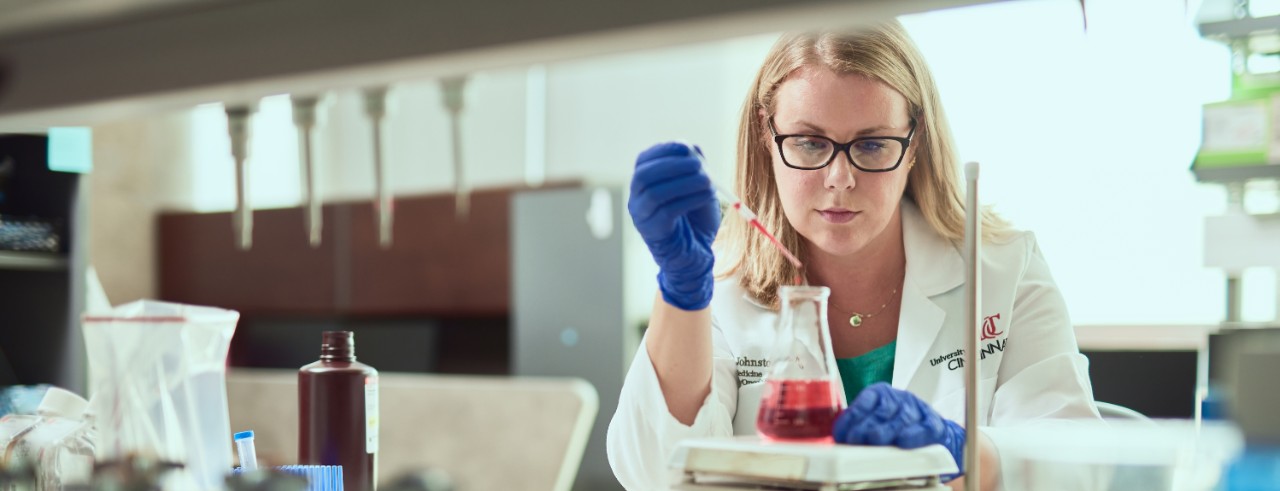
Featured photo at top of Megan Johnstone working in the lab. Photo/UC Health.
Related Stories
UC launches Bearcats Affordability Grant
January 7, 2026
The University of Cincinnati is making college more attainable for students across Ohio with the creation of the Bearcats Affordability Grant. The new grant will provide a pathway to tuition-free college for students of families who make less than $75,000 per year. Beginning in fall 2026, the Bearcats Affordability Grant will cover the remaining cost of tuition for Ohio residents who are Pell eligible.
BearcatGPT AI platform now available to all UC faculty and staff
December 9, 2025
University of Cincinnati Digital Technology Solutions is excited to announce that BearcatGPT, the university’s private, secure AI platform, is now available to all UC faculty and staff.
Sugar overload killing hearts
November 10, 2025
Two in five people will be told they have diabetes during their lifetime. And people who have diabetes are twice as likely to develop heart disease. One of the deadliest dangers? Diabetic cardiomyopathy. But groundbreaking University of Cincinnati research hopes to stop and even reverse the damage before it’s too late.