Fertility podcast highlights UC fibroids research
Biomedical engineers are studying how compressive force influences fibroids

A podcast produced by the American Society for Reproductive Medicine highlighted a new study by the University of Cincinnati that examined the way compressive force influences the growth of fibroid cells.
The podcast Fertility and Sterility on the Air discussed a study by UC College of Engineering and Applied Science Assistant Professor Stacey Schutte published in the journal F&S Science.
In her biomedical engineering lab in UC's Bioscience Center, Schutte and her students are examining the ways that cells respond differently to compressive force or strain. And these insights could give hope to millions of women who deal with painful and ubiquitous fibroids.
Co-host Daylon James, MD, highlighted the study.
“This is a mind-boggling stat for me that 70% of women at some point are affected by fibroids by age 50. That's a huge percentage,“ James said. “From a technical standpoint, I thought this was a real state-of-the-art (study).“
Researchers cultured fibroid cells and healthy myometrium cells from five patients. And they simulated compressive force, identifying 61 genes that were expressed differentially.
“It makes me wonder that maybe we've missed the boat on prevention strategies for fibroids,“ James said.
Schutte's co-authors included UC project coordinator Andreja Moset Zupan, UC doctoral grad Carolyn Nietupski and UC College of Medicine researchers Megan Sax, Emily Hurley and Rose Dean.
Listen to the Fertility and Sterility on the Air episode.
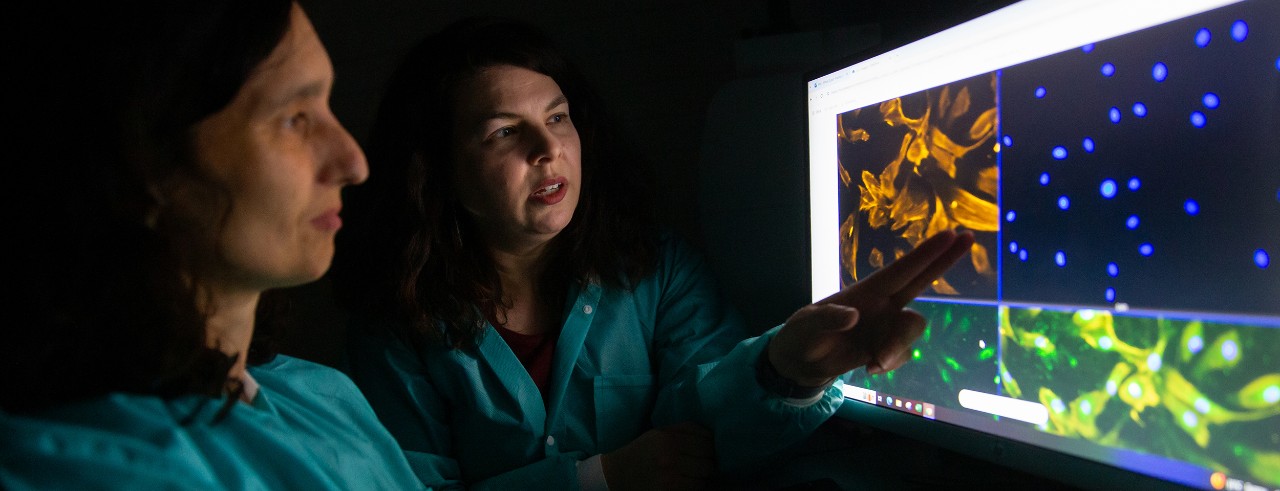
Featured image at top: Assistant Professor Stacey Schutte, right, and Research Associate Andreja Moset Zupan are looking for new treatments for fibroids in Schutte's biomedical engineering lab. Photo/Andrew Higley/UC

UC Assistant Professor Stacey Schutte is studying fibroids in her biomedical engineering lab. Photo/Andrew Higley/UC
Related Stories
Sugar overload killing hearts
November 10, 2025
Two in five people will be told they have diabetes during their lifetime. And people who have diabetes are twice as likely to develop heart disease. One of the deadliest dangers? Diabetic cardiomyopathy. But groundbreaking University of Cincinnati research hopes to stop and even reverse the damage before it’s too late.
Is going nuclear the solution to Ohio’s energy costs?
November 10, 2025

The Ohio Capital Journal recently reported that as energy prices continue to climb, economists are weighing the benefits of going nuclear to curb costs. The publication dove into a Scioto Analysis survey of 18 economists to weigh the pros and cons of nuclear energy. One economist featured was Iryna Topolyan, PhD, professor of economics at the Carl H. Lindner College of Business.
App turns smartwatch into detector of structural heart disease
November 10, 2025

An app that uses an AI model to read a single-lead ECG from a smartwatch can detect structural heart disease, researchers reported at the 2025 Scientific Sessions of the American Heart Association. Although the technology requires further validation, researchers said it could help improve the identification of patients with heart failure, valvular conditions and left ventricular hypertrophy before they become symptomatic, which could improve the prognosis for people with these conditions.