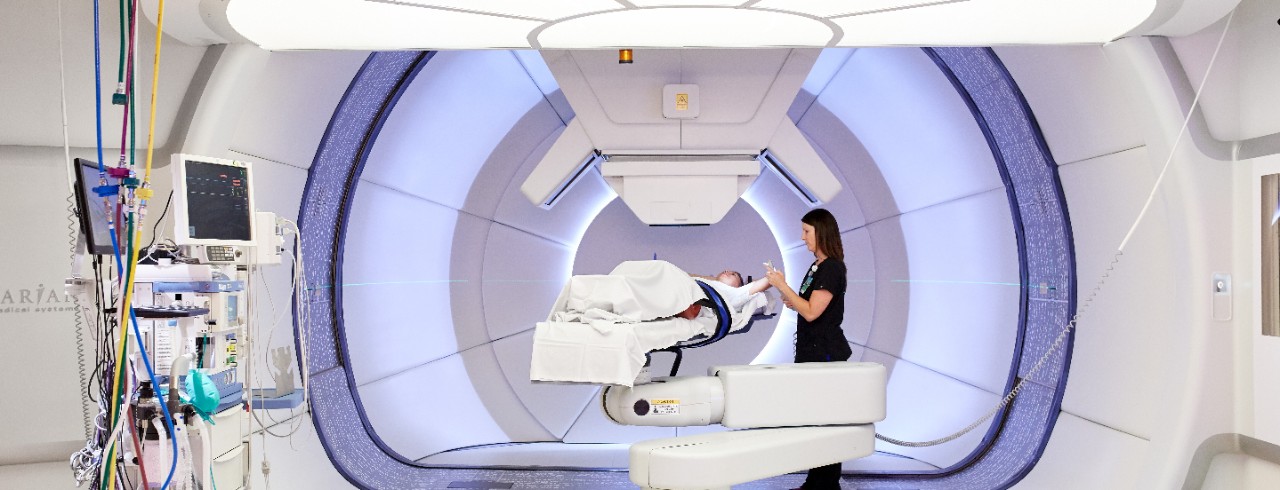
UC Cancer Center, Varian complete Flash radiotherapy trial enrollment
FAST-02 study targets painful bone metastases in the thoracic region


Emily Daugherty, MD. Photo/University of Cincinnati.
Yahoo Finance highlighted Varian's announcement of the successful completion of enrollment and treatment in the FAST-02 clinical trial targeting painful bone metastases in the thoracic region with Flash radiotherapy at the University of Cincinnati Cancer Center. Completion of enrollment represents a significant step toward bringing this investigational radiotherapy treatment into clinical practice.
The trial was conducted at Cincinnati Children’s Hospital/UC Medical Center Proton Therapy Center and enrolled 10 participants. It focused on evaluating treatment-related side effects and the efficacy of treatment, which was assessed using trial participants' reported pain relief.
Flash therapy delivers treatment at ultra-high dose rates in typically less than one second — over 100 times faster than conventional radiation therapy — and has demonstrated potential in preclinical studies to reduce damage to surrounding healthy tissues while maintaining effective tumor control.
The trial builds upon findings from the FAST-01 trial, which evaluated clinical workflow feasibility of Flash therapy and treatment-related side effects for participants with bone metastases in the extremities.
The trial is led by principal investigator John Perentesis, MD, Cancer Center senior advisor, research director of the Proton Therapy Center and director of oncology and cancer programs at Cincinnati Children’s, and lead co-investigator Emily Daugherty, MD, University of Cincinnati Cancer Center physician researcher and adjunct associate professor in UC's College of Medicine.
"Completing treatments for FAST-02 is a pivotal and progressive step in our effort to establish the safety and effectiveness of Flash radiotherapy," Perentesis said. "This trial helps lay the groundwork needed to move Flash into more advanced clinical settings — an innovation that could redefine radiation oncology and meaningfully improve patient outcomes."
UC's FLASH program was initiated by John Breneman, MD, professor emeritus in the Department of Radiation Oncology in UC's College of Medicine. Anthony Mascia, PhD, associate professor in UC's College of Medicine, serves as lead physicist.
Read the Yahoo Finance article, originally published in the Varian newsroom.
Featured photo at top of a mock patient at a treatment gantry in the Proton Therapy Center. Photo/Cincinnati Children's.
Related Stories
Sugar overload killing hearts
November 10, 2025
Two in five people will be told they have diabetes during their lifetime. And people who have diabetes are twice as likely to develop heart disease. One of the deadliest dangers? Diabetic cardiomyopathy. But groundbreaking University of Cincinnati research hopes to stop and even reverse the damage before it’s too late.
Is going nuclear the solution to Ohio’s energy costs?
November 10, 2025

The Ohio Capital Journal recently reported that as energy prices continue to climb, economists are weighing the benefits of going nuclear to curb costs. The publication dove into a Scioto Analysis survey of 18 economists to weigh the pros and cons of nuclear energy. One economist featured was Iryna Topolyan, PhD, professor of economics at the Carl H. Lindner College of Business.
App turns smartwatch into detector of structural heart disease
November 10, 2025

An app that uses an AI model to read a single-lead ECG from a smartwatch can detect structural heart disease, researchers reported at the 2025 Scientific Sessions of the American Heart Association. Although the technology requires further validation, researchers said it could help improve the identification of patients with heart failure, valvular conditions and left ventricular hypertrophy before they become symptomatic, which could improve the prognosis for people with these conditions.