Optimizing emergency care for neurotrauma patients
UC expert featured in Emergency Medicine News article

The University of Cincinnati's Natalie Kreitzer, MD, was featured in an Emergency Medicine News article discussing new practices to optimize emergency care for patients with traumatic brain injuries (TBI).
Kreitzer said one of the most significant updates is the recent availability of blood biomarker tests for mild TBI. The tests measure levels of two proteins released when neurons are injured.
Additionally, measuring pupillary light response with a new small, inexpensive device called a quantitative pupillometer can provide doctors with more precise data to make more informed decisions.
“It's something I would encourage emergency departments to use, particularly because some of those decisions will guide whether the patient is a candidate for surgery or ICP [intracranial pressure] monitoring and other things further down the road, particularly if you're working in an emergency department where you have to transfer those patients out,” said Kreitzer, associate professor in the Department of Emergency Medicine in UC's College of Medicine and a UC Health physician.
Read the Emergency Medicine News article.
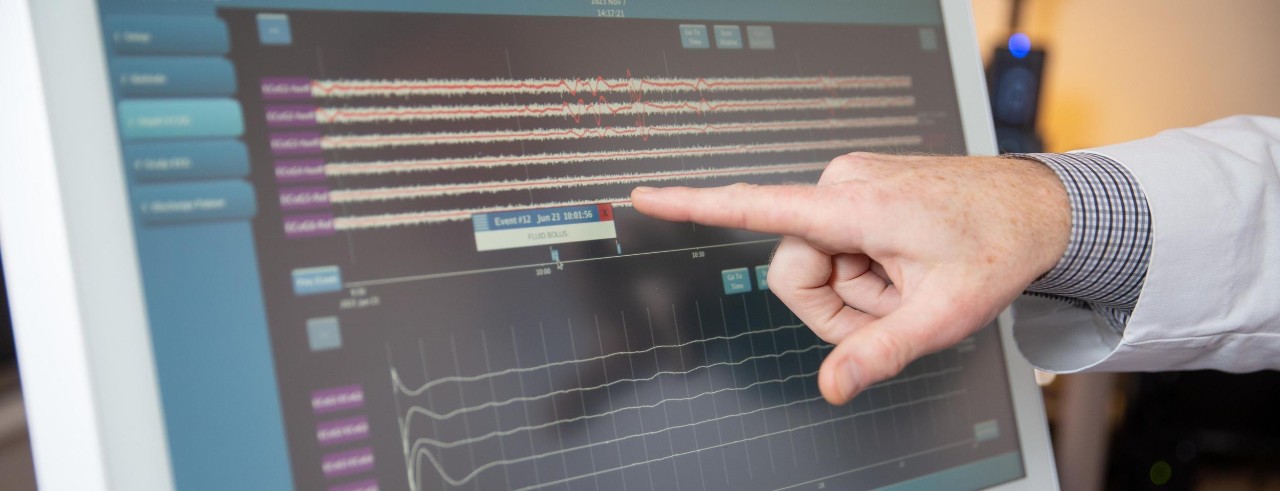
Featured photo at top of a doctor pointing to a data point on a neurotrauma monitor. Photo/Andrew Higley/UC Marketing + Brand.
Related Stories
Sugar overload killing hearts
November 10, 2025
Two in five people will be told they have diabetes during their lifetime. And people who have diabetes are twice as likely to develop heart disease. One of the deadliest dangers? Diabetic cardiomyopathy. But groundbreaking University of Cincinnati research hopes to stop and even reverse the damage before it’s too late.
Is going nuclear the solution to Ohio’s energy costs?
November 10, 2025

The Ohio Capital Journal recently reported that as energy prices continue to climb, economists are weighing the benefits of going nuclear to curb costs. The publication dove into a Scioto Analysis survey of 18 economists to weigh the pros and cons of nuclear energy. One economist featured was Iryna Topolyan, PhD, professor of economics at the Carl H. Lindner College of Business.
App turns smartwatch into detector of structural heart disease
November 10, 2025

An app that uses an AI model to read a single-lead ECG from a smartwatch can detect structural heart disease, researchers reported at the 2025 Scientific Sessions of the American Heart Association. Although the technology requires further validation, researchers said it could help improve the identification of patients with heart failure, valvular conditions and left ventricular hypertrophy before they become symptomatic, which could improve the prognosis for people with these conditions.