Biologist unlocks mechanics of snake motion
New York TV station highlights UC's discoveries about snake locomotion

WWOR-TV highlighted discoveries by the University of Cincinnati about the unique ways that snakes can move.
The program Science Now features interesting discoveries funded by the National Science Foundation. It profiled the work of UC College of Arts and Sciences Professor Bruce Jayne, who has been unlocking the surprising ways limbless reptiles have conquered oceans, deserts, grasslands, forests and suburbia.
In his biology lab, Jayne has documented in detail the many ways that snakes can move:
- Rectilinear: The snake contorts its skin to propel the snake forward in a straight line. This is especially easy to observe in heavy-bodied snakes such as pythons.
- Lateral undulation: This is the side-to-side movement of snakes as if they were traversing a slalom sometimes called serpentine locomotion.
- Sidewinding: Common to some rattlesnakes, this locomotion requires the snake to lift much of its body off the ground to propel it in a sideways direction on loose sand or slippery terrain.
- Concertina: The coiling and uncoiling of snakes like a spring.
- Lasso locomotion: The unique way that some climbing snakes such as brown tree snakes can climb wide cylinders by wrapping themselves around them. Jayne discovered and described this unique behavior in a study published in 2021.
Jayne says there are other variations of these movements that have helped snakes thrive wherever they are found.
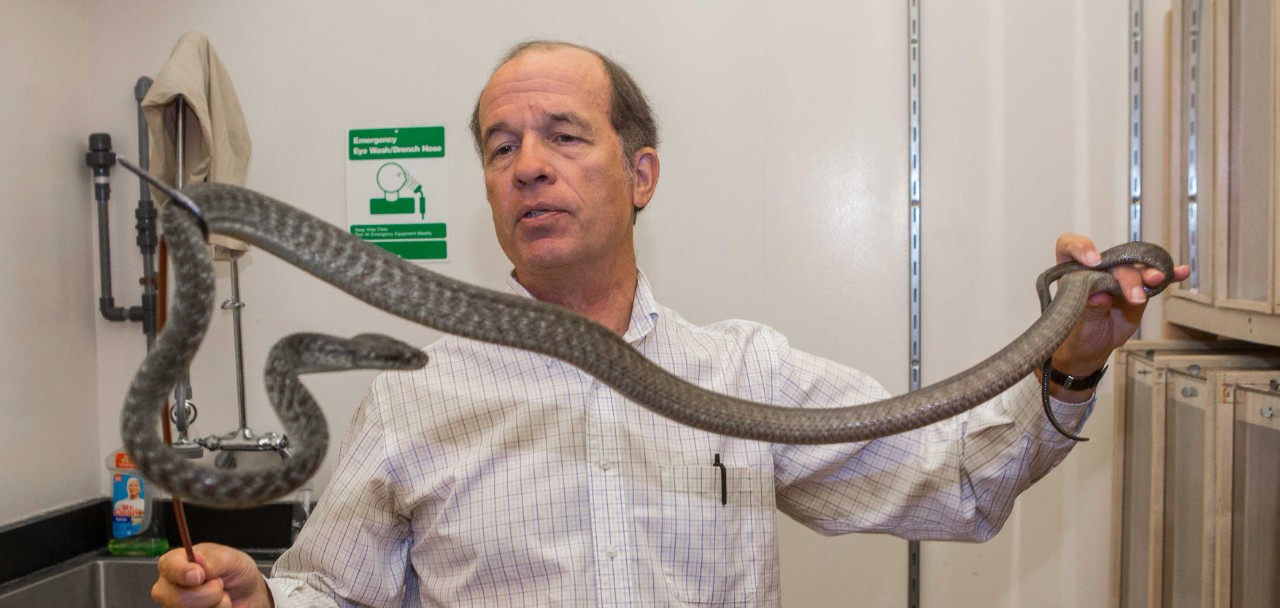
Featured image at top: UC Professor Bruce Jayne works with a brown tree snake. Photo/Joseph Fuqua II/UC

UC College of Arts and Sciences Professor Bruce Jayne studies the amazing abilities of snakes in his biology lab. Photo/Joseph Fuqua II/UC
Related Stories
Sugar overload killing hearts
November 10, 2025
Two in five people will be told they have diabetes during their lifetime. And people who have diabetes are twice as likely to develop heart disease. One of the deadliest dangers? Diabetic cardiomyopathy. But groundbreaking University of Cincinnati research hopes to stop and even reverse the damage before it’s too late.
Is going nuclear the solution to Ohio’s energy costs?
November 10, 2025

The Ohio Capital Journal recently reported that as energy prices continue to climb, economists are weighing the benefits of going nuclear to curb costs. The publication dove into a Scioto Analysis survey of 18 economists to weigh the pros and cons of nuclear energy. One economist featured was Iryna Topolyan, PhD, professor of economics at the Carl H. Lindner College of Business.
App turns smartwatch into detector of structural heart disease
November 10, 2025

An app that uses an AI model to read a single-lead ECG from a smartwatch can detect structural heart disease, researchers reported at the 2025 Scientific Sessions of the American Heart Association. Although the technology requires further validation, researchers said it could help improve the identification of patients with heart failure, valvular conditions and left ventricular hypertrophy before they become symptomatic, which could improve the prognosis for people with these conditions.