Fighting against Florida's most invasive reptile
UC biologist tracks impact of pythons on Florida's wildlife

The ecological news site Planet Forward accompanied snake catcher Donna Kalil on a hunt for one of Florida's most devastating nonnative, invasive species: the Burmese python.
These snakes are believed to have been introduced to Florida's Everglades in the 1980s through releases from the pet trade and the accidental release of snakes after Hurricane Andrew in 1992. Today, they are decimating Florida's native wild animals, according to wildlife surveys by the U.S. Fish and Wildlife Service.

UC Professor Bruce Jayne demonstrates the gape of wild-caught and euthanized Burmese python specimens in his lab. Photo/Bruce Jayne
Planet Forward talked to University of Cincinnati Professor Bruce Jayne about a study he co-authored last year with the Conservancy of Southwest Florida that examined wild-caught snakes in Florida to assess their potential predatory impact on native wildlife.
Jayne studies the many ways snakes move, hunt and consume prey. The size of prey that most snakes can consume is limited in part by what they can swallow, which starts with the gape of their mouths, he said.
Like most snakes, Burmese pythons swallow their prey whole.
“To me, for a long time, what has not been obvious is that clearly, big pythons can eat very big prey. But that doesn’t necessarily mean they’re eating as big prey as they possibly could,” Jayne told Planet Forward.
Jayne teaches biological sciences in UC's College of Arts and Sciences.
Jayne's study found that pythons could consume prey far bigger than previously known, which means more Florida wildlife is on the menu. And this is cause for concern as the invasive snakes spread across the state, he said.
Read the Planet Forward story.
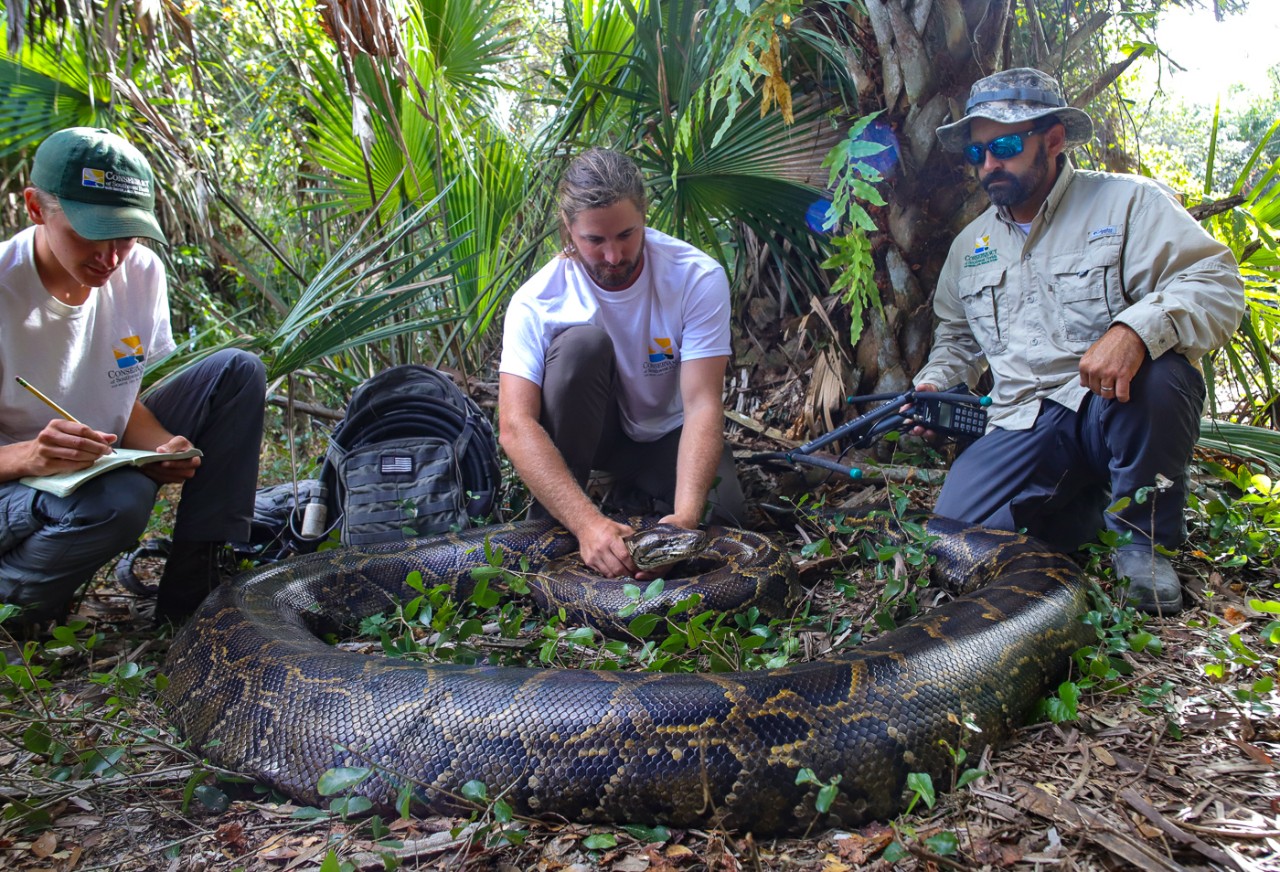
Featured image at top: Researchers with the Conservancy of Southwest Florida capture an enormous Burmese python. Photo/Conservancy of Southwest Florida
More UC Biology in the news

UC Professor Joshua Gross studies blind cavefish in his biology lab. Photo/Andrew Higley/UC Marketing + Brand
- National Geographic: The surprising strategies animals use to survive winter
- Popular Science: This eyeless cavefish grows extra taste buds
- Lake Okeechobee News: Researchers decode genome of insect harmful to citrus growers
Related Stories
Sugar overload killing hearts
November 10, 2025
Two in five people will be told they have diabetes during their lifetime. And people who have diabetes are twice as likely to develop heart disease. One of the deadliest dangers? Diabetic cardiomyopathy. But groundbreaking University of Cincinnati research hopes to stop and even reverse the damage before it’s too late.
Is going nuclear the solution to Ohio’s energy costs?
November 10, 2025

The Ohio Capital Journal recently reported that as energy prices continue to climb, economists are weighing the benefits of going nuclear to curb costs. The publication dove into a Scioto Analysis survey of 18 economists to weigh the pros and cons of nuclear energy. One economist featured was Iryna Topolyan, PhD, professor of economics at the Carl H. Lindner College of Business.
App turns smartwatch into detector of structural heart disease
November 10, 2025

An app that uses an AI model to read a single-lead ECG from a smartwatch can detect structural heart disease, researchers reported at the 2025 Scientific Sessions of the American Heart Association. Although the technology requires further validation, researchers said it could help improve the identification of patients with heart failure, valvular conditions and left ventricular hypertrophy before they become symptomatic, which could improve the prognosis for people with these conditions.