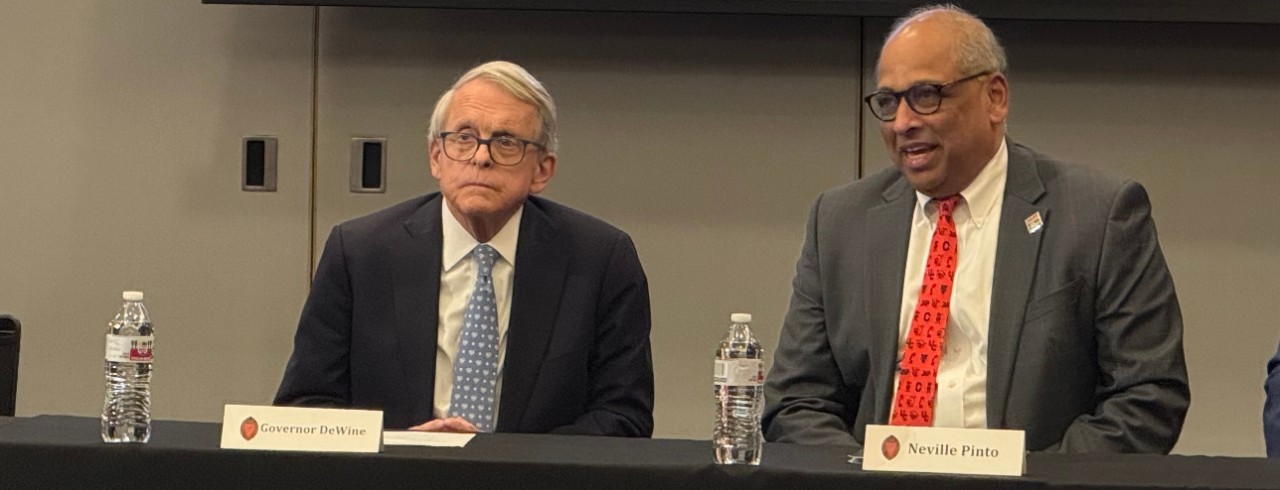
Ohio Gov. Mike DeWine visits UC to learn more about success of co-op
UC founded co-op in 1906 and is ranked in the top 5 programs nationally

Ohio Governor Mike DeWine visited the University of Cincinnati Feb. 5 for a roundtable discussion on the benefits of work-based learning opportunities, otherwise known as cooperative education, or co-op. This is a key component of Governor DeWine's executive budget.
The Governor met with university leadership, including President Neville G. Pinto, PhD, students and regional employers to discuss UC’s co-op program. The co-op model was invented at UC more than 100 years ago and connects students with employers, providing an opportunity for them to gain firsthand experience with in-demand jobs as part of their education experience.
Students who participate in UC’s co-op program spend one semester studying on campus and the next semester working in their professional field, earning cash while they’re learning.
In the 2023-24 academic year, more than 8,300 students earned an estimated $88.8 million collectively through paid co-op experiences, according to self-reported data. That averages to nearly $10,700 per student per semester.
It’s an 18% increase in wages from the last reported co-op data.
“Co-ops are transformative for our students who apply what they have learned in the classroom to real-world experiences,” said UC President Neville Pinto. “As an added bonus, earning while learning goes a long way toward easing the financial burden on students and families."

Jeremy Jarrett, Kinetic Vision CEO and UC alum, is a champion for UC's co-op program as a former co-op of the company himself. “I started here and took different assignments along the way,” Jarrett says. “I guess you could say my first co-op job got me to where I am as president.” Photo credit/Andrew Higley/UC Marketing + Brand.
Kinetic Vision, GE and Western & Southern were among the business partners represented around the table.
The Governor’s proposed executive budget requires all state colleges and universities to offer a dedicated work-based learning program.
“Work-based learning opportunities like co-ops, internship or externship programs are a win-win for students, colleges and employers,” said Governor DeWine. “Many of these roles are paid, giving students the chance to earn money while also getting the real-world experience that will prepare them to excel as they launch their career.”
Michelle Clare, dean of the College of Cooperative Education and Professional Studies, where the co-op program is housed, spoke to Fox 19, stating it's nice to see that the work being put into the program is recognized.
“We have a group of professionals that are really dedicated to early student development and workforce development so it means a lot that the state acknowledges that work and sees the value in it,” she said.
Read more about the Governor's plan.
Media coverage:
Beyond the Classroom
UC invented cooperative education more than 100 years ago, and we continue to innovate all aspects of experience-based learning, including internships, service learning, virtual co-ops, community projects and industry partnerships. Learn more.
Tags
- Impact
- 1819 Innovation Hub
- Experience-based Learning
- Student Experience
- Academic Excellence
- College of Cooperative Education and Professional Studies
- In The News
- College of Design, Architecture, Art, and Planning
- President's Office
- Lindner College of Business
- Admissions
- Next Lives Here
- College of Engineering and Applied Science
Related Stories
UC launches Bearcats Affordability Grant
January 7, 2026
The University of Cincinnati is making college more attainable for students across Ohio with the creation of the Bearcats Affordability Grant. The new grant will provide a pathway to tuition-free college for students of families who make less than $75,000 per year. Beginning in fall 2026, the Bearcats Affordability Grant will cover the remaining cost of tuition for Ohio residents who are Pell eligible.
BearcatGPT AI platform now available to all UC faculty and staff
December 9, 2025
University of Cincinnati Digital Technology Solutions is excited to announce that BearcatGPT, the university’s private, secure AI platform, is now available to all UC faculty and staff.
Lindner graduate students shine in international simulation competition
November 10, 2025
Five master’s of information systems (MS IS) students took home fifth place out of 23 universities at the International ERPsim Competition hosted by HEC Montreal during the recent spring semester. The competition tests students’ knowledge of enterprise resource planning (ERP) software and their ability to adapt to challenging business problems.