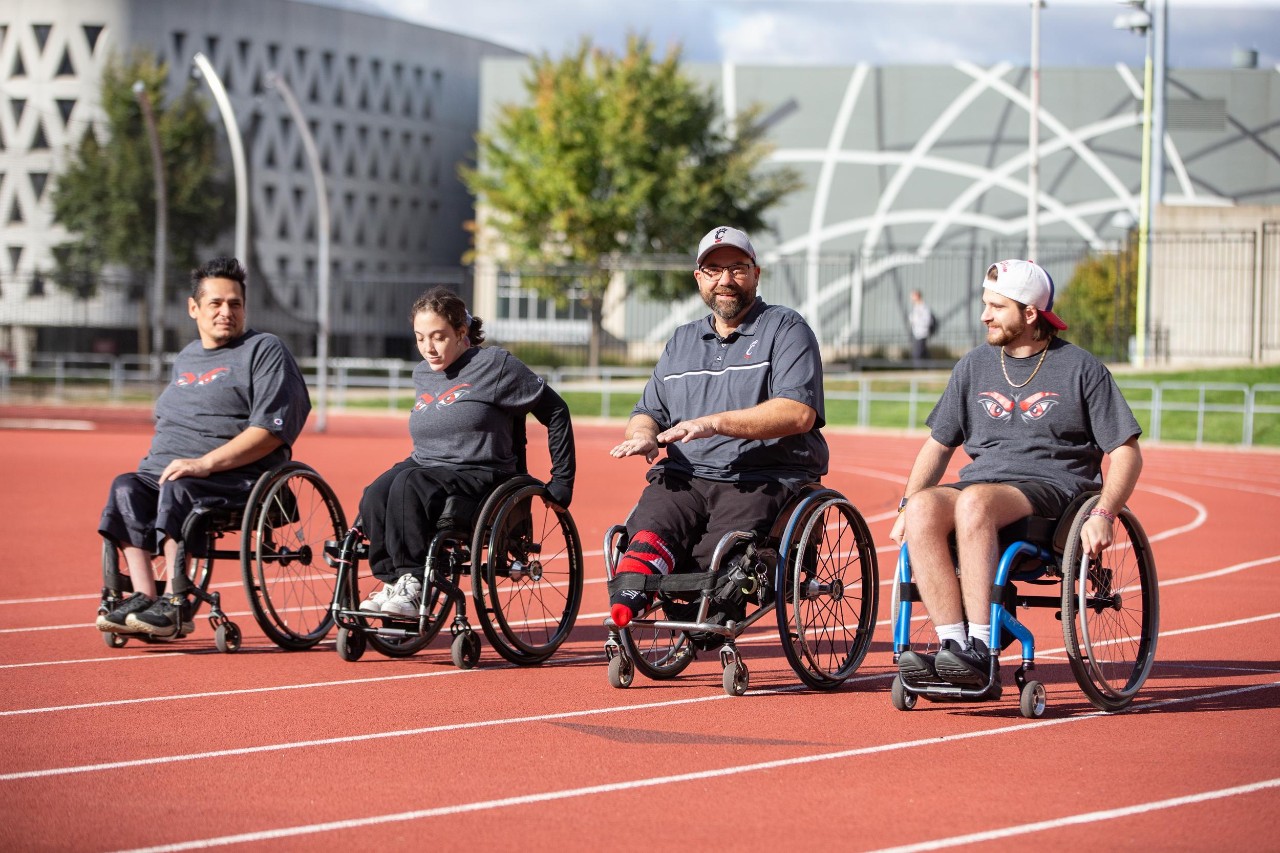
UC starts adaptive athletics program
Program director and coach speaks with Columbus Public Radio

Program director and coach Jacob Counts spoke with WOSU Columbus Public Radio about the new UC Adaptive Athletics program that gives the opportunity for athletes with disabilities to compete in collegiate sports.
Counts said the need for a college-level program became more apparent as the adaptive sports community has grown in Cincinnati. UC faculty members Victoria Heasley, MeMe Earnest-Stanley and Danny Meyer were among the cofounders of nonprofit The Bridge Adaptive Sports & Recreation along with Counts and connected with Heidi Pettyjohn, executive director of UC Accessibility Resources, to work toward launching the program.
"They saw the need of a collegiate adaptive sports program, because we were getting to a point in Cincinnati where we're producing a lot of really good high school athletes and then sending them off to other colleges like Arizona and Alabama and Michigan and Illinois,” Counts told WOSU. “So, we were basically exporting our talent."
The program has launched with adaptive track and field and adaptive tennis with four student athletes, and Counts said he is hoping to expand to around 30 student athletes and potentially other sports within the next five years.
"It's really important to give us disabled athletes the same opportunities that they're able-bodied peers have,” said Counts. “College is definitely a great place for a young person to grow academically and as a person, but it's also crucial for athletic success. Those are years where athletes really develop their skills and prepare to take the next step.”
Listen to or read the WOSU interview and story.
WVXU and The Ohio Newsroom also highlighted the new program. Listen to or read The Ohio Newsroom story.
Read more about UC Adaptive Athletics.
Featured photo at top: Left to right: UC student-athletes Jaime Mazzi and Logan Cover, UC Adaptive Athletics Coach Jacob Counts and student-athlete Seth Miller. Photo/Andrew Higley/UC Marketing + Brand.
Related Stories
Sugar overload killing hearts
November 10, 2025
Two in five people will be told they have diabetes during their lifetime. And people who have diabetes are twice as likely to develop heart disease. One of the deadliest dangers? Diabetic cardiomyopathy. But groundbreaking University of Cincinnati research hopes to stop and even reverse the damage before it’s too late.
Is going nuclear the solution to Ohio’s energy costs?
November 10, 2025

The Ohio Capital Journal recently reported that as energy prices continue to climb, economists are weighing the benefits of going nuclear to curb costs. The publication dove into a Scioto Analysis survey of 18 economists to weigh the pros and cons of nuclear energy. One economist featured was Iryna Topolyan, PhD, professor of economics at the Carl H. Lindner College of Business.
App turns smartwatch into detector of structural heart disease
November 10, 2025

An app that uses an AI model to read a single-lead ECG from a smartwatch can detect structural heart disease, researchers reported at the 2025 Scientific Sessions of the American Heart Association. Although the technology requires further validation, researchers said it could help improve the identification of patients with heart failure, valvular conditions and left ventricular hypertrophy before they become symptomatic, which could improve the prognosis for people with these conditions.