Research team aims to simplify the mammography process for patients
National media highlight College of Medicine, DAAP collaborative project

MSN, Becker's Hospital Review and a San Francisco television station highlighted a multidisciplinary project from the University of Cincinnati’s Colleges of Medicine and Design, Architecture, Art and Planning that took a human-centered design approach to identify and implement tangible patient-centered improvements in the screening mammography program.
The collaborative team sought to identify areas of the mammography process that cause anxiety for patients and implement design solutions to reduce this anxiety.
“We had seen this as something that we know is anxiety-provoking for women,” said Ann Brown, MD, associate professor of radiology at the UC College of Medicine and a UC Health breast radiologist. “We found we do very well in terms of sending reminders but not so well in terms of what are the next steps for patients.”
After identifying pain points, much of the work focused on improving or adding features to patient dashboards on MyChart, the online platform where patients can schedule appointments, message their providers and view test results.
“One of the biggest things we focused on was how we’re utilizing technology, since people are now relying on their devices and accessing their health care information using the online MyChart tools,” Brown said. “With the release of patients now being able to read their own reports, we realized we need to have a better system whereby patients can understand those reports.”
Read the Becker's Hospital Review article.
Watch Brown's segment on San Francisco's KTVU morning show.
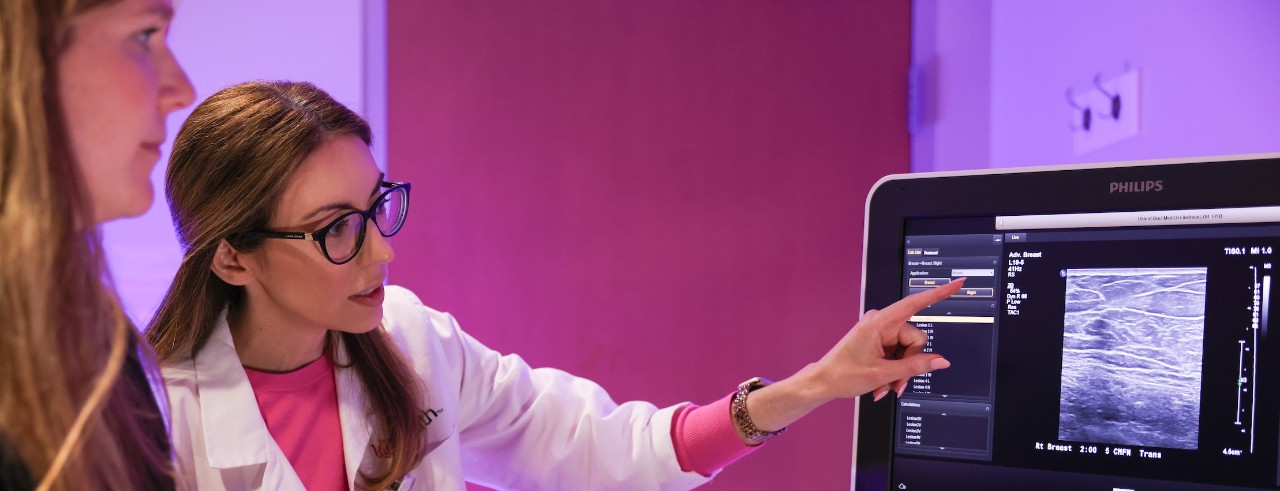
Featured photo at top of Ann Brown and a colleague reviewing a mammography image. Photo/UC Health.
Related Stories
Sugar overload killing hearts
November 10, 2025
Two in five people will be told they have diabetes during their lifetime. And people who have diabetes are twice as likely to develop heart disease. One of the deadliest dangers? Diabetic cardiomyopathy. But groundbreaking University of Cincinnati research hopes to stop and even reverse the damage before it’s too late.
Is going nuclear the solution to Ohio’s energy costs?
November 10, 2025

The Ohio Capital Journal recently reported that as energy prices continue to climb, economists are weighing the benefits of going nuclear to curb costs. The publication dove into a Scioto Analysis survey of 18 economists to weigh the pros and cons of nuclear energy. One economist featured was Iryna Topolyan, PhD, professor of economics at the Carl H. Lindner College of Business.
App turns smartwatch into detector of structural heart disease
November 10, 2025

An app that uses an AI model to read a single-lead ECG from a smartwatch can detect structural heart disease, researchers reported at the 2025 Scientific Sessions of the American Heart Association. Although the technology requires further validation, researchers said it could help improve the identification of patients with heart failure, valvular conditions and left ventricular hypertrophy before they become symptomatic, which could improve the prognosis for people with these conditions.