This UC professor's nanoparticle research could help treat hearing loss better
WVXU highlights NIH-funded study

WVXU highlighted the University of Cincinnati's Daniel Sun, who is studying the potential of using magnetic nanoparticles as a delivery system for drugs to reach the inner ear to treat hearing loss.
Aside from often ineffective steroids, there are currently no drugs approved by the Food and Drug Administration to treat hearing loss. While progress is being made on new treatments, getting these medications into the inner ear, where hearing loss occurs, is a major hurdle.
"I like to make the analogy of launching astronauts into space," Sun, MD, the Myles L. Pensak, MD, Endowed Professor in Neurotology and Skull Base Surgery, director of the Division of Neurotology, neurotology fellowship program director and associate professor of otolaryngology in the University of Cincinnati College of Medicine, and a UC Health physician, told WVXU. "We need to not only understand how the spaceship that the astronaut sits in works, but also systematically design the rocket itself so that it can lift the capsule into space. What we work on is designing the rocket that can get these medications into the ear."
Funded by a career development award of just more than $1 million from the National Institutes of Health’s National Institute on Deafness and Other Communication Disorders, Sun and colleagues are studying how magnetic nanoparticles might be used to carry and steer medications to the parts of the ear where the hearing loss is occurring. He says they've been able to design specialized nanoparticles that can penetrate the ear while carrying and delivering some of these newer medications.
"One specific advantage with using these kind of nanoparticles is that they could be administered in a very minimally invasive way," Sun said. "Rather than having to administer these medications through a very delicate surgical procedure in the inner ear that requires general anesthesia and may have risks to further hearing loss, these nanoparticles with the medications they carry could potentially be just injected in a clinic and then penetrate into the inner ear without need for surgery or anesthesia."
Watch or listen to the WVXU story.
Sun also discussed the research with the This Week in Hearing podcast and the Broadcast Retirement Network.
Watch or listen to the This Week in Hearing interview.
Watch the Broadcast Retirement Network segment.
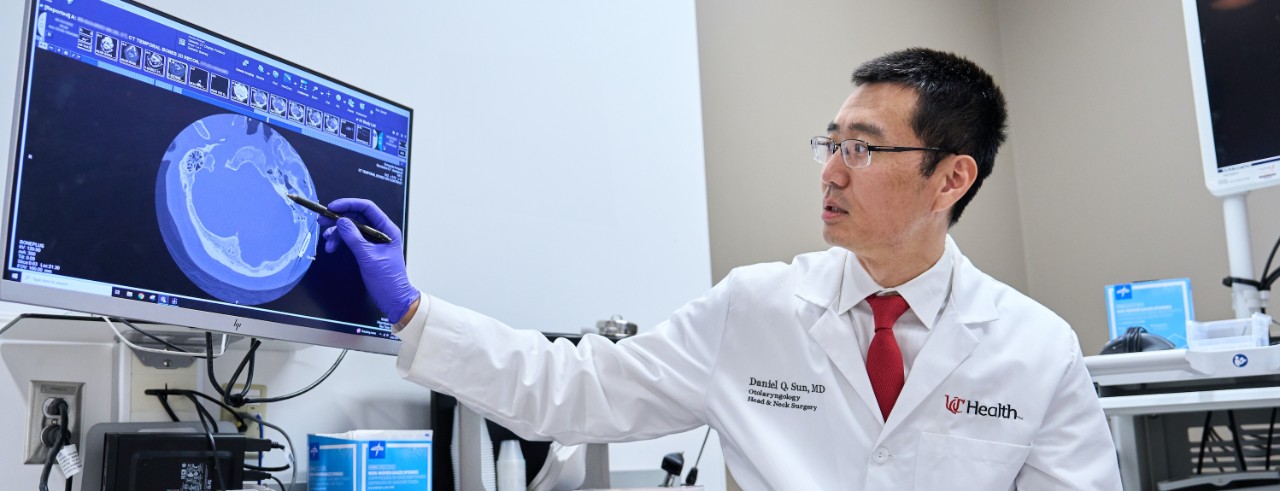
Featured photo at top of Sun pointing to a scan on a monitor. Photo/UC Health.
Sun was initially awarded this grant while at Johns Hopkins University and transferred the grant when he joined the faculty at UC.
Related Stories
Sugar overload killing hearts
November 10, 2025
Two in five people will be told they have diabetes during their lifetime. And people who have diabetes are twice as likely to develop heart disease. One of the deadliest dangers? Diabetic cardiomyopathy. But groundbreaking University of Cincinnati research hopes to stop and even reverse the damage before it’s too late.
Is going nuclear the solution to Ohio’s energy costs?
November 10, 2025

The Ohio Capital Journal recently reported that as energy prices continue to climb, economists are weighing the benefits of going nuclear to curb costs. The publication dove into a Scioto Analysis survey of 18 economists to weigh the pros and cons of nuclear energy. One economist featured was Iryna Topolyan, PhD, professor of economics at the Carl H. Lindner College of Business.
App turns smartwatch into detector of structural heart disease
November 10, 2025

An app that uses an AI model to read a single-lead ECG from a smartwatch can detect structural heart disease, researchers reported at the 2025 Scientific Sessions of the American Heart Association. Although the technology requires further validation, researchers said it could help improve the identification of patients with heart failure, valvular conditions and left ventricular hypertrophy before they become symptomatic, which could improve the prognosis for people with these conditions.