UC hosts camp for children, teens who stutter
People who stutter just need more time to communicate, Fox 19 reports

Children and teens who stutter have learned skills to help them communicate effectively, advocate for themselves and develop confidence about their communication abilities during a weeklong camp at the University of Cincinnati, Fox 19 reported.
This is the first year that Camp Dream. Speak. Live. has been hosted in Cincinnati. The camp, which was developed a decade ago at the University of Texas at Austin, is open to children between the ages of 4 and 17.
“Really what stuttering is is just a different way of communicating,” said Katie Winters, PhD, an assistant professor in UC’s College of Allied Health Sciences. “It's a different way of talking where the way in which the brain communicates with the articulators — so the lips, the tongue, the parts of our body that produce speech sounds — is different for folks who stutter compared to folks who don't stutter.”
When we ask people who stutter to slow down or think about what they want to say, it can be really frustrating because they do know what they want to say. What they're really asking for is more time in which to say it.
Katie Winters, PhD Assistant professor in UC’s College of Allied Health Sciences
While many people associate stuttering with nervousness, it's actually a neurophysiological communication disability that affects approximately 3 million people in the United States.
“When we're listening to people who stutter, we hear them repeat sounds, prolong sounds or have what's called blocks,” Winters said. “But for the speaker themselves, what they often experience is this loss of control during speech.”
Each day at the camp, Winters and her staff, which includes UC students, model effective communication and ways to navigate situations with peers and adults. Children and teens participate in these direct-teach activities, engage with members of the community who support the intervention and reflect on their experiences throughout the program.
“When we ask people who stutter to slow down or think about what they want to say, it can be really frustrating because they do know what they want to say,” Winters said. “What they're really asking for is more time in which to say it.”
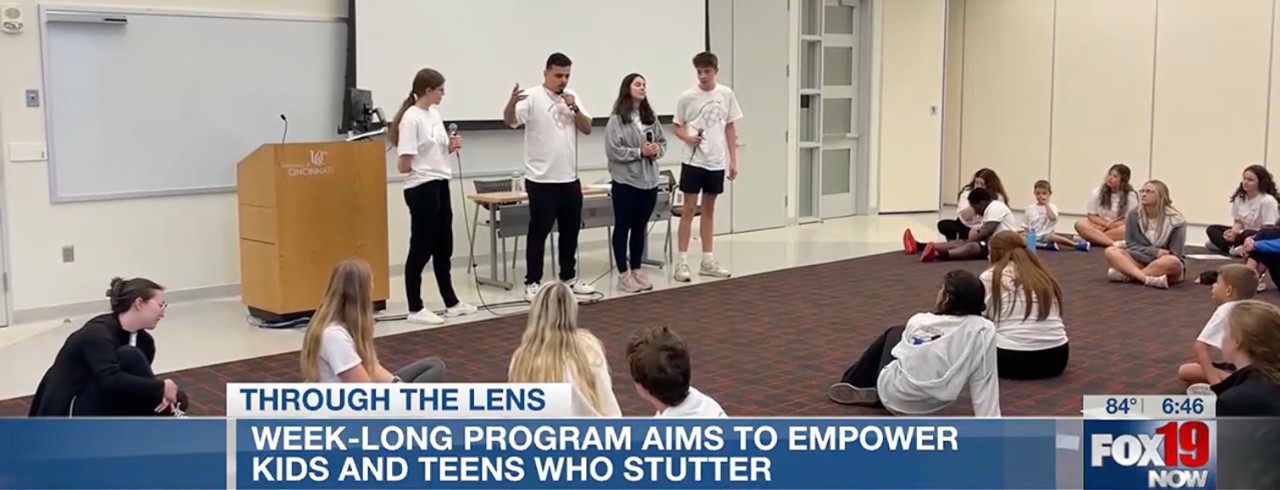
Featured image at top: DJ Juan Cortez and UC students demonstrate effective communicate strategies to children and teens who stutter at Camp Dream. Speak. Live. in Cincinnati. Photo/Fox 19
Impact Lives Here
The University of Cincinnati is leading public urban universities into a new era of innovation and impact. Our faculty, staff and students are saving lives, changing outcomes and bending the future in our city's direction. Next Lives Here.
Related Stories
Sugar overload killing hearts
November 10, 2025
Two in five people will be told they have diabetes during their lifetime. And people who have diabetes are twice as likely to develop heart disease. One of the deadliest dangers? Diabetic cardiomyopathy. But groundbreaking University of Cincinnati research hopes to stop and even reverse the damage before it’s too late.
Is going nuclear the solution to Ohio’s energy costs?
November 10, 2025

The Ohio Capital Journal recently reported that as energy prices continue to climb, economists are weighing the benefits of going nuclear to curb costs. The publication dove into a Scioto Analysis survey of 18 economists to weigh the pros and cons of nuclear energy. One economist featured was Iryna Topolyan, PhD, professor of economics at the Carl H. Lindner College of Business.
App turns smartwatch into detector of structural heart disease
November 10, 2025

An app that uses an AI model to read a single-lead ECG from a smartwatch can detect structural heart disease, researchers reported at the 2025 Scientific Sessions of the American Heart Association. Although the technology requires further validation, researchers said it could help improve the identification of patients with heart failure, valvular conditions and left ventricular hypertrophy before they become symptomatic, which could improve the prognosis for people with these conditions.