WVXU: Find your CPAP annoying? UC researchers are working on a more comfortable device
Dr Liran Oren of the UC College of Medicine discusses the VortexPAP

Sleep apnea if left unchecked can lead to an increased risk in cardiovascular and metabolic health.
Nearly 40 million Americans have obstructive sleep apnea, according to the Council on Aging, and some 33 million use a CPAP machine. Obstructive sleep apnea occurs when air can’t move into or out of the nose or mouth, even when individuals are trying to breathe.
CPAP devices are highly effective — the problem is a lot of people find the masks uncomfortable. Dr. Liran Oren, a research associate professor in the UC College of Medicine’s Department of Otolaryngology, Head and Neck Surgery, thinks he might have a new solution.
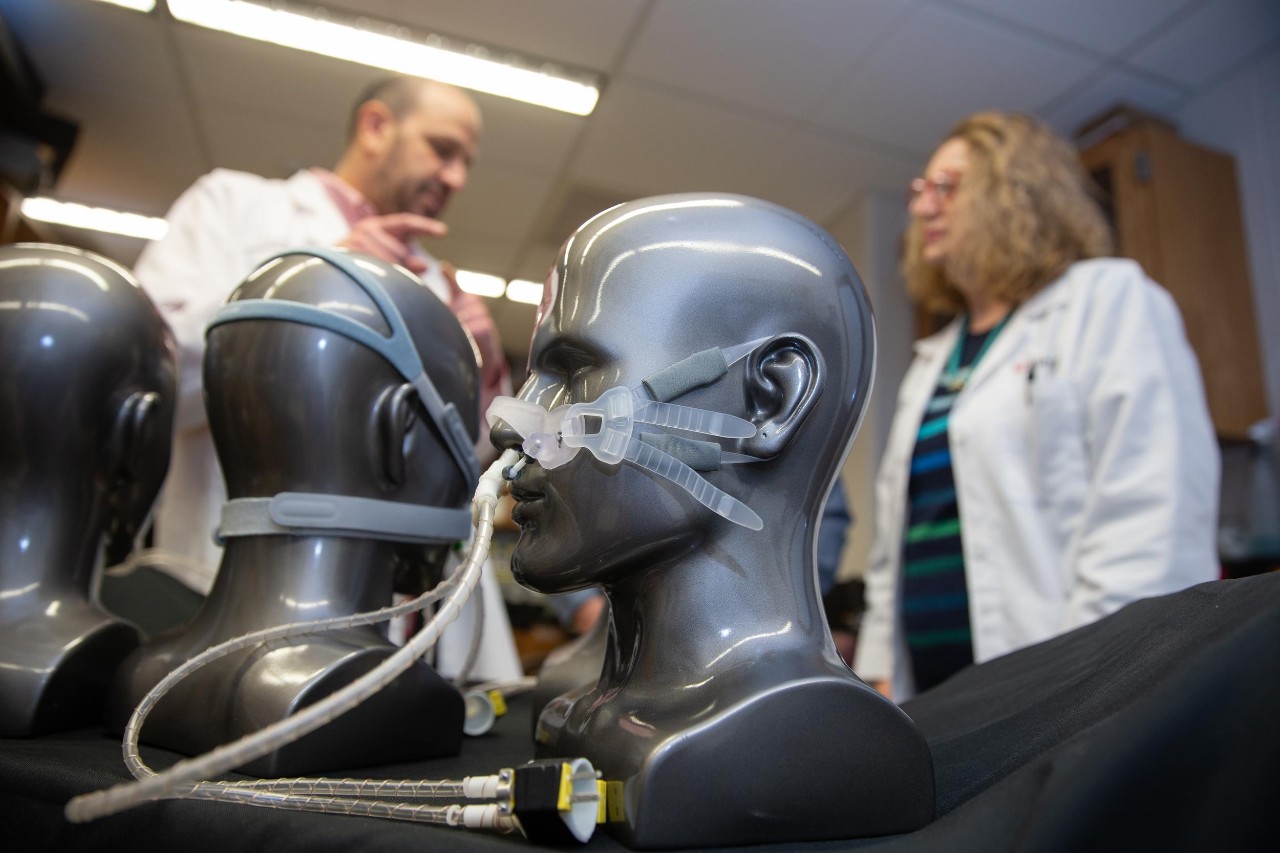
Oren is part of a research team at the University of Cincinnati developing a VortexPAP machine that takes advantage of vortex airflow technology. A preliminary clinical study with current CPAP users demonstrated that the VortexPAP can deliver the pressure levels that are used in the subjects’ CPAP therapy, but the mask is more comfortable to wear. It has a minimalistic design that is less intrusive and barely touches the patient’s face.
Oren spoke with WVXU for a segment on Vortex PAP.
Instead of having a continuous airflow, the VortexPAP pulsates the airflow and each pulse is made out of a vortex, Oren told WVXU. It's similar to when someone blows a smoke ring. The air is forcefully pushed out and you can see the ring float across the room. However, if they just exhale, the smoke stays around the face.
"The aerodynamics of that ring is very different compared to continuous airflow,” Oren told WVXU. “What we're doing is basically shooting this train of vortices into your nose, instead of having continuous airflow. The aerodynamics are very different; we can actually pressurize the airway in the same manner as CPAP devices, we just don't need the seal anymore.”
Listen to the WVXU segment online.
Research on the VortexPAP was also part of a segment on Spectrum News.
Learn more about Dr. Liran Oren’s work with the VortexPAP online.
Featured top image showing a VortexPAP device on the face of a mannequin in a laboratory in the UC College of Medicine.
Related Stories
Sugar overload killing hearts
November 10, 2025
Two in five people will be told they have diabetes during their lifetime. And people who have diabetes are twice as likely to develop heart disease. One of the deadliest dangers? Diabetic cardiomyopathy. But groundbreaking University of Cincinnati research hopes to stop and even reverse the damage before it’s too late.
Is going nuclear the solution to Ohio’s energy costs?
November 10, 2025

The Ohio Capital Journal recently reported that as energy prices continue to climb, economists are weighing the benefits of going nuclear to curb costs. The publication dove into a Scioto Analysis survey of 18 economists to weigh the pros and cons of nuclear energy. One economist featured was Iryna Topolyan, PhD, professor of economics at the Carl H. Lindner College of Business.
App turns smartwatch into detector of structural heart disease
November 10, 2025

An app that uses an AI model to read a single-lead ECG from a smartwatch can detect structural heart disease, researchers reported at the 2025 Scientific Sessions of the American Heart Association. Although the technology requires further validation, researchers said it could help improve the identification of patients with heart failure, valvular conditions and left ventricular hypertrophy before they become symptomatic, which could improve the prognosis for people with these conditions.