UC joins clinical trial to test treatment for abdominal injury
Injectable foam provides more time to get patients to life-saving surgery

Researchers at the University of Cincinnati are part of a clinical study for ResQFoam, a new device for the treatment of life-threatening abdominal internal bleeding. UC Medical Center is one of a handful of Level I Trauma Centers in the United States selected to participate in the multicenter Reducing Exsanguination Via In‐Vivo Expandable Foam (REVIVE) study.
ResQFoam is an injectable biomaterial that expands within the abdomen, providing pressure on internal organs to stop bleeding. That provides enough time to get the patient into the operating room, where the foam is easily removed prior to surgery.
The objective of the REVIVE study is to demonstrate the safety, effectiveness and benefit-risk profile of ResQFoam for the in-hospital treatment of severe internal abdominal bleeding and shock as the result of a traumatic injury.
We hope to demonstrate that this foam can safely and effectively be used to help save lives, both in the hospital and on the battlefield
Timothy Pritts, MD
ResQFoam was developed by Arsenal Medical, a medical technology company, with funding from the U.S. Department of Defense.
Patients enrolled in this study will be closely monitored for the first 30 days of their hospital visit. Pritts and his team will examine patient outcomes to determine the risks and benefits of the device in trauma patients.
The trauma physician will determine if incoming patients are possible candidates for this study and will enroll the patient if they are considered a good candidate. Unlike traditional clinical studies, this study will require the physicians to begin experimental emergency treatment without first obtaining an informed consent from the patient or a legal representative and/or family member.
All reasonable attempts will be made to contact a family member to discuss this study and obtain their permission for the patient to be in the study. All studies are voluntary and the patient or family members can decide at any time to withdraw from the study if they choose. Those who do not wish to take part in the study may opt out by requesting an embossed wristband.
“We hope to demonstrate that this foam can safely and effectively be used to help save lives, both in the hospital and on the battlefield,” said Timothy Pritts, MD, professor in the Division of Trauma Critical Care and Acute Care Surgery in the Department of Surgery at the UC College of Medicine and chief of the section of general surgery at UC Medical Center, and principal investigator of the study.
Within 30 minutes of arrival in the emergency department, a determination will be made to enroll a patient in the study. At that point, enrolled participants will receive an abdominal injection of two liquid polymers that react when they come in contact with each other, forming a foam that rapidly expands and molds to the anatomy. It is easily removed when the patient undergoes surgery to repair the traumatic injury. Those not enrolled in the study will receive current standard treatment for abdominal traumatic injuries.
Anyone with questions regarding this study or who would like to obtain an embossed wristband to opt out of the trial can contact the REVIVE Study Hotline at 513-558-6332 or at REVIVE@uc.edu.
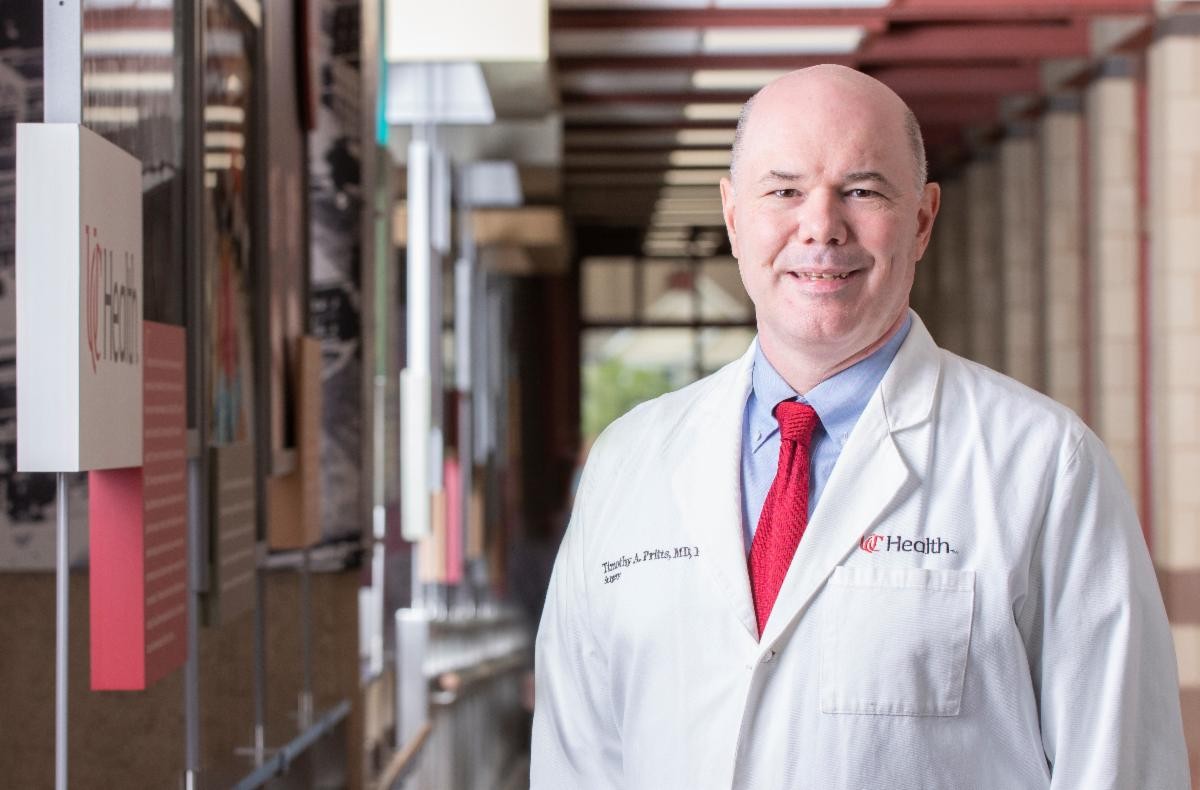
Lead Photo of Timothy Pritts, MD/Colleen Kelley/UC Marketing + Brand
Next Lives Here
The University of Cincinnati is classified as a Research 1 institution by the Carnegie Commission and is ranked in the National Science Foundation's Top-35 public research universities. UC's graduate students and faculty investigate problems and innovate solutions with real-world impact. Next Lives Here.
Related Stories
UC launches Bearcats Affordability Grant
January 7, 2026
The University of Cincinnati is making college more attainable for students across Ohio with the creation of the Bearcats Affordability Grant. The new grant will provide a pathway to tuition-free college for students of families who make less than $75,000 per year. Beginning in fall 2026, the Bearcats Affordability Grant will cover the remaining cost of tuition for Ohio residents who are Pell eligible.
Sugar overload killing hearts
November 10, 2025
Two in five people will be told they have diabetes during their lifetime. And people who have diabetes are twice as likely to develop heart disease. One of the deadliest dangers? Diabetic cardiomyopathy. But groundbreaking University of Cincinnati research hopes to stop and even reverse the damage before it’s too late.
App turns smartwatch into detector of structural heart disease
November 10, 2025

An app that uses an AI model to read a single-lead ECG from a smartwatch can detect structural heart disease, researchers reported at the 2025 Scientific Sessions of the American Heart Association. Although the technology requires further validation, researchers said it could help improve the identification of patients with heart failure, valvular conditions and left ventricular hypertrophy before they become symptomatic, which could improve the prognosis for people with these conditions.