CNN: Fossil could help solve evolutionary mystery
UC expert says discovery of new mosasaur helps us understand prehistoric oceans

CNN turned to a University of Cincinnati biology professor to explain the significance of the discovery of a new species of mosasaur found in 2015 in North Dakota.
UC College of Arts and Sciences Associate Professor Takuya Konishi is an expert in mosasaurs, marine reptiles that ruled ancient oceans as apex predators for millions of years about 70 million years ago. This animal was the surprise hero of the blockbuster film “Jurassic World.”
A team of researchers led by Amelia Zietlow with the American Museum of Natural History described a new species of mosasaur they called Jormungandr walhallaensis, named for a Norse myth about an enormous serpent that dwelled in the land of Midgard.
The mosasaur was about 24 feet long with features resembling different types of marine reptile that defied easy classification. The findings were published in the journal Bulletin of the American Museum of Natural History.
Konishi, who was not part of the study, told CNN that the process of fossilization can sometimes distort bone, making it more difficult to conceive what the animal looked like before it died.
“Just how distinct J. walhallaensis is from (the other species) has yet to be investigated further,” Konishi told CNN.
But we still have much to learn about these ancient marine reptiles, Konishi said, and studies such as Zietlow's are unlocking secrets about their rich diversity on the planet during the Cretaceous.
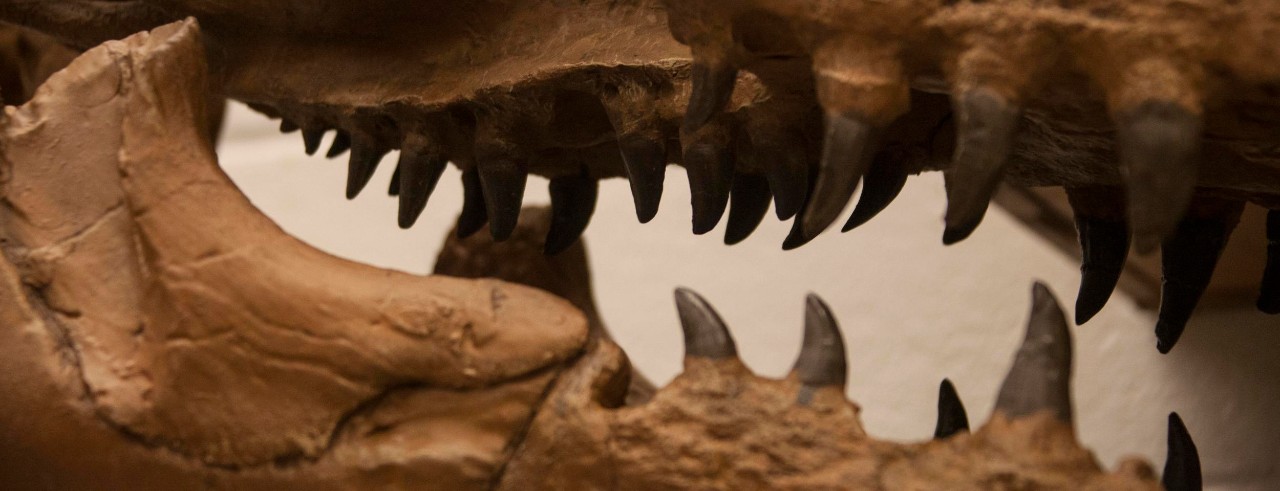
Featured image at top: The fearsome maw of a mosasaur. Photo/Ravenna Rutledge/UC

UC Associate Professor Takuya Konishi is an expert on ancient marine reptiles called mosasaurs. Photo/Joseph Fuqua II/UC
Related Stories
Sugar overload killing hearts
November 10, 2025
Two in five people will be told they have diabetes during their lifetime. And people who have diabetes are twice as likely to develop heart disease. One of the deadliest dangers? Diabetic cardiomyopathy. But groundbreaking University of Cincinnati research hopes to stop and even reverse the damage before it’s too late.
Is going nuclear the solution to Ohio’s energy costs?
November 10, 2025

The Ohio Capital Journal recently reported that as energy prices continue to climb, economists are weighing the benefits of going nuclear to curb costs. The publication dove into a Scioto Analysis survey of 18 economists to weigh the pros and cons of nuclear energy. One economist featured was Iryna Topolyan, PhD, professor of economics at the Carl H. Lindner College of Business.
App turns smartwatch into detector of structural heart disease
November 10, 2025

An app that uses an AI model to read a single-lead ECG from a smartwatch can detect structural heart disease, researchers reported at the 2025 Scientific Sessions of the American Heart Association. Although the technology requires further validation, researchers said it could help improve the identification of patients with heart failure, valvular conditions and left ventricular hypertrophy before they become symptomatic, which could improve the prognosis for people with these conditions.