Spectrum News: UC Football team helped by engineers, fabrication lab
Digital Fabrication Lab works with UC Athletics to help with wearable tech

Spectrum News highlighted a collaboration between UC Athletics and UC's Digital Fabrication Lab to protect wearable tech worn by football players during practices and games.
The lab uses industrial machines to create custom models to exacting specifications for a variety of student and faculty research projects and commercial uses. The lab is in UC’s College of Engineering and Applied Science but works with colleges and departments across campus.

Digital Fabrication Lab Manager Sam Antoline holds up a 3D model of a heart. Photo/Andrew Higley/UC Marketing + Brand
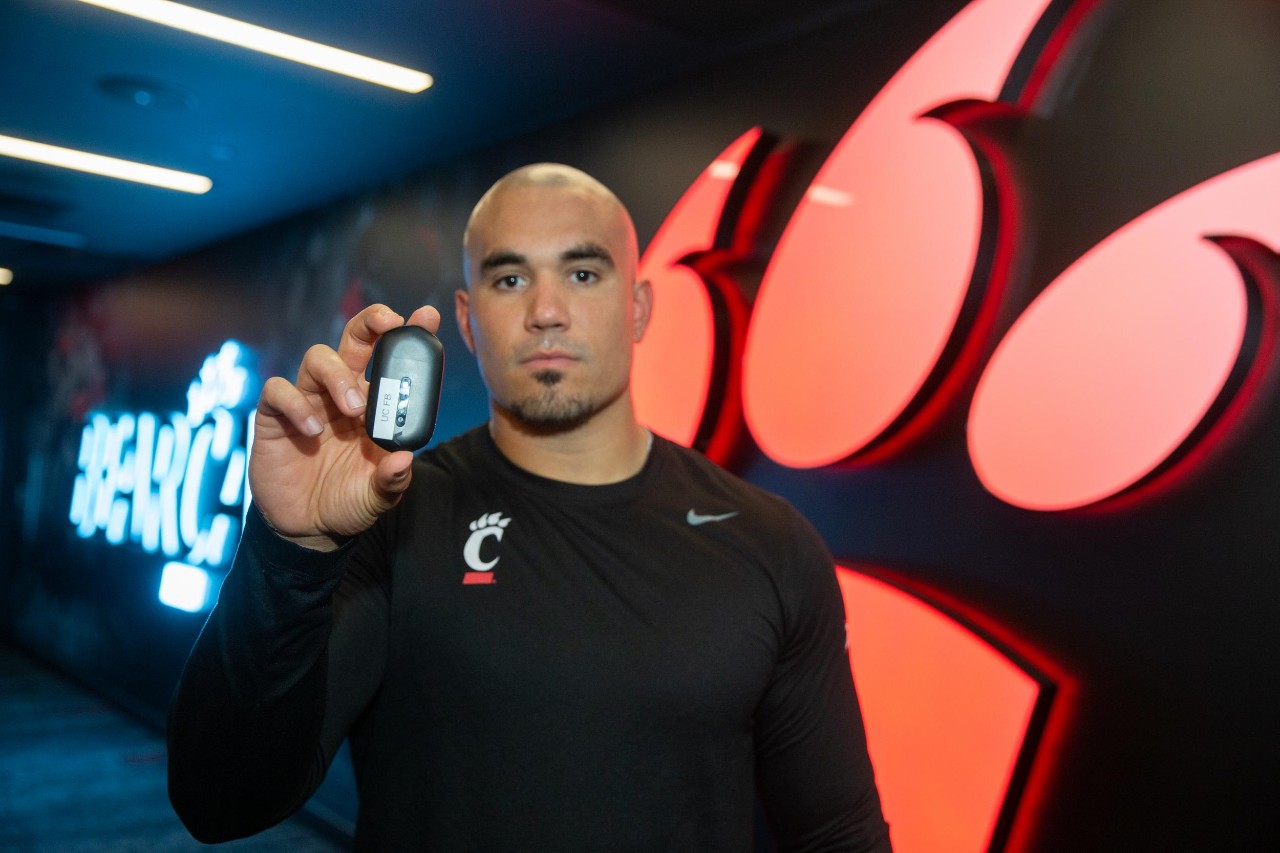
Their latest project took them to the UC Athletics Center to develop a custom-made protective case for sensors the Bearcats’ football team wears to track player performance.
Lab Manager Sam Antoline said he and his students have worked with doctors at hospitals such as UC Medical Center and Cincinnati Children’s, where the lab produced patient-specific heart models for surgical planning and practice.
And they have helped aerospace engineering students visualize nozzle designs for jet aircraft. They also support local industry by offering their services to companies that need help with modeling electronics, machine parts or other equipment. But this was the first time they worked with wearable technology.
Antoline said they went through several iterations of 3D-fabricated prototypes to find a version that would work and fit best around the player's shoulder pads.
Assistant Director of Football Sports Performance Brandon Garcia said the team uses the sensors to monitor player performance, which is especially helpful when a player is recuperating from an injury.
Watch the Spectrum News story.
Featured image at top: Assistant Director of Football Sports Performance Brandon Garcia holds up wearable technology that helps monitor player performance. Photo/Andrew Higley/UC Marketing + Brand

Digital Fabrication Lab Manager Sam Antoline and his students worked with UC Athletics on a wearable technology project for the football team. Photo/Andrew Higley/UC Marketing + Brand
Related Stories
Sugar overload killing hearts
November 10, 2025
Two in five people will be told they have diabetes during their lifetime. And people who have diabetes are twice as likely to develop heart disease. One of the deadliest dangers? Diabetic cardiomyopathy. But groundbreaking University of Cincinnati research hopes to stop and even reverse the damage before it’s too late.
Is going nuclear the solution to Ohio’s energy costs?
November 10, 2025

The Ohio Capital Journal recently reported that as energy prices continue to climb, economists are weighing the benefits of going nuclear to curb costs. The publication dove into a Scioto Analysis survey of 18 economists to weigh the pros and cons of nuclear energy. One economist featured was Iryna Topolyan, PhD, professor of economics at the Carl H. Lindner College of Business.
App turns smartwatch into detector of structural heart disease
November 10, 2025

An app that uses an AI model to read a single-lead ECG from a smartwatch can detect structural heart disease, researchers reported at the 2025 Scientific Sessions of the American Heart Association. Although the technology requires further validation, researchers said it could help improve the identification of patients with heart failure, valvular conditions and left ventricular hypertrophy before they become symptomatic, which could improve the prognosis for people with these conditions.