Research Evangelist: UC expert discusses improving accessibility to lung cancer treatments

The University of Cincinnati Cancer Center's Robert Van Haren, MD, recently joined the Research Evangelist podcast to discuss advancements in lung cancer care. He said while there are exciting advancements in treatments, it is important to continue to work to address disparities in accessibility to the best treatments.
Van Haren noted Black and Hispanic patients have been greatly underrepresented in recent Phase 3 worldwide trials that enroll many patients.
"With these great new breakthroughs, how do we make this accessible to all patients rather than a certain subset of patients? Because there’s even the potential to widen some of the disparities in outcomes that we’re seeing," said Van Haren, assistant professor of surgery in the Division of Thoracic Surgery in UC’s College of Medicine and a UC Health thoracic surgeon.
Van Haren said research and work to address these disparities have included no longer requiring patients to stop smoking prior to lung cancer resection and a pilot study that examined patient/physician relationships and trust.
"We found about 20% of patients declined the surgery recommended to them, and those patients were more likely to be Black or African American, more likely to have food and housing instability and more likely to report poor patient/physician relationsihps," he said.
The Cancer Center's lung cancer team is taking concrete steps including strengthening integrative supportive services, working closely with community navigators and conducting cultural humility training to improve care for all patients, Van Haren said.
"Just because you’re doing something equally doesn’t necessarily mean it’s equitable, and that’s what we’re going to try to tackle with the next projects," he said.
Listen to the Research Evangelist podcast.
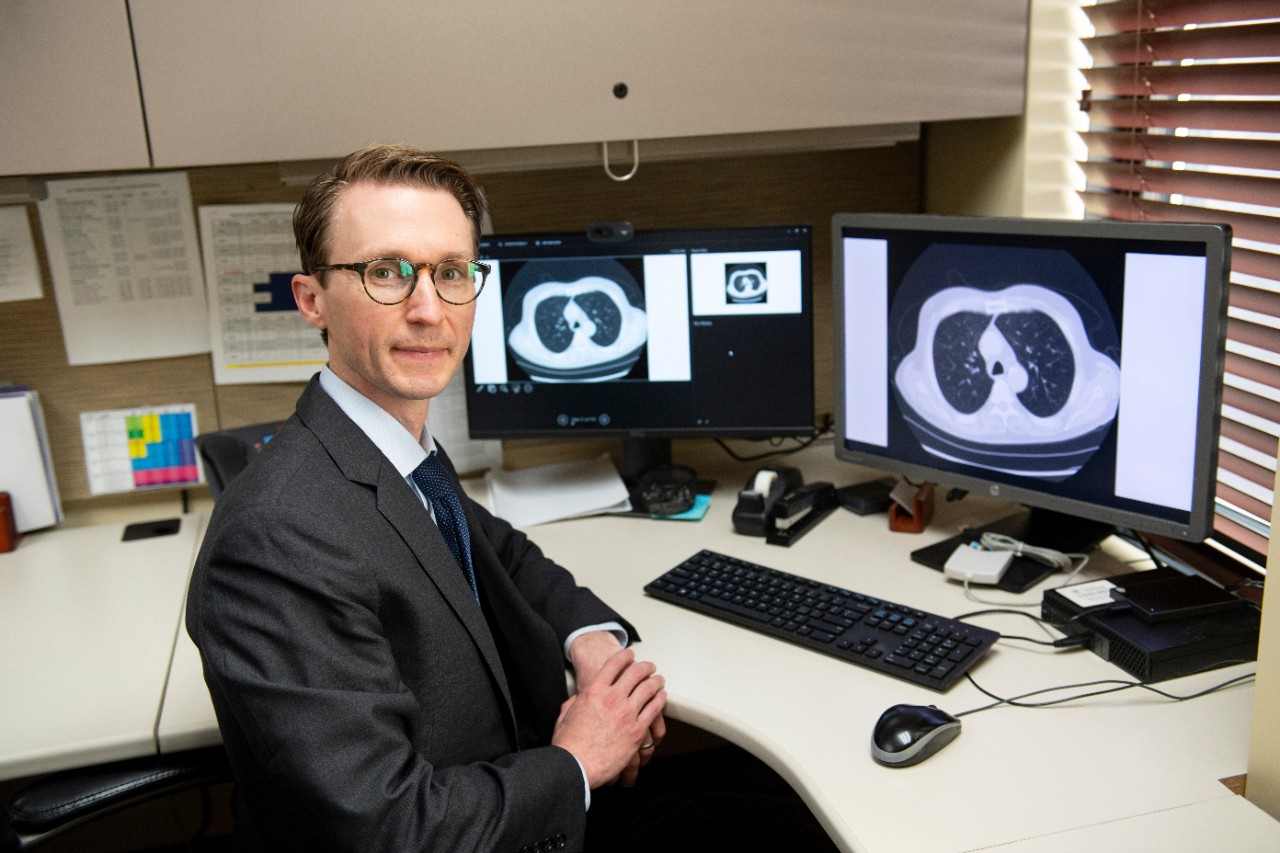
Featured photo at top of Van Haren. Photo/Colleen Kelley/UC Marketing + Brand.
Related Stories
Sugar overload killing hearts
November 10, 2025
Two in five people will be told they have diabetes during their lifetime. And people who have diabetes are twice as likely to develop heart disease. One of the deadliest dangers? Diabetic cardiomyopathy. But groundbreaking University of Cincinnati research hopes to stop and even reverse the damage before it’s too late.
Is going nuclear the solution to Ohio’s energy costs?
November 10, 2025

The Ohio Capital Journal recently reported that as energy prices continue to climb, economists are weighing the benefits of going nuclear to curb costs. The publication dove into a Scioto Analysis survey of 18 economists to weigh the pros and cons of nuclear energy. One economist featured was Iryna Topolyan, PhD, professor of economics at the Carl H. Lindner College of Business.
App turns smartwatch into detector of structural heart disease
November 10, 2025

An app that uses an AI model to read a single-lead ECG from a smartwatch can detect structural heart disease, researchers reported at the 2025 Scientific Sessions of the American Heart Association. Although the technology requires further validation, researchers said it could help improve the identification of patients with heart failure, valvular conditions and left ventricular hypertrophy before they become symptomatic, which could improve the prognosis for people with these conditions.