UC joining National Cancer Institute clinical trials network a 'big deal' for patients
Partnership will provide exclusive access to more trials, treatments

The University of Cincinnati Cancer Center has joined the National Cancer Institute’s Experimental Therapeutics Clinical Trials Network (ETCTN), providing patients with access to cutting edge treatments only available through the network.
Davendra Sohal, MD, said the ETCTN is a cooperative group specifically designed to test treatments in Phase I trials, where researchers focus primarily on a drug’s safety and the optimal dose in a small group of patients before larger trials test the drug’s efficacy.
“It is a big deal,” said Sohal, associate director for clinical research at the Cancer Center and professor of internal medicine in UC’s College of Medicine. “The NCI sees us as nationally prominent clinical trial investigators, and this gives us a seat at the national table. We can open clinical trials with novel cancer drugs that are available exclusively through this network.”
“Membership to this prestigious network is reserved for institutions on the forefront of cancer care,” said Syed Ahmad, MD, Cancer Center co-director, The Hayden Family Endowed Chair for Cancer Research and professor of surgery in UC’s Division of Surgical Oncology. “The ETCTN will allow us to offer clinical trials to our patients and our region that offer the most novel and cutting-edge treatment options.”
Nine academic cancer centers across the country lead subgroups within the larger ETCTN, each with its own specific portfolio of cancer drugs and clinical trials. UC has joined the University of Pittsburgh Medical Center (UPMC) Hillman Cancer Center’s network, joining institutions including the University of California Irvine and the Montefiore Medical Center at the Albert Einstein College of Medicine.
“This will allow rapid access to brand new approaches for cancer care,” said William L. Barrett, MD, Cancer Center co-director, chair and professor of radiation oncology in the UC College of Medicine and medical director of the Barrett Center for Cancer Prevention, Treatment and Research. “It helps to place our community at the forefront of advances in the field, benefiting patients in the Greater Cincinnati region.”

Clinical trials help translate findings from lab settings into treatments for patients. Photo/UC Health.
Out of dozens of trials UPMC has in its portfolio, Sohal said UC will pick five to six trials per year that fit best with ongoing research and the needs of Cincinnati’s patient population. He estimated about 20 patients would be enrolled in ETCTN trials per year.
“So either we can join an already open clinical trial, or we can pitch our own idea saying, ‘Hey, we want to do a clinical trial using this drug that you have in your portfolio,’” Sohal said.
The first trials to open at UC will focus on gastrointestinal cancers, led by Sohal, blood cancers, led by John Byrd, MD, and Emily Curran, MD, and head and neck cancer, led by Trisha Wise-Draper, MD, PhD.
“As time goes on, if we hit the enrollment numbers, then we will open more trials,” he said. “Trials could be opened for any cancer.”
First trial opening
Sohal is the site principal investigator for the first ETCTN trial opening at UC that will test a new treatment for pancreatic cancer that cannot be removed with surgery.
“It is a targeted treatment, rather than chemotherapy,” Sohal said of the study drug. “It blocks growth signals in cancer cells, thereby killing them.”
Patients enrolled in the Phase I trial will receive the experimental drug in addition to two chemotherapy drugs that are currently part of standard treatment for pancreatic cancer. Researchers will test the safety, side effects and best dose of the drug in combination with the chemotherapy.
Sohal noted this drug is only available for pancreatic cancer patients through the ETCTN, and about five to 10 patients are expected to enroll in the trial at UC.
“If successful, this can lead to a great new treatment option for pancreatic cancer patients,” Sohal said.
The same drug is also being tested in leukemia, and Dan Starczynowski, PhD, associate director for basic science research at the Cancer Center, is one of the world’s leading experts in this work.
Next Lives Here
The University of Cincinnati is classified as a Research 1 institution by the Carnegie Commission and is ranked in the National Science Foundation's Top-35 public research universities. UC's medical, graduate and undergraduate students and faculty investigate problems and innovate solutions with real-world impact. Next Lives Here.
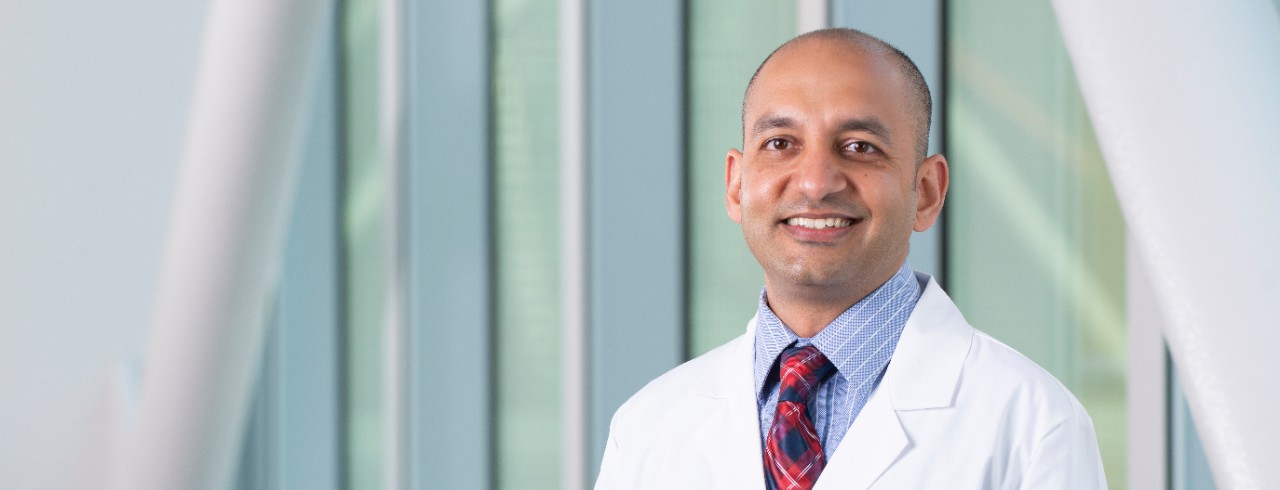
Featured photo at top of Davendra Sohal. Photo/University of Cincinnati.
Related Stories
Sugar overload killing hearts
November 10, 2025
Two in five people will be told they have diabetes during their lifetime. And people who have diabetes are twice as likely to develop heart disease. One of the deadliest dangers? Diabetic cardiomyopathy. But groundbreaking University of Cincinnati research hopes to stop and even reverse the damage before it’s too late.
Is going nuclear the solution to Ohio’s energy costs?
November 10, 2025

The Ohio Capital Journal recently reported that as energy prices continue to climb, economists are weighing the benefits of going nuclear to curb costs. The publication dove into a Scioto Analysis survey of 18 economists to weigh the pros and cons of nuclear energy. One economist featured was Iryna Topolyan, PhD, professor of economics at the Carl H. Lindner College of Business.
App turns smartwatch into detector of structural heart disease
November 10, 2025

An app that uses an AI model to read a single-lead ECG from a smartwatch can detect structural heart disease, researchers reported at the 2025 Scientific Sessions of the American Heart Association. Although the technology requires further validation, researchers said it could help improve the identification of patients with heart failure, valvular conditions and left ventricular hypertrophy before they become symptomatic, which could improve the prognosis for people with these conditions.