Business Courier: UC wins public-private grant for microchip research
Tha National Science Foundation award $45M to 24 semiconductor projects

The Business Courier highlighted a $45 million grant from the National Science Foundation that will sponsor 24 research projects on microchips, including one at the University of Cincinnati.
UC College of Engineering and Applied Science Assistant Professor Sarah Watzman will receive $773,000 to study “spin gapless semiconductors” in collaboration with four other academic institutions.

Sarah Watzman. Photo/Andrew Higley/UC Marketing + Brand
“Focusing on the spin of an electron, rather than on the whole electron, makes it possible to make smaller devices that operate at higher speeds and consume less energy,” Watzman said.
The UC team will coordinate with researchers at the University of Alabama, Northern Illinois University, Iowa State University and the Illinois Institute of Technology.
Watzman is collaborating on the research project with two professors in UC's College of Arts and Sciences.
Evgeny Mikheev, an assistant professor of physics, will work on the device development portion of the project while Assistant Professor Melissa Jacquart in philosophy will oversee technology communications. Jacquart is the associate director of the UC Center for Public Engagement with Science, which supports researchers in achieving broader impacts of their work on students and society.
“This project will also promote development of the semiconductor workforce through technical communication coursework and credentialing,” Watzman said.
UC is among 47 institutions that will use the NSF grants to support their two-dozen projects.
Read the Business Courier story.
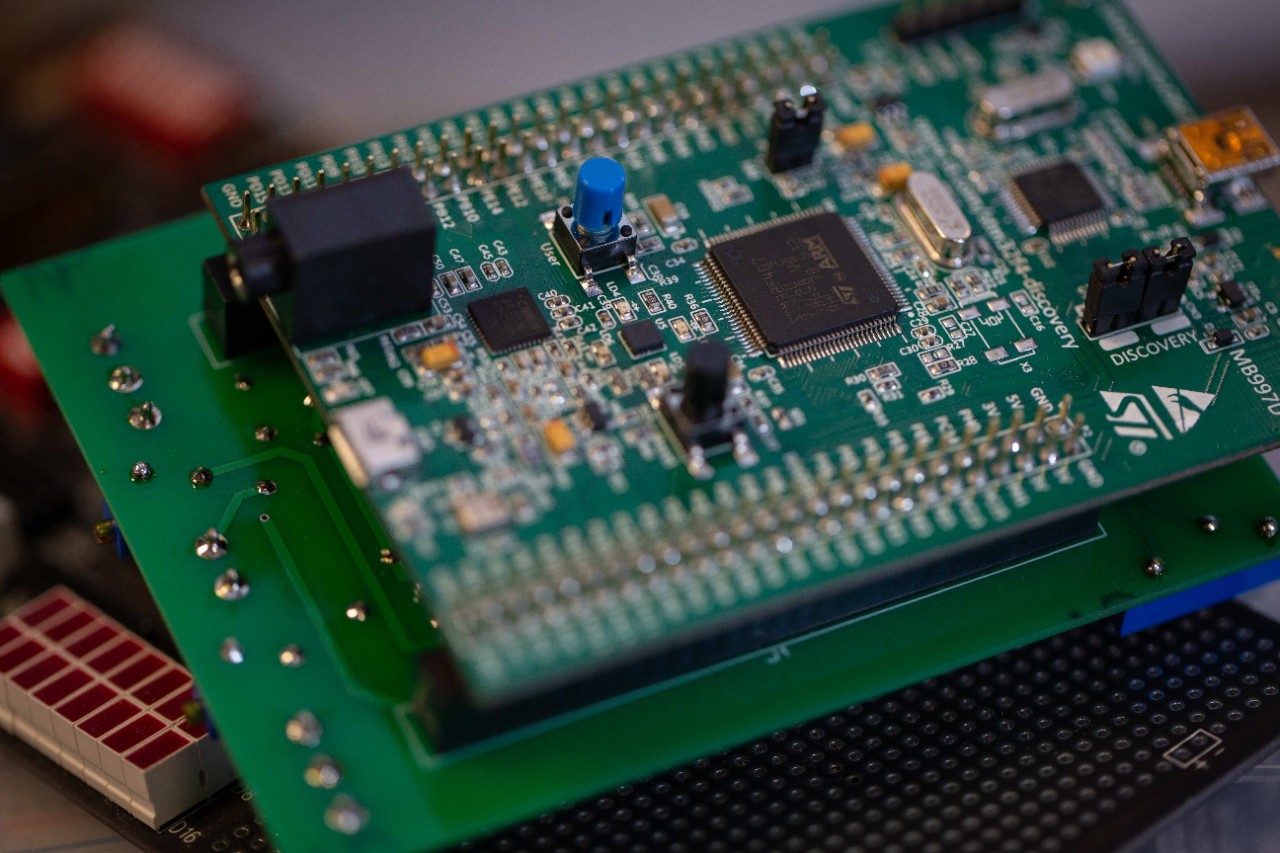
Featured image at top: A circuit board. UC is among 47 institutions that will split $45 million in National Science Foundation funding for semiconductor research. Photo/Andrew Higley/UC Marketing + Brand
Related Stories
Sugar overload killing hearts
November 10, 2025
Two in five people will be told they have diabetes during their lifetime. And people who have diabetes are twice as likely to develop heart disease. One of the deadliest dangers? Diabetic cardiomyopathy. But groundbreaking University of Cincinnati research hopes to stop and even reverse the damage before it’s too late.
Is going nuclear the solution to Ohio’s energy costs?
November 10, 2025

The Ohio Capital Journal recently reported that as energy prices continue to climb, economists are weighing the benefits of going nuclear to curb costs. The publication dove into a Scioto Analysis survey of 18 economists to weigh the pros and cons of nuclear energy. One economist featured was Iryna Topolyan, PhD, professor of economics at the Carl H. Lindner College of Business.
App turns smartwatch into detector of structural heart disease
November 10, 2025

An app that uses an AI model to read a single-lead ECG from a smartwatch can detect structural heart disease, researchers reported at the 2025 Scientific Sessions of the American Heart Association. Although the technology requires further validation, researchers said it could help improve the identification of patients with heart failure, valvular conditions and left ventricular hypertrophy before they become symptomatic, which could improve the prognosis for people with these conditions.