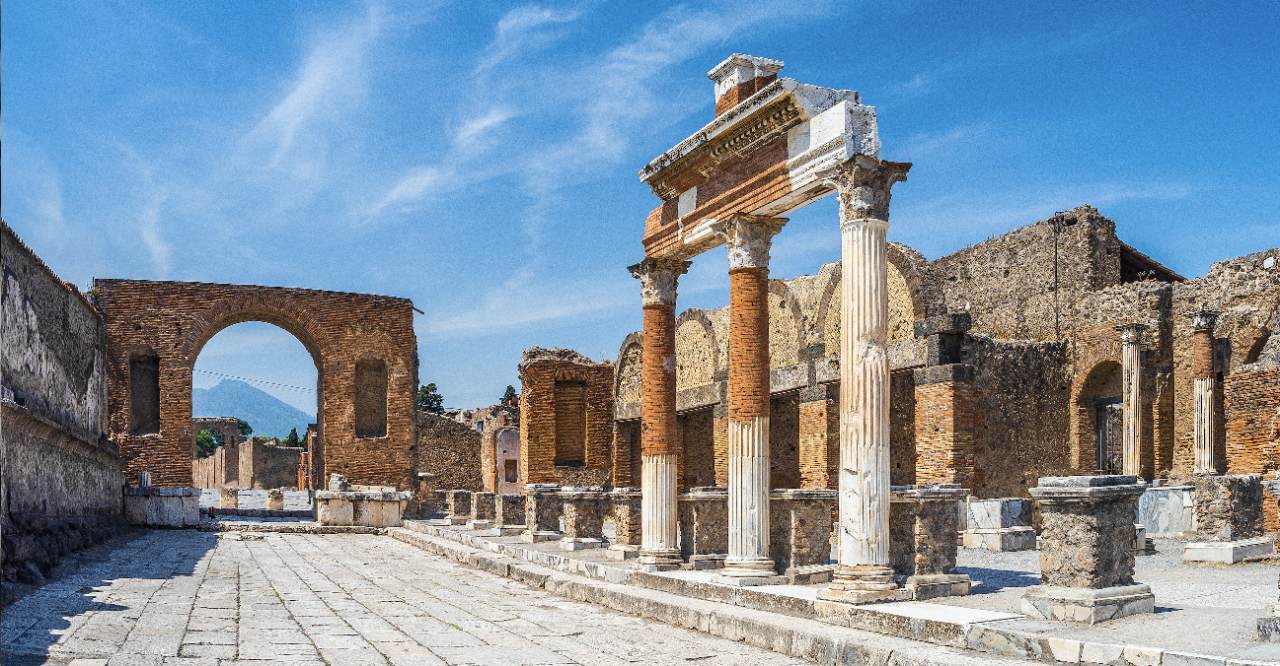
NatGeo: Pompeii has secrets to uncover — should we keep digging?
UC Classics professor explains why preservation is so important

National Geographic turned to a University of Cincinnati expert for insights into the controversial question of whether archaeologists should excavate more of the ancient city of Pompeii.
The famous Italian city just south of Naples was buried by as much as 20 feet of ash from the eruption of Mount Vesuvius in 79 AD.
Today, the ruins of the ancient city are among Italy's most famous attractions, a UNESCO World Heritage Site visited by more than 2.5 million people each year.
According to the magazine, archaeologists recently have shared their discoveries of a 2,000-year-old laundromat, a bedroom used by slaves and a fresco of a platter featuring a chalice of wine and foods that include what looks like a pizza.
But none of these discoveries were from recent excavations, the magazine said. Italy has forbidden new excavations at the city for decades.

UC Classics Associate Professor Steven Ellis is director of the Pompeii Archaeological Research Project: Porta Stabia. Photo/Dottie Stover/UC
UC Classics Associate Professor Steven Ellis said these findings came about from efforts to preserve and restore disturbed areas.
Ellis is an expert in Roman archaeology and is director of the Pompeii Archaeological Research Project: Porta Stabia. He also directs UC's Tharros Archaeological Research Project at Sardinia. The first of four volumes on his Pompeii project will be published in October. According to its description, it examines the urban development of two town blocks containing homes, shops and other buildings.
Ellis said to prevent further damage to archaeological sites from erosion, workers have shored up some of the steep cliff edges, which required some excavation.
The question today is whether archaeologists should conduct more excavations at the ancient city, the magazine said.
"We have enough of [excavated] Pompeii for the general public. We have enough of Pompeii for the scholarly community to learn from," Ellis told National Geographic. "What we really need to be doing is keeping it as well preserved for the future as we possibly can."
Proponents of excavating argue that the elements are already taking a toll on the exposed ruins. Heavy rains have caused damage to some sites.
Opponents say Italy should keep remaining portions of the ancient city undisturbed for future generations who likely will have new technology undreamed of today.
Ellis is author of "The Roman Retail Revolution" (Oxford 2018) and "The Making of Pompeii: Studies in the history and urban development of an ancient city" (Portsmouth 2011).
Featured image at top: A plaza in the ancient city of Pompeii. Photo/Balate Dorin
More UC Classics in the news

The cover of Smithsonian Magazine features UC's discovery of the Griffin Warrior in Pylos, Greece.
Related Stories
Sugar overload killing hearts
November 10, 2025
Two in five people will be told they have diabetes during their lifetime. And people who have diabetes are twice as likely to develop heart disease. One of the deadliest dangers? Diabetic cardiomyopathy. But groundbreaking University of Cincinnati research hopes to stop and even reverse the damage before it’s too late.
Is going nuclear the solution to Ohio’s energy costs?
November 10, 2025

The Ohio Capital Journal recently reported that as energy prices continue to climb, economists are weighing the benefits of going nuclear to curb costs. The publication dove into a Scioto Analysis survey of 18 economists to weigh the pros and cons of nuclear energy. One economist featured was Iryna Topolyan, PhD, professor of economics at the Carl H. Lindner College of Business.
App turns smartwatch into detector of structural heart disease
November 10, 2025

An app that uses an AI model to read a single-lead ECG from a smartwatch can detect structural heart disease, researchers reported at the 2025 Scientific Sessions of the American Heart Association. Although the technology requires further validation, researchers said it could help improve the identification of patients with heart failure, valvular conditions and left ventricular hypertrophy before they become symptomatic, which could improve the prognosis for people with these conditions.