UC officially opens Clifton Court Hall
UC’s new physical structure highlighted as an impressive ‘Next’ step

The University of Cincinnati celebrated the grand opening of Clifton Court Hall on Tuesday, Sept. 19, with a ribbon cutting, attended by approximately 200 administrators, faculty, staff, students and alumni.
“We are growing and cutting ribbons because we have incredibly dedicated and talented people — along with committed donors — who care deeply about our students and their future,” UC’s 30th President Neville G. Pinto remarked in his address.
The celebration, Pinto said, emphasizes the success of the university’s Next Lives Here strategic direction, noting that last week 131,000 donors helped push UC’s Next, Now campaign over the $2 billion mark, with a year left to go on the campaign.
“It is this sort of generosity that makes buildings like this possible,” said Pinto.

The ribbon cutting event for the grand opening of Clifton Court Hall, est. 2023. Left to right: UC Foundation President Peter Landgren, A&S Dean James Mack, UC President Neville Pinto, Provost Valerio Ferme, Interim Associate Dean Margaret Hanson and UC Board of Trustees Chairman Phil Collins. Photo/Andrew Higley/UC Marketing + Brand
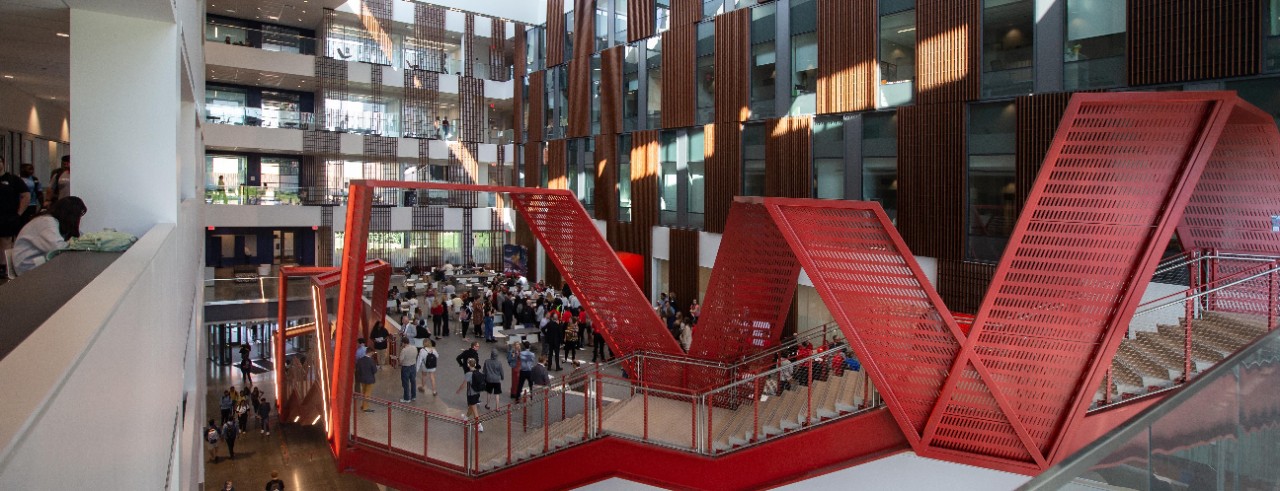
Clifton Court Hall, situated near the northwest corner of campus, is a 185,000-square-foot structure that houses several departments within the College of Arts and Sciences, in addition to 24 classrooms and 230 faculty and staff offices.
Designed collaboratively by LMN Architects and KZF Design, and built by Messer Construction, the building includes a large central atrium, pedestrian bridges and gates, specialized lab space and collaboration areas.
The focal feature of the $93 million structure, as described in a Cincinnati Magazine article, is the “great, red stairway,” which pays homage to UC’s school colors and as a symbol of connectivity.
Cincinnati Business Courier shared a photo gallery of the space, while fourth-year journalism major Anna Carlson touted the hall as “a wonderful addition to campus” in UC’s student newspaper, The News Record.
Televised coverage included all local broadcast television stations, including Local 12, WKRC.
Featured image at top: Andrew Higley/UC Marketing + Brand
Impact Lives Here
The University of Cincinnati is leading public urban universities into a new era of innovation and impact. Our faculty, staff and students are saving lives, changing outcomes and bending the future in our city's direction. Next Lives Here.
Tags
- School of Communication, Film, and Media Studies
- Impact
- Asian Studies
- College of Arts and Sciences
- Department of Romance Languages and Literatures
- UC Foundation
- Department of Psychology
- Alumni Association
- In The News
- President's Office
- Department of Journalism
- School of Public and International Affairs
- Provost
- Department of German Studies
- Next Lives Here
Related Stories
UC launches Bearcats Affordability Grant
January 7, 2026
The University of Cincinnati is making college more attainable for students across Ohio with the creation of the Bearcats Affordability Grant. The new grant will provide a pathway to tuition-free college for students of families who make less than $75,000 per year. Beginning in fall 2026, the Bearcats Affordability Grant will cover the remaining cost of tuition for Ohio residents who are Pell eligible.
BearcatGPT AI platform now available to all UC faculty and staff
December 9, 2025
University of Cincinnati Digital Technology Solutions is excited to announce that BearcatGPT, the university’s private, secure AI platform, is now available to all UC faculty and staff.
Sugar overload killing hearts
November 10, 2025
Two in five people will be told they have diabetes during their lifetime. And people who have diabetes are twice as likely to develop heart disease. One of the deadliest dangers? Diabetic cardiomyopathy. But groundbreaking University of Cincinnati research hopes to stop and even reverse the damage before it’s too late.