WVXU: Football helmets don't protect back of head as well
UC biomedical engineer studies concussions in football

WVXU highlighted concussion research by the University of Cincinnati that explored how well helmets protect players from hits at different angles.
Eric Nauman, a professor of biomedical engineering in UC's College of Engineering and Applied Science, put popular football helmets made by leading brands through impact testing and found that no single design demonstrated superior reduction of potential concussion incidence or consistent energy absorption at every part of the helmet.
Concussions from football are a health concern across all age groups from youth sports to professional leagues.
Nauman's study was published in the Journal of Biomechanical Engineering.
Nauman's tests showed that players are especially vulnerable to potential concussions from hits to the back of their helmets such as when their head hits the ground.
“The classic one is that Tua Tagovailoa, when he's playing the Bills. He fell backwards and hit his head on the ground,” Nauman told WVXU. “He clearly was impaired after that. We think that's largely because that helmet doesn't absorb a lot of the energy when it's a blow to the back of the head.”
Nauman says he doesn't want to prevent anybody from playing football, he just wants to make the game safer for those who do want to play.
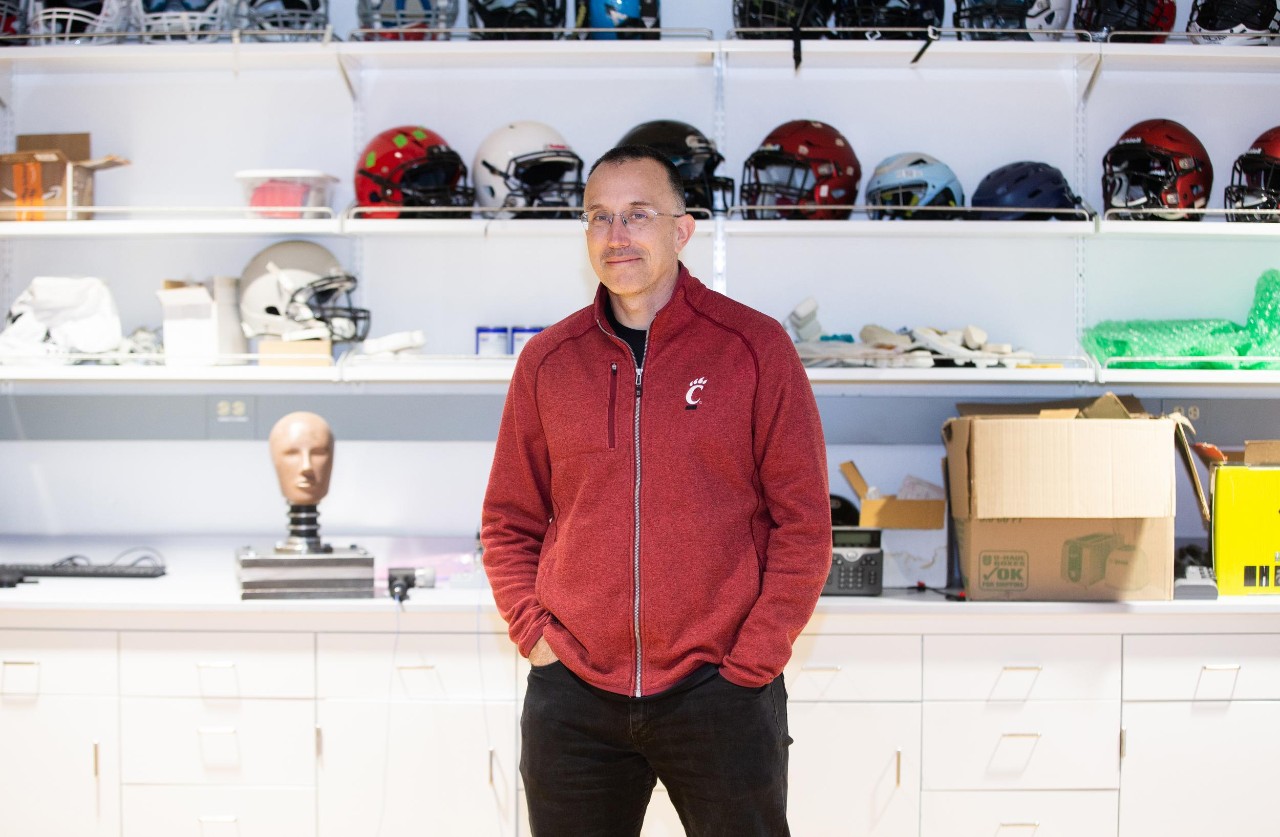
Featured image at top: UC biomedical engineering professor Eric Nauman is studying ways to make helmets safer in his lab. Photo/Andrew Higley/UC Marketing + Brand

UC student Christopher Boles uses a modal hammer to strike a helmet. Photo/Andrew Higley/UC Marketing + Brand
Related Stories
Sugar overload killing hearts
November 10, 2025
Two in five people will be told they have diabetes during their lifetime. And people who have diabetes are twice as likely to develop heart disease. One of the deadliest dangers? Diabetic cardiomyopathy. But groundbreaking University of Cincinnati research hopes to stop and even reverse the damage before it’s too late.
Is going nuclear the solution to Ohio’s energy costs?
November 10, 2025

The Ohio Capital Journal recently reported that as energy prices continue to climb, economists are weighing the benefits of going nuclear to curb costs. The publication dove into a Scioto Analysis survey of 18 economists to weigh the pros and cons of nuclear energy. One economist featured was Iryna Topolyan, PhD, professor of economics at the Carl H. Lindner College of Business.
App turns smartwatch into detector of structural heart disease
November 10, 2025

An app that uses an AI model to read a single-lead ECG from a smartwatch can detect structural heart disease, researchers reported at the 2025 Scientific Sessions of the American Heart Association. Although the technology requires further validation, researchers said it could help improve the identification of patients with heart failure, valvular conditions and left ventricular hypertrophy before they become symptomatic, which could improve the prognosis for people with these conditions.