WLW: UC geologist explains local risks from earthquakes
More than 19,000 killed in deadly Turkey earthquake

WLW turned to a University of Cincinnati geologist to explain the earthquake risks in the Midwest after a natural disaster in Turkey and Syria killed more than 19,000 people.
A magnitude 7.8 earthquake on Monday destroyed hundreds of thousands of structures in Turkey and Syria in what the Turkish president described as “the disaster of the century.”

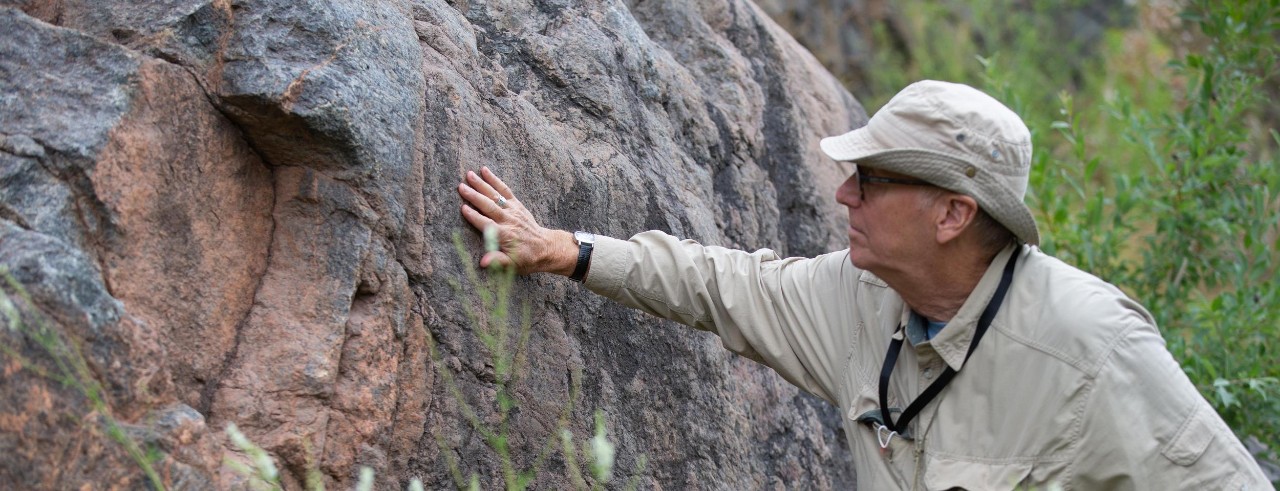
UC associate professor Craig Dietsch leads a geology field trip to Thunder Bay, Ontario. Photo/Andrew Higley/UC Marketing + Brand
UC associate professor Craig Dietsch, head of UC's Department of Geosciences, told 700-WLW's Eddie & Rocky Show that earthquakes occur along known fault lines with no warning.
“Predicting earthquakes is very tricky,” Dietsch told co-hosts Rocky Boiman and Eddie Fingers.
“The fault lines in Turkey are very similar to the San Andreas,” Dietsch said. “They occur where these giant pieces of the Earth's crust are moving around and grinding past one another.”
Dietsch said the largest earthquake recorded in the United States was an 9.2 in southern Alaska in 1964, which generated a tsunami that killed people as far away as California.
“Any earthquake above 7 is a gigantic earthquake,” Dietsch said.
Dietsch leads regular geosciences field trips so students can explore the unique geology of places such as Thunder Bay, Ontario. Read: School of Rocks.
Dietsch said some new buildings in earthquake-prone areas have shock absorbers to help mitigate damage from tremors.
“Everywhere on our planet is under constant stress. If rocks are weak, they tend to slide past each other and you don't get an earthquake,” Dietsch said. “But if two strong rocks are strong, pressure builds up and sooner or later that stress will be released through an earthquake.”
Dietsch said the closest fault to Cincinnati is the Reelfoot Rift in Missouri.
“We live in a pretty seismically safe zone,” Dietsch said.
Listen to the WLW interview on the Eddie and Rocky Show.
Featured image at top: UC associate professor Craig Dietsch examines a cliff face near Duluth, Minnesota, during a 2022 field trip. Photo/Andrew Higley/UC Marketing + Brand
Related Stories
Sugar overload killing hearts
November 10, 2025
Two in five people will be told they have diabetes during their lifetime. And people who have diabetes are twice as likely to develop heart disease. One of the deadliest dangers? Diabetic cardiomyopathy. But groundbreaking University of Cincinnati research hopes to stop and even reverse the damage before it’s too late.
Is going nuclear the solution to Ohio’s energy costs?
November 10, 2025

The Ohio Capital Journal recently reported that as energy prices continue to climb, economists are weighing the benefits of going nuclear to curb costs. The publication dove into a Scioto Analysis survey of 18 economists to weigh the pros and cons of nuclear energy. One economist featured was Iryna Topolyan, PhD, professor of economics at the Carl H. Lindner College of Business.
App turns smartwatch into detector of structural heart disease
November 10, 2025

An app that uses an AI model to read a single-lead ECG from a smartwatch can detect structural heart disease, researchers reported at the 2025 Scientific Sessions of the American Heart Association. Although the technology requires further validation, researchers said it could help improve the identification of patients with heart failure, valvular conditions and left ventricular hypertrophy before they become symptomatic, which could improve the prognosis for people with these conditions.