WaPo: Cavefish offer clues to future of human couch potatoes
UC biologist explains sedentary behavior of blind cavefish

The Washington Post turned to a University of Cincinnati biologist to explain how the evolution of Mexican blind cavefish could offer clues to our future evolution given people's increasingly sedentary lifestyles.

UC associate professor Joshua Gross. Photo/Andrew Higley/UC Marketing + Brand
Even people who are active every day had trouble maintaining their lifestyle during the COVID-19 pandemic when gyms, parks, playgrounds and group activities were shut down for social distancing, the Post said.
But UC College of Arts and Sciences associate professor Joshua Gross told the Post that our sedentary lifestyle does not compare to that of the Mexican blind cavefish.
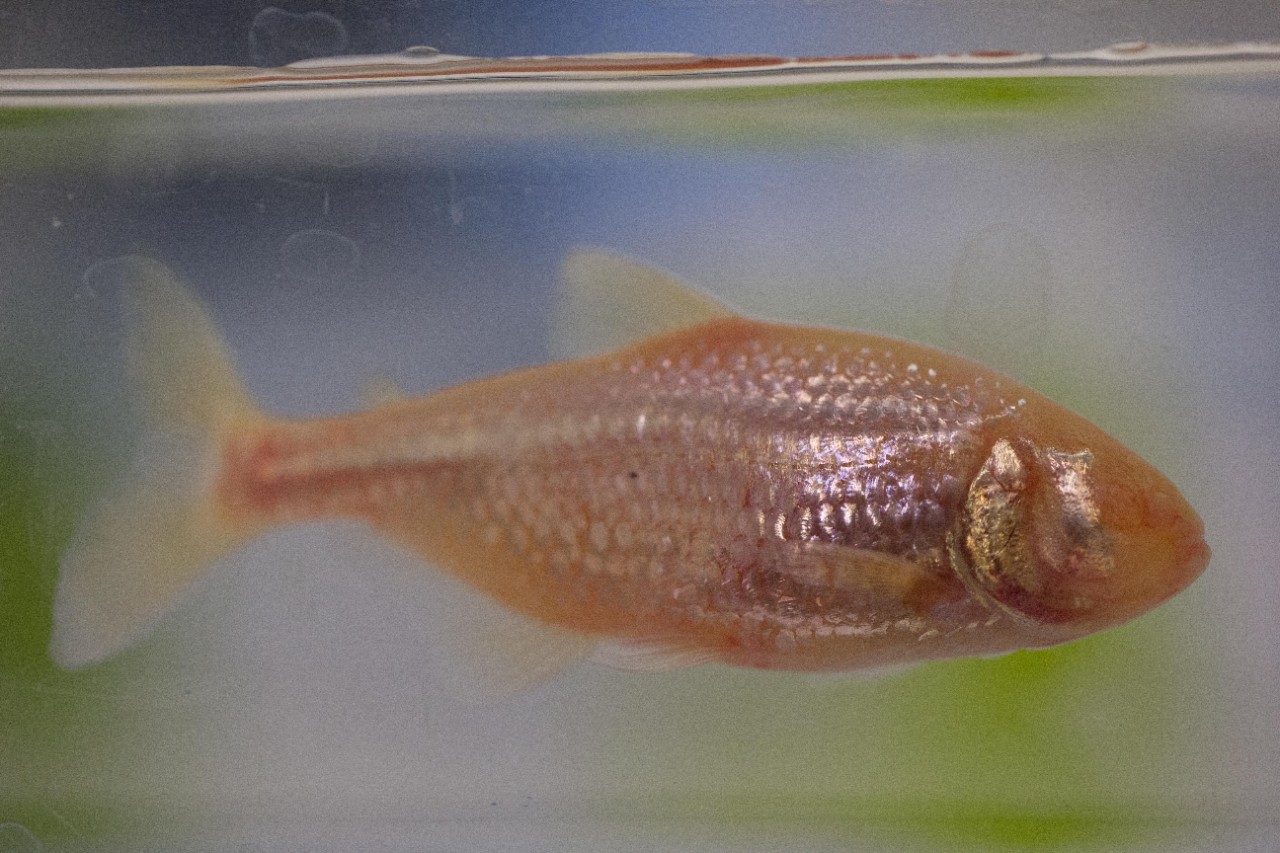
Gross studies the fish and their interesting evolutionary path in his biology lab. The fish were swept deep underground by flooding more than 160,000 years ago and over thousands of generations evolved in dark world that had little food to offer. They lost eyes that had become useless in their dark world while developing other characteristics that help them survive.
Meanwhile, their ancestors continue to thrive on the surface, giving scientists a unique opportunity to compare the animals side by side to see how they diverged.
The Post turned to Gross to explain a new study in the Proceedings of the National Academies of Science that examined how the fish evolved to swim slowly, starve for long periods and get by with less muscle mass and more fat. He was not part of the research.
“What I felt was interesting is that in humans, it has been long understood that a sedentary lifestyle leads to pretty negative health outcomes, but those come within a lifetime,” Gross told the Post. “This study provides an idea of how inactivity can play out not just in a lifetime, but in long-term evolutionary changes.”
In his biology lab, Gross and his students have learned more about how cavefish survive and navigate their low-nutrient, low-oxygen environment.
Read the Washington Post story.
Read more about UC's blind cavefish research.
Featured image at top: A Mexican blind cavefish swims in a UC biology lab. Photo/Andrew Higley/UC Marketing + Brand
Related Stories
Sugar overload killing hearts
November 10, 2025
Two in five people will be told they have diabetes during their lifetime. And people who have diabetes are twice as likely to develop heart disease. One of the deadliest dangers? Diabetic cardiomyopathy. But groundbreaking University of Cincinnati research hopes to stop and even reverse the damage before it’s too late.
Is going nuclear the solution to Ohio’s energy costs?
November 10, 2025

The Ohio Capital Journal recently reported that as energy prices continue to climb, economists are weighing the benefits of going nuclear to curb costs. The publication dove into a Scioto Analysis survey of 18 economists to weigh the pros and cons of nuclear energy. One economist featured was Iryna Topolyan, PhD, professor of economics at the Carl H. Lindner College of Business.
App turns smartwatch into detector of structural heart disease
November 10, 2025

An app that uses an AI model to read a single-lead ECG from a smartwatch can detect structural heart disease, researchers reported at the 2025 Scientific Sessions of the American Heart Association. Although the technology requires further validation, researchers said it could help improve the identification of patients with heart failure, valvular conditions and left ventricular hypertrophy before they become symptomatic, which could improve the prognosis for people with these conditions.