Spectrum News: Clovernook Center program brings Braille storybooks to visually impaired kids in East Africa
UC graduate student contributed design on Braille books printed by local publishing company

“It’s not something I’ll soon forget,” says a representative from Cincinnati’s Clovernook Center for the Blind and Visually Impaired who traveled to East Africa to present 2,000 Braille storybooks to visually impaired children there.
The trip was a pilot program developed through the company’s printing arm, Clovernook Braille Printing House, and focuses on early learning and literacy among global populations that have a higher prevalence of childhood visual impairments and lack access to accessible resources. Spectrum News 1 featured the program and the work of a University of Cincinnati student.
The Cincinnati-based printing house is the largest producer of Braille in the world by volume at more than 30 million printed pages every year. The Braille storybooks were distributed to almost a dozen schools throughout East Africa.

Schools received 200 to 300 books and 3D models to help explain the stories in the book. Photo/courtesy of Clovernook Center for the Blind and Visually Impaired
Along with the books, each school received 12 sets of custom designed and printed tactile 3D models representing items found within the book.
UC graduate student Henry Levesque designed and produced many of these 3D model kits during a summer with the printing house, as part of a co-op independent studies project-based work. Levesque is a masters of design student in UC's College of Design, Architecture, Art, and Planning.
Cooperative education (often shortened to “co-op”) is an educational model, founded at UC, in which a student alternates traditional academic semesters with semesters spent working in the field.
The year-round schedule permits students in the program to have at least a year of highly beneficial professionally related experience before graduation and to obtain first-hand knowledge of professional practices and opportunities. Learn more about UC co-op.
Read the article from Spectrum News.
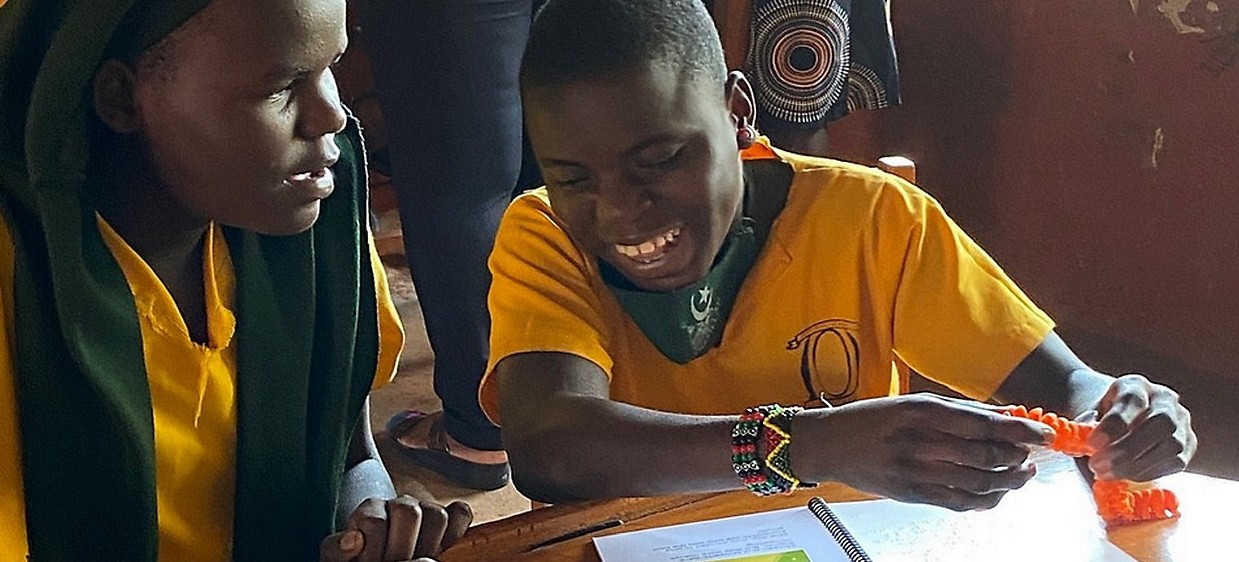
Featured photo is classroom in Uganda. (Photo courtesy of Clovernook Center for the Blind and Visually Impaired)
Beyond the classroom
UC invented cooperative education more than 100 years ago, and we continue to innovate all aspects of experience-based learning, including internships, service learning, virtual co-ops, community projects and industry partnerships.
Related Stories
Sugar overload killing hearts
November 10, 2025
Two in five people will be told they have diabetes during their lifetime. And people who have diabetes are twice as likely to develop heart disease. One of the deadliest dangers? Diabetic cardiomyopathy. But groundbreaking University of Cincinnati research hopes to stop and even reverse the damage before it’s too late.
Is going nuclear the solution to Ohio’s energy costs?
November 10, 2025

The Ohio Capital Journal recently reported that as energy prices continue to climb, economists are weighing the benefits of going nuclear to curb costs. The publication dove into a Scioto Analysis survey of 18 economists to weigh the pros and cons of nuclear energy. One economist featured was Iryna Topolyan, PhD, professor of economics at the Carl H. Lindner College of Business.
App turns smartwatch into detector of structural heart disease
November 10, 2025

An app that uses an AI model to read a single-lead ECG from a smartwatch can detect structural heart disease, researchers reported at the 2025 Scientific Sessions of the American Heart Association. Although the technology requires further validation, researchers said it could help improve the identification of patients with heart failure, valvular conditions and left ventricular hypertrophy before they become symptomatic, which could improve the prognosis for people with these conditions.