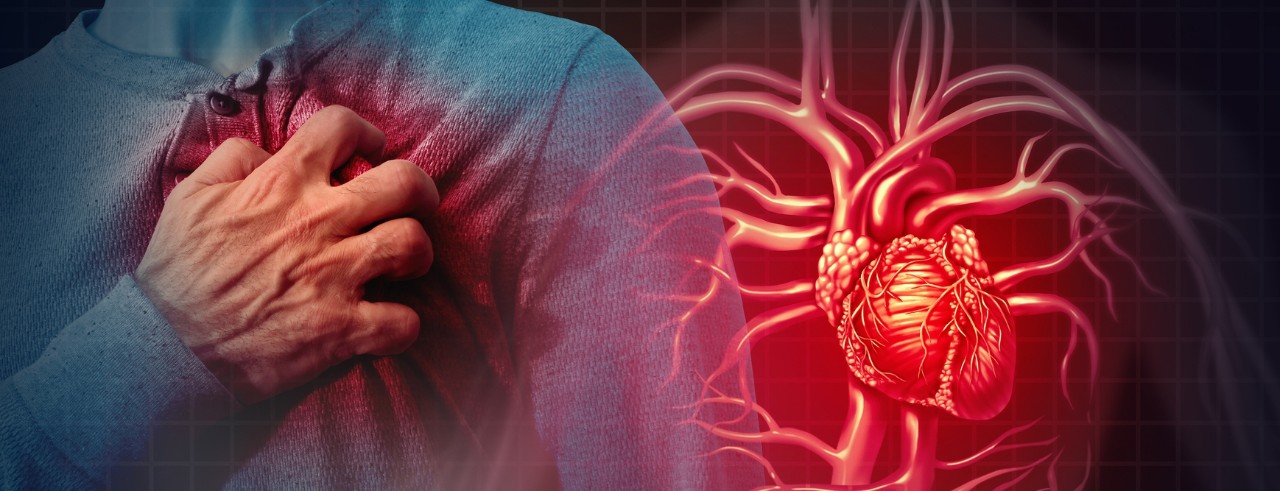
Everyday Health: Does chest pain always mean a heart attack?
UC expert says immediate attention is critical

The American Heart Association says that chest pain accounts for more than 6.5 million emergency room visits each year in the United States, plus nearly 4 million outpatient visits. While not all episodes of chest discomfort turn out to be life-threatening, chest pain is the most common symptom of a heart attack in adults of all ages, so it needs to be taken seriously. In a story posted by Everyday Health, Richard Becker, MD, professor of medicine in the UC College of Medicine is one of the experts quoted.

Richard Becker, MD, professor of medicine in the UC Division of Cardiovascular Health and Disease at the UC College of Medicine/Photo/Colleen Kelley/UC Marketing + Brand
Becker described to Everyday Health the variety of symptoms that may indicate a possible heart attack.
“New onset or worsening chest pain located in the center of the chest, particularly when radiating to the neck, jaw, shoulder, or arm, and accompanied by sudden or rapidly progressive weakness, shortness of breath, sweating, or lightheadedness, nausea, or vomiting can signal a heart emergency and requires evaluation by a medical provider,” says Becker.
If a person experiences serious symptoms, time is of the essence, Everyday Health reported. Cedars-Sinai Medical Center in Los Angeles stresses that about half the deaths due to a heart attack occur in the first three to four hours after symptoms begin. More than 90% of heart attack victims can survive if treated quickly, Harvard Medical School reports.
“Delays in care not only place people with a heart attack at risk of death but also lessen the overall benefit of well-established treatments,” says Becker. “The key message is: Having heart attack symptoms? Don’t wait. Don’t hesitate.”
Next Lives Here
The University of Cincinnati is classified as a Research 1 institution by the Carnegie Commission and is ranked in the National Science Foundation's Top-35 public research universities. UC's graduate students and faculty investigate problems and innovate solutions with real-world impact. Next Lives Here.
Related Stories
Sugar overload killing hearts
November 10, 2025
Two in five people will be told they have diabetes during their lifetime. And people who have diabetes are twice as likely to develop heart disease. One of the deadliest dangers? Diabetic cardiomyopathy. But groundbreaking University of Cincinnati research hopes to stop and even reverse the damage before it’s too late.
Is going nuclear the solution to Ohio’s energy costs?
November 10, 2025

The Ohio Capital Journal recently reported that as energy prices continue to climb, economists are weighing the benefits of going nuclear to curb costs. The publication dove into a Scioto Analysis survey of 18 economists to weigh the pros and cons of nuclear energy. One economist featured was Iryna Topolyan, PhD, professor of economics at the Carl H. Lindner College of Business.
App turns smartwatch into detector of structural heart disease
November 10, 2025

An app that uses an AI model to read a single-lead ECG from a smartwatch can detect structural heart disease, researchers reported at the 2025 Scientific Sessions of the American Heart Association. Although the technology requires further validation, researchers said it could help improve the identification of patients with heart failure, valvular conditions and left ventricular hypertrophy before they become symptomatic, which could improve the prognosis for people with these conditions.