Medical Scientist Training Program student receives grant to complete doctoral research
Study looks at why diversification of medical specialties has not matched that of medical schools

University of Cincinnati Medical Scientist Training Program (MSTP) student Juliana Madzia has received a Doctoral Dissertation Research Improvement Grant from the American Sociological Association. The grant will support her study titled “Inequality in Medical Professionalization and Specialization.”
“In recent years, medical schools in the U.S. have made major investments in diversifying their cohorts. Despite these efforts, students who match into the most competitive medical specialties are predominantly straight, cisgender, white men. This raises the question of why diversification of medical specialties has not matched the rate of diversification of medical schools,” Madzia says.
As part of her research, Madzia will conduct in-depth interviews with more than 50 fourth-year medical students across the country to investigate how medical students with one or more minoritized identities experience the process of medical professionalization. She will also study why medical students with minoritized identities disproportionately match into less competitive specialties and to what extent this is due to personal choice versus forces of exclusion. Her goal is to design interventions that would help students with minoritized identities succeed in matching into whatever specialty they wish to pursue. Madzia hopes that this could reduce stratification across medical specialties and contribute to the creation of a medical profession that is representative of and, therefore, best equipped to care for the populations it serves.
The MSTP is a MD/PhD program supported by the UC College of Medicine and Cincinnati Children’s Hospital Medical Center. Students complete their first two years of medical school and then shift their studies to graduate school training before finishing their final two years of medical school to receive both a medical degree and a doctorate. The mission of the program is to develop individuals who make a difference in patient outcomes through bench to bedside research. It is funded through a National Institutes of Health award.

Juliana Madzia
Madzia, who received her bachelor's degree in neuroscience from UC in 2017, is currently working toward a doctoral degree from the Department of Sociology at the UC College of Arts and Sciences. She says she is excited to do this research as a student of both medicine and sociology, as traditionally, there has been very little communication between these two fields.
“Doing qualitative interviews with medical students, while being a medical student myself, means that I can build rapport with participants and put their responses into context in a way that a researcher not in medicine might not be able to,” she says. “I think this will ultimately make my work more impactful because I will be able to communicate my findings in the sociology community as well as the medical community, where it has the potential to inform positive change within medical education.”
Madzia is the only UC MSTP student pursuing a doctoral degree in the social sciences.
“I wanted to obtain this double degree because applying a sociological lens to health inequities allows me to think critically about the ways that inequality—based on race, class, gender, sexual orientation and other aspects of identity—is perpetuated through individuals’ interactions with health care providers,” she says.
She hopes to continue to use the skills and knowledge she is gaining in her doctoral studies in her future work as a gender-affirming surgeon.
“Through sociology, I’ve taken classes that have helped me develop a nuanced understanding of gender and identity, and as a result I’ve had the opportunity to get involved in research projects designed to meet the needs of Cincinnati’s trans and non-binary community,” Madzia says. “This combination of theoretical and real-world experience will help me to better understand the needs of and build relationships with my future patients who are seeking gender-affirming surgery.”
Madzia expects to complete her doctorate in March 2023 and then complete the final two years of her medical studies to receive her medical degree in 2025. She is planning to do her residency in plastic surgery followed by a fellowship in gender-affirming surgery.
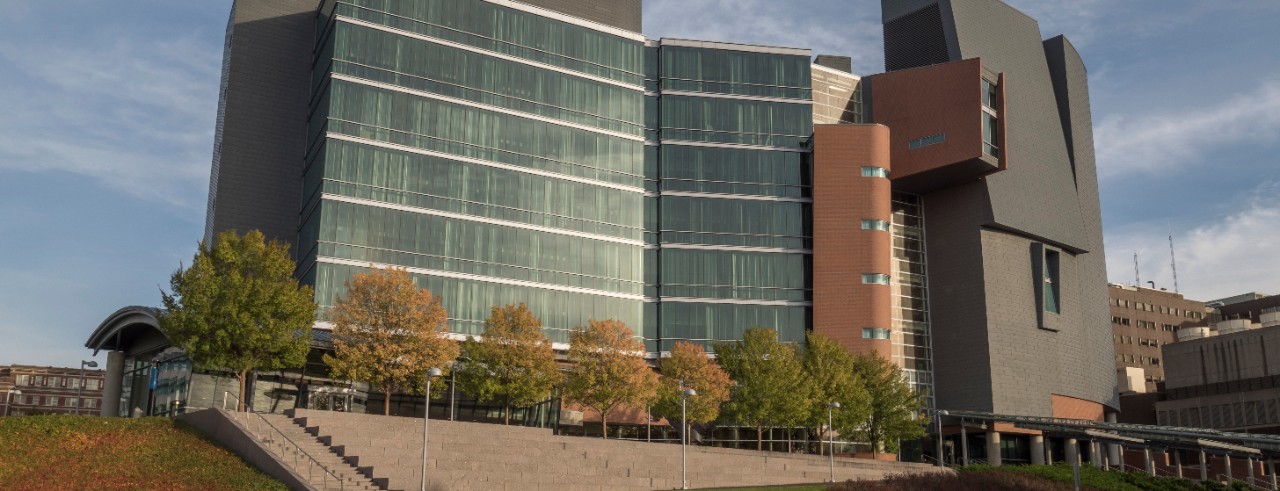
Featured image at top: CARE/Crawley Building, UC College of Medicine. Colleen Kelley/UC Marketing + Brand
Related Stories
Sugar overload killing hearts
November 10, 2025
Two in five people will be told they have diabetes during their lifetime. And people who have diabetes are twice as likely to develop heart disease. One of the deadliest dangers? Diabetic cardiomyopathy. But groundbreaking University of Cincinnati research hopes to stop and even reverse the damage before it’s too late.
App turns smartwatch into detector of structural heart disease
November 10, 2025

An app that uses an AI model to read a single-lead ECG from a smartwatch can detect structural heart disease, researchers reported at the 2025 Scientific Sessions of the American Heart Association. Although the technology requires further validation, researchers said it could help improve the identification of patients with heart failure, valvular conditions and left ventricular hypertrophy before they become symptomatic, which could improve the prognosis for people with these conditions.
Combination immunotherapy helps overcome melanoma treatment resistance
November 10, 2025

MSN highlighted research led by the University of Cincinnati Cancer Center's Trisha Wise-Draper showing a combination of immunotherapy medications can activate a robust immune response and help overcome treatment resistance in patients with refractory melanoma.