Fox19: UC contributes to search for life on Mars
Astrobiologist Andy Czaja and his students serve on the NASA science team exploring Mars

Fox19 highlighted work by students their professor at the University of Cincinnati who are helping NASA search for evidence of ancient life on Mars.
UC College of Arts and Sciences associate professor Andy Czaja and doctoral students Andrea Corpolongo and Desirée Baker serve on the NASA science team that is using the Perseverance rover and Ingenuity helicopter to look for evidence of ancient life on Mars.

Andy Czaja, associate professor in UC's College of Arts and Sciences.
Finding evidence that life exists — or existed at one time — on the red planet would change our fundamental understanding of our place in the universe. It also would help explain just how easy or difficult the creation and establishment of life on any planet is, which might give us a better appreciation for our own blue planet.
In its second year, the Perseverance rover mission has begun its task in earnest to look for evidence of ancient life in Jezero Crater, a former river delta chosen by Czaja and other NASA scientists because of its likelihood to hold ancient clues to the past when Mars contained an atmosphere and surface water.
"It means everything professionally. I couldn't be more excited to be a part of this team that's ... looking for evidence of ancient life on another planet," Czaja told Fox19.
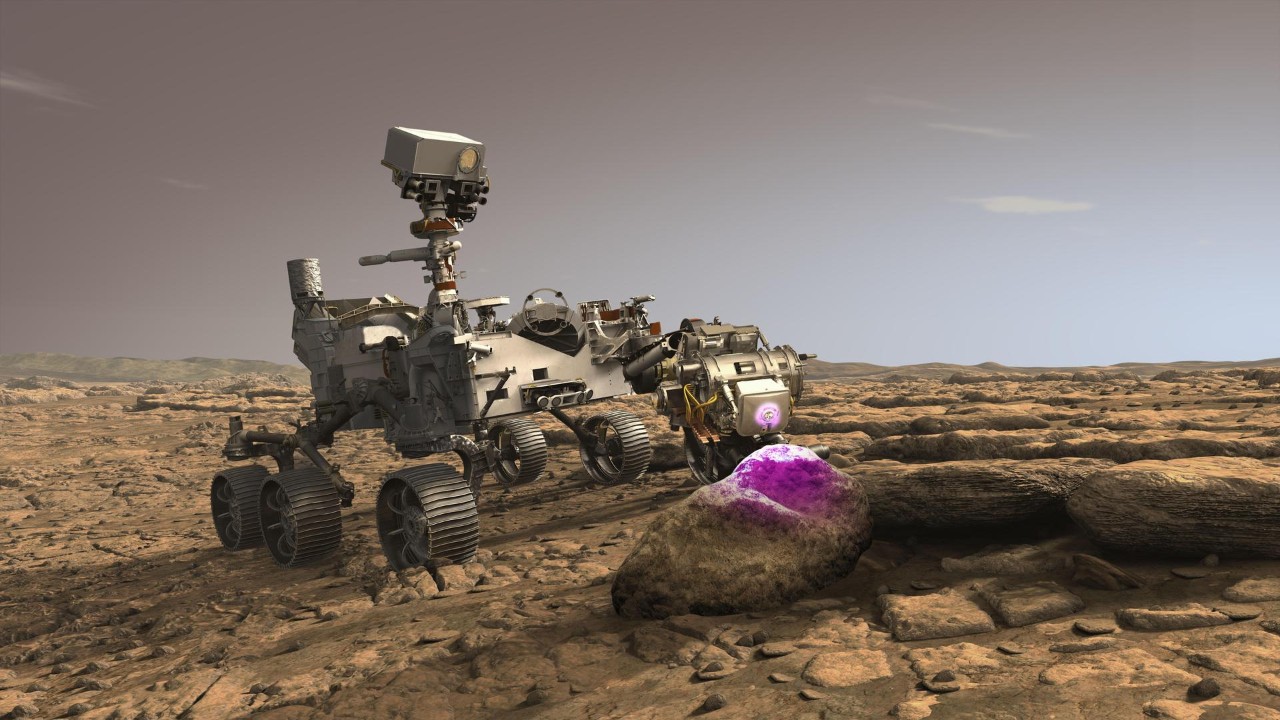
Featured image at top: An illustration of the Perseverance rover using its suite of instruments to inspect a rock on Mars. Graphic/NASA-JPL/Caltech

The Perseverance rover captured its own tracks with its cameras. UC students and their professor serve on the NASA science team deciding daily where to send the rover and what to study on the Martian surface. Photo/NASA-JPL/Caltech
Related Stories
Sugar overload killing hearts
November 10, 2025
Two in five people will be told they have diabetes during their lifetime. And people who have diabetes are twice as likely to develop heart disease. One of the deadliest dangers? Diabetic cardiomyopathy. But groundbreaking University of Cincinnati research hopes to stop and even reverse the damage before it’s too late.
Is going nuclear the solution to Ohio’s energy costs?
November 10, 2025

The Ohio Capital Journal recently reported that as energy prices continue to climb, economists are weighing the benefits of going nuclear to curb costs. The publication dove into a Scioto Analysis survey of 18 economists to weigh the pros and cons of nuclear energy. One economist featured was Iryna Topolyan, PhD, professor of economics at the Carl H. Lindner College of Business.
App turns smartwatch into detector of structural heart disease
November 10, 2025

An app that uses an AI model to read a single-lead ECG from a smartwatch can detect structural heart disease, researchers reported at the 2025 Scientific Sessions of the American Heart Association. Although the technology requires further validation, researchers said it could help improve the identification of patients with heart failure, valvular conditions and left ventricular hypertrophy before they become symptomatic, which could improve the prognosis for people with these conditions.