Earth.com: Sleep-deprived mosquitoes are less interested in food
UC biologists found that tired mosquitoes would rather catch up on sleep than bite you

Earth.com highlighted a study by the University of Cincinnati that found that tired mosquitoes are more interested in catching up on sleep than looking for food.
By understanding the mosquitoes' circadian rhythms, researchers hope to find effective, nontoxic ways to prevent mosquito-borne illness.

UC doctoral student Oluwaseun Ajayi, lead author of the study, said even for insects, sleep is a vital biological function. Photo/Andrew Higley/UC Marketing + Brand
“It was a bit surprising. Sleep deprived or not, a blood meal should appeal to them,” UC doctoral student and study lead author Oluwaseun Ajayi said.
The study was published in the Journal of Experimental Biology.
The researchers from UC’s College of Arts and Sciences and Virginia Tech’s Department of Biochemistry, found it challenging to study sleep patterns in mosquitoes. They spent more than a year developing protocols to study the phenomenon effectively – mosquitoes are easily disturbed by the presence of an observer, whom they detect as a potential host. This means that any experiments on mosquito sleep are likely to be confounded by the presence of the observer — a phenomenon called the observer effect — according to UC biologist Joshua Benoit.
“It’s really hard to quantify sleep in mosquitoes when, as soon as you walk in the room, you’re considered their Thanksgiving dinner,” Benoit said.
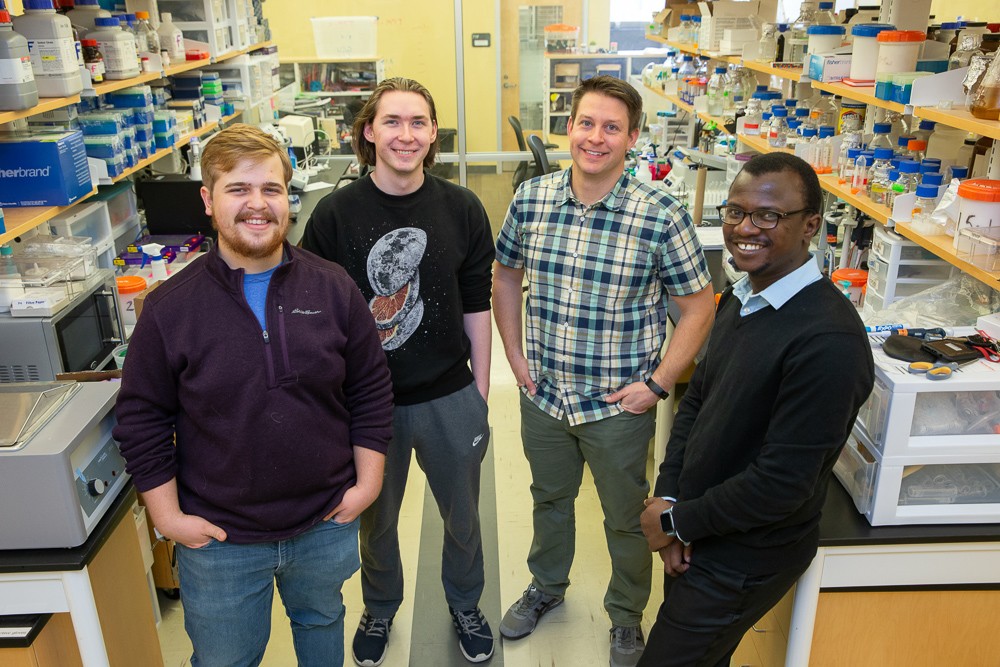
Featured image at top: UC assistant professor Joshua Benoit and his students examined the role sleep plays in three species of mosquitoes. Pictured from left are Lucas Gleitz, Evan Smith, Benoit and UC student Oluwaseun Ajayi. Photo/Andrew Higley/UC Marketing + Brand
Related Stories
Sugar overload killing hearts
November 10, 2025
Two in five people will be told they have diabetes during their lifetime. And people who have diabetes are twice as likely to develop heart disease. One of the deadliest dangers? Diabetic cardiomyopathy. But groundbreaking University of Cincinnati research hopes to stop and even reverse the damage before it’s too late.
Is going nuclear the solution to Ohio’s energy costs?
November 10, 2025

The Ohio Capital Journal recently reported that as energy prices continue to climb, economists are weighing the benefits of going nuclear to curb costs. The publication dove into a Scioto Analysis survey of 18 economists to weigh the pros and cons of nuclear energy. One economist featured was Iryna Topolyan, PhD, professor of economics at the Carl H. Lindner College of Business.
App turns smartwatch into detector of structural heart disease
November 10, 2025

An app that uses an AI model to read a single-lead ECG from a smartwatch can detect structural heart disease, researchers reported at the 2025 Scientific Sessions of the American Heart Association. Although the technology requires further validation, researchers said it could help improve the identification of patients with heart failure, valvular conditions and left ventricular hypertrophy before they become symptomatic, which could improve the prognosis for people with these conditions.