Silk layer improves function of surgical masks
A double layer of silk improves the function and extends the lifespan of surgical masks

University of Cincinnati researchers found that a double layer of silk in combination with a surgical mask can enhance its ability to prevent the spread of viruses like COVID-19.
UC biologist Patrick Guerra, UC biologist Theresa Culley, UC postdoctoral researcher Adam Parlin, now at SUNY-ESF, and UC graduate student Samuel Stratton, now at the University of Michigan, began investigating silk as an alternative face mask material at the start of the COVID-19 pandemic in 2020 when personal protective equipment such as the N95 face mask was in short supply.
UC researchers found that double masking with a silk face mask also helps prolong the life of surgical masks without impeding a person's ability to breathe comfortably.
The study was published in the journal Aerosol and Air Quality Research.

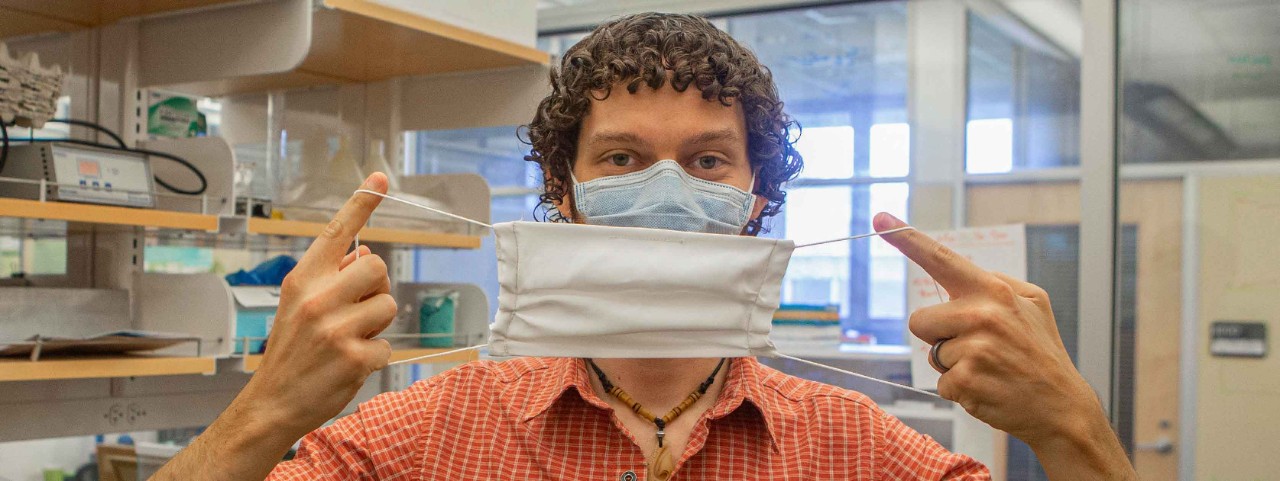
UC researchers studied the effectiveness of surgical masks in combination with a silk face mask. Biology student Adam Parlin, now with SUNY-ESF, examined the properties of silk in a UC biology lab. Photo/Joseph Fuqua II/UC Creative + Brand
The study was a collaboration between UC biologists and Sergey Grinshpun, Mikhail Yermakov and Susan Reutman in the Center for Health-Related Aerosol Studies in UC's College of Medicine.
“People are still using surgical masks to protect others and themselves. But they can be loose at the sides and around the nose,” said Guerra, an assistant professor of biology in UC’s College of Arts and Sciences.
Guerra and his colleagues collaborated with researchers with the UC College of Medicine’s Center for Health-Related Aerosol Studies.
As cases of COVID-19 begin to increase across the United States, more people are reaching for masks again to protect themselves and those around them.
“At the time of our study, personal protective equipment was at a premium in terms of availability because of supply-chain issues,” Guerra said. “People were having to reuse their masks.”
Masks are becoming a growing source of litter around the world.
“They take a long, long time to degrade,” Guerra said.
So taking full advantage of each mask’s useful lifespan can help prevent waste, he said.
Guerra studies the amazing properties of silk in his biology lab. Silk fiber has antimicrobial properties. And silk is hydrophobic, which means it sheds water unlike cotton masks that typically absorb it.
And silk is far more breathable than cotton.
“We showed that a silk mask doesn’t increase the burden of breathing when used in a double layer with a surgical mask. It wasn’t uncomfortable,” Guerra said. “And it enhances the ability of surgical masks to do their job.”
The research was supported by grants from the National Institute for Occupational Safety and Health and UC's Education and Research Center.
Featured image at top: UC student Adam Parlin holds up a silk face mask in a biology lab. Photo/Joseph Fuqua II/UC Creative + Brand
UC researchers tackle COVID-19

Researchers across UC's colleges are tackling issues relating to the COVID-19 pandemic. Photo/Volodymyr Hryshchenko/Unsplash
Impact Lives Here
The University of Cincinnati is leading public urban universities into a new era of innovation and impact. Our faculty, staff and students are saving lives, changing outcomes and bending the future in our city's direction. Next Lives Here.
Related Stories
Sugar overload killing hearts
November 10, 2025
Two in five people will be told they have diabetes during their lifetime. And people who have diabetes are twice as likely to develop heart disease. One of the deadliest dangers? Diabetic cardiomyopathy. But groundbreaking University of Cincinnati research hopes to stop and even reverse the damage before it’s too late.
App turns smartwatch into detector of structural heart disease
November 10, 2025

An app that uses an AI model to read a single-lead ECG from a smartwatch can detect structural heart disease, researchers reported at the 2025 Scientific Sessions of the American Heart Association. Although the technology requires further validation, researchers said it could help improve the identification of patients with heart failure, valvular conditions and left ventricular hypertrophy before they become symptomatic, which could improve the prognosis for people with these conditions.
Combination immunotherapy helps overcome melanoma treatment resistance
November 10, 2025

MSN highlighted research led by the University of Cincinnati Cancer Center's Trisha Wise-Draper showing a combination of immunotherapy medications can activate a robust immune response and help overcome treatment resistance in patients with refractory melanoma.