Reuters Health: Stroke treatment effective for patients with disability, dementia

The American Heart Association and American Stroke Association have published new guidance stating people with a disability or dementia who experience a stroke should receive appropriate treatment, which could allow for a return to prestroke levels of function.
The researchers explained that subgroups of patients, such as those with pre-existing disability, were not included in early trials that helped develop endovascular thrombectomy (EVT), or the removal of a blood clot using imaging guidance, as a standard of care for stroke treatment. However, new data shows comparable safety to perform EVT on patients with dementia or disability.
Stacie Demel, DO, PhD, assistant professor of clinical neurology and rehabilitation medicine in the University of Cincinnati College of Medicine and a UC Health physician at the UC Gardner Neuroscience Institute, commented on the statement for Reuters Health.
"Prior to referring a patient for EVT, an understanding of a patient's baseline functional status plays a central role in the decision regarding taking a patient for (the) procedure," Demel said. "Blindly excluding patients with physical disability or dementia will result in inequitable stroke treatment across populations. However, in lieu of strong evidence to either treat or defer treatment, it is the obligation of the treating physician to be cognizant of bias and to engage and educate the patient and/or the family in decision making."
Read the Reuters Health article.
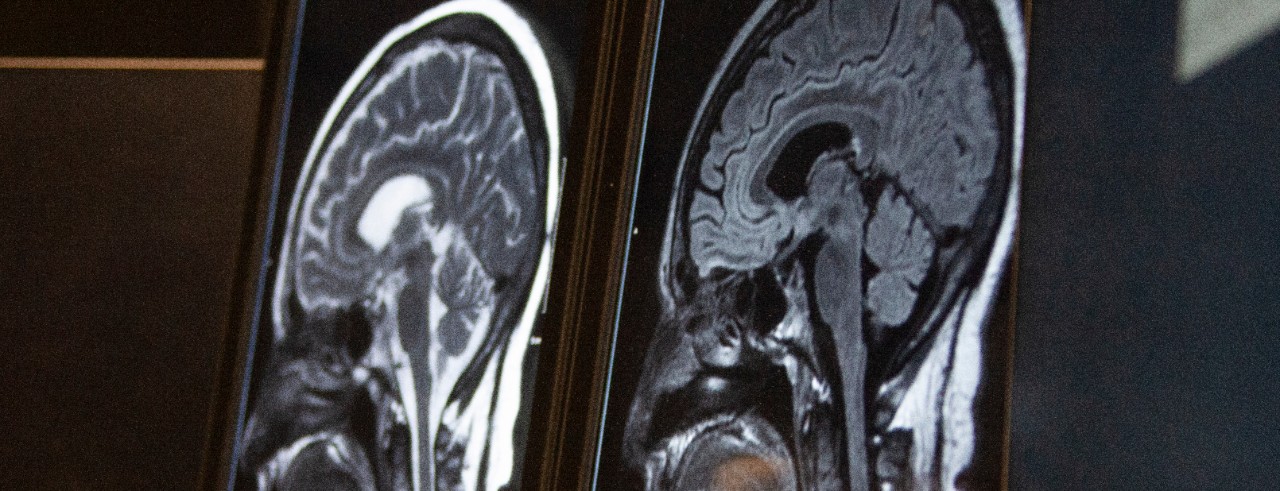
Featured photo at top of MRI brain scan. Photo/Ravenna Rutledge/University of Cincinnati.
Related Stories
Sugar overload killing hearts
November 10, 2025
Two in five people will be told they have diabetes during their lifetime. And people who have diabetes are twice as likely to develop heart disease. One of the deadliest dangers? Diabetic cardiomyopathy. But groundbreaking University of Cincinnati research hopes to stop and even reverse the damage before it’s too late.
Is going nuclear the solution to Ohio’s energy costs?
November 10, 2025

The Ohio Capital Journal recently reported that as energy prices continue to climb, economists are weighing the benefits of going nuclear to curb costs. The publication dove into a Scioto Analysis survey of 18 economists to weigh the pros and cons of nuclear energy. One economist featured was Iryna Topolyan, PhD, professor of economics at the Carl H. Lindner College of Business.
App turns smartwatch into detector of structural heart disease
November 10, 2025

An app that uses an AI model to read a single-lead ECG from a smartwatch can detect structural heart disease, researchers reported at the 2025 Scientific Sessions of the American Heart Association. Although the technology requires further validation, researchers said it could help improve the identification of patients with heart failure, valvular conditions and left ventricular hypertrophy before they become symptomatic, which could improve the prognosis for people with these conditions.